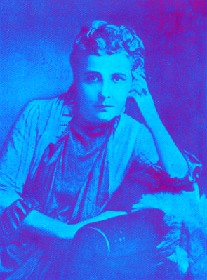
Annie Besant
Study in Consciousness
By
Annie Besant
A Contribution to the Science of Psychology
First Published 1915
Return to Annie Besant
Selection
FOREWORD.
THIS book is
intended as an aid to student in their study of the growth and development of
consciousness, offering hints and suggestions which may prove serviceable to
them. It does not pretend to be a complete exposition, but rather, as its
sub-title states, a contribution to the science of Psychology. Far ampler materials
than are within my reach are necessary for any complete exposition of the
far-reaching science which deals with the unfolding of consciousness. These
materials are slowly accumulating in the hands of earnest and painstaking
students, but no effort has yet been made to arrange and systematise them into
a co-ordinated whole. In this little volume I have only arranged a small part
of this material, in the hope that it may be useful now to some of the toilers
in the great field of the Evolution of Consciousness, and may serve, in the
future, as a stone in the complete building. It will need a great architect to
plan that temple of knowledge, and skilful master masons to direct the
building; enough, for the moment, to do the apprentice task, and prepare the
rough stones for the use of the more expert workmen.
ANNIE BESANT
PART I
CONSCIOUSNESS
Introduction
Origins
Origination of Monads
CHAPTER I.
THE PREPARATION OF THE FIELD.
1. The Formation of the Atom
2. Spirit-Matter
3. The Sub-Planes
4. The Five Planes
CHAPTER II.
CONSCIOUSNESS.
1. The Meaning of the Word
2. The Monads
CHAPTER III.
THE PEOPLING OF THE FIELD.
1. The Coming
2. The Weaving
3. The Seven Streams
4. The Shining Ones
CHAPTER IV.
THE PERMANENT ATOM.
1. The Attaching of the Atoms
2. The Web of Life
3. The Choosing of the Permanent Atoms
4. The Use of the Permanent Atom
5. Monadic Action on the Permanent Atoms
CHAPTER V.
GROUP-SOULS.
1. The Meaning of the Term
2. The Division of the Group-Soul
CHAPTER VI.
UNITY OF CONSCIOUSNESS.
1. Consciousness a Unit
2. The Unity of Physical Consciousness
3. The Meaning of Physical Consciousness
CHAPTER VII.
THE MECHANISM OF CONSCIOUSNESS.
1. The Development of the Mechanism
2. The Astral or Desire Body
3. Correspondence in Root-Races
CHAPTER VIII.
FIRST HUMAN STEPS.
1. The Third Life-Wave
2. Human Development
3. Incongruous Souls and Bodies
4. Dawn of Consciousness on the Astral
Plane
CHAPTER IX.
CONSCIOUSNESS AND SELF-CONSCIOUSNESS.
1. Consciousness
2. Self-Consciousness
3. Real and Unreal
CHAPTER X.
HUMAN STATES OF CONSCIOUSNESS.
1. The Sub-Consciousness
2. The Waking Consciousness
3. The Super-Physical Consciousness
CHAPTER XI.
THE MONAD AT WORK.
1. Building his Vehicles
2. An Evolving Man
3. The Pituitary Body and Pineal Gland
4. The Paths of Consciousness
CHAPTER XII.
THE NATURE OF MEMORY.
1. The Great Self and the Little Selves
2. Changes in the Vehicles and in
Consciousness
3. Memories
4. What is Memory
5. Remembering and Forgetting
6. Attention
7. The One Consciousness
PART II
WILL, DESIRE AND EMOTION
CHAPTER I.
THE WILL TO LIVE
CHAPTER II.
DESIRE
1. The Nature of Desire
2. The Awakening of Desire
3. The Relation of Desire to Thought
4. Desire, Thought, Action
5. The Binding Nature of Desire
6. The Breaking of the Bonds
CHAPTER III.
DESIRE (Continued)
1. The Vehicle of Desire
2. The Conflict of Desire and Thought
3. The Value of an Ideal
4. The Purification of Desire
CHAPTER IV.
EMOTION
1. The Birth of Emotion
2. The Play of Emotion in the Family
3. The Birth of Virtues
4. Right and Wrong
5. Virtue and Bliss
6. The Transmutation of the Emotions into
Virtues and Vices
7. Application of the Theory to Conduct
8. The Uses of Emotion
CHAPTER V.
EMOTION (Continued)
1. The Training of Emotion
2. The Distorting Force of Emotion
3. Methods of Ruling the Emotions
4. The Using of Emotion
5. The Value of Emotion in Evolution
CHAPTER VI.
THE WILL
1. The Will winning its Freedom
2. Why so much Struggle
3. The Power of the Will
4. White and Black Magic
5. Entering into Peace
INTRODUCTION.
THE subject
of the unfolding of consciousness in the beings whose field of evolution is a
solar system is one of considerable difficulty; none of us may at present hope
to do more than master a small portion of its complexity, but it may be
possible to study it in such fashion as may fill up some of the gaps in our
thinking, and as may yield us a fairly clear outline to guide our future work.
We cannot,
however, trace this outline in any way satisfactory to the intelligence,
without considering first our solar system as a whole, and endeavouring to
grasp some idea, however vague that idea may be, of "the beginnings"
in such a system.
1. ORIGINS.
We have
learned that the matter in a solar system exists in seven great modifications,
[1] or planes; on three of these, the physical, emotional (astral), and mental
- often spoken of as "the three worlds", the well-known Triloki, or
Tribhuvanam, of the Hindu cosmogony - is
proceeding the normal evolution of humanity. On the next two planes, the
spiritual - those of wisdom and power, the buddhic and the atmic - goes on the
specific evolution of the Initiate, after the first of the Great Initiations.
These five planes form the field of the evolution of consciousness, until the
human merges in the divine. The two planes beyond the five represent the sphere
of divine activity, encircling and enveloping all, out of which pour forth all
the divine energies which vivify and sustain the whole system. They are at
present entirely beyond our knowledge, and the few hints that have been given
regarding them probably convey as much information as our limited capacity is
able to grasp. We are taught that they are the planes of divine Consciousness,
wherein the LOGOS, or the divine Trinity of Logoi, is manifested, and wherefrom
He shines forth as the Creator, the Preserver, the [2] Dissolver, evolving a
universe, maintaining it during its life-period, withdrawing it into Himself at
its ending. We have been given the names of these two planes: the lower is the
Anupadaka, that wherein "no vehicle has yet been formed";[1] the
higher is the Adi, "the first", the foundation of a universe, its
support and the fount of its life. We have thus the seven planes of a universe,
a solar system, which, as we see by this brief description, may be regarded as
making up three groups:
[3]
The two
highest planes may be conceived of as existing before the solar system is
formed, and we may imagine the highest, the Adi, as consisting of so much of
the matter of space - symbolised by points - as the LOGOS has marked out to
form the material basis of the system. He is about to produce. As a workman
chooses out the material he is going to shape into his product, so does the
LOGOS choose the material and the place for His universe. Similarly we may
imagine the Anupadaka - symbolised by lines - as consisting of this same
matter, modified by His individual life, coloured, to use a significant
metaphor, by His all-ensouling Consciousness, and thus differing in some way
from the corresponding plane in another solar system. We are told that the
supreme facts of this preparatory work may be further imaged forth in symbols;
of these we are given two [4] sets, one of which images the triple
manifestation of the Logic Consciousness, the other the triple change in
matter corresponding to the triple Life - the life and form aspects of the
three Logoi. We may place them side by side, as simultaneous happenings:
We have here,
under Life, the primeval Point in the centre of the Circle, the LOGOS as One
within the self-imposed encircling sphere of subtlest matter, in which He has
enclosed Himself for the purpose of manifestation, of shining forth from the
Darkness. At once the question arises: Why three Logoi? Though we touch here on
the deepest question of metaphysics, to expound which even inadequately
requires a volume, we must indicate the answer, to be wrought out by close
thinking. In the analysis of all that exists, we come to the great
generalisation:
"All is
separable into 'I' and 'Not I', the 'SELF' and the 'Not-Self'. Every separate
thing is summed up under one or other of the headings, SELF or Not-Self. There
is nothing which cannot be placed under one of them. SELF is Life,
Consciousness; Not-Self is Matter, Form." Here, then, we have a duality.
But the Twain are not two separate things isolated and unrelated; there is a
continual Relation between them, a continual approach and withdrawal; an
identification and a repudiation; this inter-play shows itself as the
ever-changing universe. Thus we have a Trinity, not a Duality - the SELF, the
Not-Self, and the Relation between them. All is here summed up, all things and
all relations, actual and possible, and hence Three, neither more nor less, is
the foundation of all universes in their totality, and of each universe in
particular.[2] This fundamental fact imposes on a Locos a triplicity of
manifestation in [6] a solar system, and hence the One, the Point, going forth
in three directions to the circumference of the Circle of Matter and returning
on Itself, manifests a different aspect at each place of contact with the
Circle-the three fundamental expressions of Consciousness: or Will, Wisdom, and
Activity - the divine Triad or Trinity.[3] For the Universal SELF, the
Pratyag-atma, the "Inner-Self", thinking of the Not-Self, identifies Himself with it,
thereby sharing with it His Being; this is the divine Activity, Sat, Existence
lent to the Non-existent, the Universal Mind. The SELF, realising Himself, is
Wisdom, Chit, the principle of preservation. The SELF, withdrawing Himself from
the Not-Self, in His own pure nature, is Bliss, Ananda, free from form. Every
LOGOS of a universe repeats this universal SELF-Consciousness: in His
Activity, He is the creative Mind, Kriya - corresponding to the universal Sat -
the Brahma of the Hindu, the Holy Spirit of the Christian, the Chochmah of the
Kabbalist. In His Wisdom, He is the preserving ordering Reason, Jnana -
corresponding to the universal Chit - the Vishnu of the Hindu, the Son of the
Christian, the Binah of the Kabbalist. In His Bliss, He is the Dissolver of
forms, the Will, Ichchha - corresponding to the universal Ananda - the Shiva
of the Hindu, the Father of the Christian, the Kepher of the Kabbalist. Thus
appear in every universe the three Logoi, the three Beings who create, preserve,
and destroy Their universe, each showing forth predominantly in His function in the universe one ruling Aspect,
to which the other two are subordinate, though of course ever-present. Hence
every manifested GOD is spoken of as a Trinity. The joining of these three
Aspects, or phases of manifestation, at their outer points of contact with the
[8] circle, gives the basic Triangle of contact with Matter, which, with the
three Triangles made with the lines traced by the Point, thus yields the divine
Tetractys, sometimes called the Kosmic Quaternary, the three divine Aspects in
contact with Matter, ready to create. These, in their totality, are the
Oversoul[4] of the kosmos that is to be.
Under Form we
may first glance at the effects of these Aspects as responded to from the side
of Matter. These are not, of course, due to the LOGOS of a system, but are the
correspondences in universal Matter with the Aspects of the universal SELF. The
Aspect of Bliss, or Will, imposes on Matter the quality of Inertia - Tamas, the
power of resistance, stability, quietude. The Aspect of Activity gives to
Matter its responsiveness to action - Rajas, mobility. The Aspect of Wisdom
gives it Rhythm - Satva, vibration, harmony. It is by the aid of Matter thus
prepared that the Aspects of Logic Consciousness manifest themselves as Beings.
[9]
The LOGOS -
not yet a first, since there is yet no second - is seen as a Point irradiating a sphere of Matter, drawn round Him
as the field of the future universe, flashing with unimaginable splendour, a
true Mountain of Light, as Manu has it, but Light invisible save on the
spiritual planes. This great sphere has been spoken of as primary Substance: it
is the SELF-conditioned LOGOS, inseparate at every point with the Matter He has
appropriated for His universe, ere He draws Himself a little apart from it in
the second manifestation; it is the sphere of SELF-conditioning Will, which is
to lead to the creative Activity: "I am This," when the
"This," the Not-Self, is cognised. The Point, speaking symbolically -
in order to make the suggestion of Form as seen from the side of appearances vibrates
between centre and circumference, thus making the Line which marks the drawing
apart of Spirit and Matter[5], [10] rendering cognition possible, and thus
generating the Form for the second Aspect, the Being we call the Second Logos,
symbolically the Line, or Diameter of the Circle. It is said of this in mystic
phrase: "Thou art My Son; this day have I begotten Thee"[6]; this
relation of Father and Son within the unity of the Divine Existence, of the
first and Second Logoi, belongs, of course, to the Day of Manifestation, the
life-period of a universe. It is this begetting of the Son, this appearance of
the Second Logos, the Wisdom, which is marked in the world of Form by the
differentiation, the drawing apart, of Spirit and Matter, the two poles between
which is spun the web of a universe; the separation, as it were, of the neutral
inactive Electricity - which may symbolise the First Logos - into the dual form
of positive and negative - symbolising the Second - thus making the unmanifest
manifest. This separation [11] within the First Logos is vividly imaged for us
in the preparation for cell-multiplication that we may study on the physical
plane, wherein we see the processes that lead up to the appearance of a
dividing wall, whereby the one cell becomes two. For all that happens down here
is but the reflexion in gross matter of the happenings on higher planes, and we
may often find a crutch for our halting imagination in our studies of physical
development. "As above, so below." The physical is the reflexion of
the spiritual.
Then the
Point, with Line revolving with it, vibrates at right angles to the former
vibration, and thus is formed the Cross, still within the Circle, the Cross
which thus "proceedeth from the Father and the Son," the symbol of
the Third Logos, the Creative Mind, the divine Activity now ready to manifest
as Creator. Then He manifests Himself as the Active Cross, or Svastika, the
first of the Logoi to manifest outside the two highest planes, though the third
stage of the divine Unfolding. [12]
But before
considering the creative Activity of the Third Logos, we must note the
origination of the Monads, or Units of Consciousness, for whose evolution in
matter the field of a universe is to be prepared. We shall return to their
fuller consideration in Chapter II. The myriads of such Units who are to be
developed in that coming universe are generated within the divine Life, as
germ-cells in organisms, before the field for their evolution is formed. Of
this forthgiving it is written: "THAT willed: I shall multiply and be
born"[7]; and the Many arise in the One by that act of Will. [13] Will has
its two aspects of attraction and repulsion, of in-breathing and out-breathing,
and when the repulsion-aspect energises there is separation, driving apart.
This
multiplication within the One by the action of Will marks the place of origin -
the first Logos, the undivided Lord, the Eternal Father. These are the sparks
of the Supreme Fire, the "divine Fragments"[8], named generally
"Monads". A Monad is a fragment of the divine Life, separated off as
an individual entity by rarest film of matter, matter so rare that, while it
gives a separate form to each, it offers no obstacle to the free
inter-communication of a life thus incased with the surrounding similar lives.
The life of the Monads is thus of the First Logos, and is therefore of triple
aspect, Consciousness existing as Will, Wisdom, and Activity; this life takes
form on the plane of divine Manifestation, the second, or Anupadaka, Sons of the Father even as is the Second
Logos, but younger Sons, with [14] none of their divine powers capable of
acting in matter denser than that of their own planes; while He, with ages of evolution behind Him, stands ready to
exercise His divine powers, "the First-born among many brethren"[9]. Fitly
they dwell on the Anupadaka plane, the roots of their life in the Adi, as yet
without vehicles in which they can express themselves, awaiting the day of
"manifestation of the Sons of God"[10]. There they remain while the
Third Logos begins the external work of manifestation, the shaping of the objective
universe. He is going to put forth His life into matter, to fashion it into the
materials fitted for the building of the vehicles which the Monads need for
their evolution. But he will not be merged in His work; for, vast as that work
seems to us, to Him it is but a little thing: "Having pervaded this whole
universe with a portion of Myself, I remain"[11]." That marvellous
Individuality is not lost, and only a portion [15] thereof suffices for the
life of a kosmos. The LOGOS, the Oversoul, remains, the God of His universe.
[16]
STUDY IN
CONSCIOUSNESS.
CHAPTER I.
THE
PREPARATION OF THE FIELD.
1. THE
FORMATION OF THE ATOM.
THE Third
Logos, the Universal Mind, begins His creative Activity by working on the matter
drawn in from the infinite space on every side for the building of our solar
system. This matter exists in space in forms incognisable by us, but is
apparently already shaped to the needs of vaster systems. For we have been told by H. P. Blavatsky that the atomic
sub-planes of our planes make up the first, or lowest, kosmic plane. If we
think of the atoms of that kosmic plane as symbolised by [17] a musical note.
Our atoms, as formed by the Third Logos, may perhaps be symbolised by the
overtones in such a note. What seems clear is that they are in close relation
to the "atoms of space", correspond with them, but are not, in their
present form, identical with them. But the seven types of matter, that become
our "atoms", are indicated in the matter drawn from space to form the
solar system, and are ultimately reducible again to them. H. P. Blavatsky hints
at the repeated seven-fold division into atoms of lower and lower grade, when
she writes: "The One Kosmic Atom becomes seven atoms on the plane of matter,
and each is transformed into a centre of energy. That same atom becomes seven
rays on the plane of spirit ... separate till the end of the kalpa and yet in
close embrace".[12]
Outside the
limits of a universe this matter is in a very peculiar state; the three
qualities of matter, inertia, mobility, and rhythm[13], are balanced against
each [18] other, and are in a state of equilibrium. They might be thought of as
existing as a closed circle, quiescent. In fact, in some ancient books, matter
in its totality is described in this state as inertia. It is also spoken of as
virgin; it is the celestial Virgin Mary, the ocean of virgin matter, that is to
become the Mother by the action of the Third Logos. The beginning of creative
Activity is the breaking of that closed circle, throwing the qualities out of
stable into unstable equilibrium. Life is motion, and the life of the Solar
LOGOS - His Breath, as it is poetically called - touching this quiescent
matter, threw the qualities into a condition of unstable equilibrium, and
therefore of continual motion in relation to each other. During the life-period
of a universe matter is ever in a condition of incessant internal motion. H. P.
Blavatsky says: "Fohat hardens and scatters the seven Brothers . electrifies
into life and separates primordial stuff, or pregenetic matter, into
atoms"[14].
The formation
of the atom has three [19] stages. First, the fixing of the limit within which
the ensouling life - the Life of the Logos in the atom - shall vibrate; this
limiting and fixing of the wave-length of the vibration is technically called
"the divine measure"[15]; this gives to the atoms of a plane their
distinctive peculiarity. Secondly, the Logos marks out, according to this
divine measure, the lines which determine the shape of the atom, the
fundamental axes of growth, the angular relation of these, which determines the
form, being that of the corresponding kosmic atom[16]; the nearest analogy to
these are the axes of crystals. Thirdly, by the measure of the vibration and
the angular relation of the axes of growth with each other, the size and form
of the surface, which we may call the surface or wall of the atom, is
determined. Thus in every atom we have the measure of its ensouling life, its
axes of growth, and its enclosing surface or wall. [20]
Of such atoms
the Third Logos creates five different kinds, the five different
"measures" implying five different vibrations, and each kind forms
the basic material of a plane; each plane, however various the objects in it,
has its own fundamental type of atom, into which any of its objects may
ultimately be reduced.
2.
SPIRIT-MATTER.
The epithet,
spirit-matter, will perhaps be better appreciated if we pause for a moment on
the method of the formation of the atoms of the successive planes. For each
system the matter of space around it is its Root of Matter, Mulaprakriti, as
the Hindus graphically call it. The matter of each system has that surrounding
matter for its root, or base, and its own special matter grows out of, is
developed from, that. The LOGOS, the Oversoul, of the system, drawing round
Himself the necessary matter from space, ensouls it with His own life, and this
life within this [21] subtle matter, this Mulaprakriti, is the Atma, the SELF,
the Spirit, in every particle. Fohat, the energy of the Locos, says H. P. B.,
"digs holes in space", and no description could be finer and truer.
That whirling energy forms innumerable vortices, each shaped by the divine
energy and the axes of growth, and each shelled with the matter of space, Atma
in a shell of Mulaprakriti, spirit in a shell of matter, the "atoms"
of the Adi, or highest plane, the first. Some of these remain as
"atoms"; others join together and form "molecules"; "molecules"
join together and make more complex molecular combinations; and so on till six
sub-planes below the atomic are formed. [This by analogy with what may be
observed below, since these highest planes are incognisable.] Now comes the
forming of the atoms of the second plane. Their measure and axes of growth
being fixed as above described by the Third Logos, some of the atoms of the
adi, or first, pane draw round themselves a shell of the combinations of their
own lowest sub-plane; the Spirit plus its original shell of [22] kosmic matter
(Mulaprakriti), or the atom of the first plane, is the spirit of the second
plane, and permeates the new shell, formed out of the lowest-grade combinations
of itself. These shells, thus ensouled, are the atoms of the anupadaka, or
second, plane. By the ever more complicated aggregations of these the remaining
six sub-planes are brought into being. Some of the atoms of the anupadaka
plane, in like manner, become clothed with the aggregations of their own
lowest sub-plane, and thus become the atmic atoms, the Spirit now being clothed
with two shells, inside its atomic wall of aggregations of the lowest sub-plane
of the anupadaka, and the original Spirit, or Life, plus its two shells, being
called the spirit of the atmic plane, while the wall of its atom is regarded
as the matter. This atom, ensheathed once more in the aggregations of the
lowest atmic sub-plane, becomes the atom of the buddhic plane, Spirit on the
buddhic plane having thus three enclosing films within its atomic shell of
lowest atmic aggregations. On the mental plane the Spirit has a fourfold sheath
within the [23] atomic wall, on the astral plane a fivefold, and on the
physical a sixfold, with the atomic wall in each case in addition. But the
Spirit plus all its sheaths save the outermost is ever regarded as Spirit, and
the outermost sheath only as form or body. It is this involution of Spirit
which makes evolution possible, and complicated as the description may sound,
the principle is simple and can be easily grasped. Truly, then, may we speak of
"spirit-matter" everywhere.
3. THE
SUB-PLANES.
Now the
ultimate atoms of the physical plane are not the "atoms" of the
modern chemist; the ultimate atoms are
aggregated into successive typical groups, forming "states of
matter", and the chemical atom may be in the fifth, sixth, or seventh of
these states, a gas, a liquid, or a solid.
Familiar are the gaseous, the liquid, and the solid states of matter,
or, as they are often called, the gaseous, liquid, and solid sub-planes; [24]
and above the gaseous are four less familiar conditions, the three etheric
states of matter, or sub-planes, and the true atomic. These true atoms are
aggregated into groups, which then act as units, and these groups are called
molecules; the atoms in a molecule are held together by magnetic attraction,
and the molecules on each sub-plane are arranged geometrically in relation to
each other on axes identical with the axes of growth of the atom of the
corresponding plane. By these successive aggregations of atoms into molecules,
and of simpler into more complex
molecules, the sub-planes of each plane are formed under the directive
Activity of the Third Logos, until the field of evolution, consisting of five
planes, each showing seven sub-planes - the first and second planes being
beyond this field - is completed. But it must not be supposed that these seven
sub-planes, as formed by the Third Logos, are at all identical with those which
are now existing. Taking the physical plane as an illustration, they bear
something of the same [25] relation to the present sub-planes as that which the
chemist calls proto-hydrogen bears to the chemical element said to be built up
out of it. The present conditions were not brought about by the work of the
Third Logos only, in whom Activity predominates; the more strongly attractive
or cohesive energies of the Second Logos, who is Wisdom and therefore Love,
were needed for the further integrations.
It is
important to remember that the planes are interpenetrating, and that corresponding sub-planes are directly related
to each other, and are not really separated from each other by intervening
layers of denser matter. Thus we must not think of the atomic sub-planes as
being separated from each other by six sub-planes of generally increasing
density, but as being in immediate connexion with each other. We may figure
this in a diagram as follows: [26]
It must be
understood that this is a diagram, not a picture i.e., it represents relations, not material
facts-the relations existing between the planes by virtue of their
intermingling, and not forty-nine separate bricks placed in seven rows, one an
the top of another.
Now this
relation is a most important one, for it implies that life can pass from [27]
plane to plane by the short road of the communicating atomic sub-planes, and
need not necessarily circle round through the six molecular sub-planes before
it can reach the next atomic sub-plane to continue its descent. As a matter of
fact we shall find presently that life-streams from the Monad do follow this
atomic road in their descent to the physical plane. If we now consider a
physical atom, looking at it as a whole, we see a vortex of life, the life of
the Third Logos, whirling with inconceivable rapidity. By the attraction
between these whirling vortices, molecules are built up, and the plane with its
sub-planes formed. But at the limiting surface of this whirling vortex are the
spirillae, whirling currents, each at right angles to the one within it and the
one without it. These whirling currents are made by the life of the Monad, not
by the life of the Third Logos, and are not present at the early stage we are
considering; they develop one after another into full activity in the course of
evolution, normally one in each Round; their rudiments are indeed completed by
the Fourth [28] Round by the action of the Second Logos, but the life-stream of
the Monad circulates in only four of them, the other three being but faintly
indicated. The atoms of the higher planes are formed on the same general plan,
as regards the Logic central vortex and its enclosing currents, but all details
are at present lacking to us. Many of the practices of yoga are directed to
bring about the more rapid evolution of the atoms by quickening this spirillae vivifying
work of the Monad upon it. As these currents of the monadic life are added to
the Logic vortex, the note of life grows richer and richer in its quality. We
may compare the central vortex to the fundamental note, the whirling encircling
currents to the overtones; the addition of each overtone means an added
richness to the note. New forces, new beauties, are thus ever added to the
seven-fold chord of life.
4. THE FIVE
PLANES.
The different
responses which the matter of the planes will later give under [29] the impulse
of consciousness depend on the work of the Third Logos, on the
"measure" by which He limits the atom. The atom of each plane has its
own measure, as we have seen, and this limits its power of response, its
vibratory action, and gives it its specific character. As the eye is so
constituted that it is able to respond to vibrations of ether within a certain
range, so is each type of atom, by its constitution, able to respond to
vibrations within a certain range. One plane is called the plane made of
"mind-stuff", because the "measure" of its atoms makes
their dominant response that which answers to a certain range of the vibrations
of the Knowledge Aspect of the LOGOS, as modified by the Creative Activity.[17]
Another is called the plane of "desire-stuff", because the
"measure" of its atoms makes their dominant response that which
answers to a certain range of the vibrations of the Will[18] Aspect of the
LOGOS. Each type of atom has thus its own peculiar [30] power of response, determined
by its own measure of vibration. In each atom lie involved numberless
possibilities of response to the three aspects of consciousness, and these
possibilities within the atom will be brought out of the atom as powers in the
course of evolution. But the capacity of the matter to respond, and the nature
of the response, these are determined by the original action of the triple
Self on it, and by the measure imposed on the atoms by the Third Logos; He, out
of the infinite capacity of His own multitude of vibratory powers, gives a
certain portion to the matter of a particular system in a particular cycle of
evolution. This capacity is stamped on matter by the Third Logos, and is ever
maintained in matter by His life infolded in the atom. Thus is formed the
fivefold field of evolution in which consciousness is to develop.
This work of
the Third Logos is usually spoken of as the First Life Wave. [31]
CHAPTER II.
CONSCIOUSNESS.
1. THE
MEANING OF THE WORD.
LET us now consider
what we mean by consciousness, and see if this consideration will build for us
the much longed -for "bridge", which is the despair of modern
thought, between consciousness and matter, will span for us the
"gulf" alleged to exist for ever between them.
To begin with
a definition of terms consciousness and life are identical, two names for one
thing as regarded from within and from without. There is no life without
consciousness; there is no consciousness without life. When we vaguely separate
them in thought and analyse what we have done, we find that we have called
consciousness turned inward by the name of life, and life [32] turned outwards
by the name of consciousness. When our attention is fixed on unity we say
life; when it is fixed upon multiplicity we say consciousness; and we forget
that the multiplicity is due to, is the essence of, matter, the reflecting
surface in which the One becomes the Many. When it is said that life is
"more or less conscious", it is not the abstraction life that is
thought of, but "a living thing" more or less aware of its
surroundings. The more or less awareness depends on the thickness, the density,
of the enwrapping veil which makes it a living thing, separate from its
fellows. Annihilate in thought that veil and you annihilate in thought also
life, and are in THAT into which all opposites are resolved, the ALL.
This leads us
to our next point: the existence of consciousness implies a separation into
two aspects of the fundamental all-underlying UNITY. The modern name of
consciousness, "awareness", equally implies this. For you cannot hang
up awareness in the void; awareness [33] implies something of which it is
aware, a duality at the least. Otherwise it exists not. In the highest
abstraction of consciousness, of awareness, this duality is implied;
consciousness ceases if the sense of limitation be withdrawn, is dependent on
limitation for existence. Awareness is essentially awareness of limitation, and
only secondarily awareness of others. Awareness of others comes into being with
what we call Self-consciousness, Self-awareness. This abstract Twain-in-One,
consciousness - limitation, spirit - matter, life - form, are ever
inseparable, they appear and disappear together; they exist only in relation
to each other; they resolve into a necessarily unmanifest Unity, the supreme
synthesis.
"As
above, so below." Again let the "below" help us; let us look at
consciousness as it appears when considered from the side of form, as we see
it in a universe of conscious things. Electricity manifests only as positive
and negative; when these neutralise each other, electricity vanishes. In all
things electricity [34] exists, neutral, unmanifest; from all things it can
appear, but not as positive only, or as negative only; always as balancing
amounts of both, over against each other, and these ever tending to re-enter
together into apparent nothingness, which is not nothingness but the source
equally of both.
But if this
be so, what becomes of the "gulf "? what need of the "bridge"?
Consciousness and matter affect each other because they are the two constituents
of one whole, both appearing as they draw apart, both disappearing as they
unite, and as they draw apart a relation exists ever between them.[19] There is
no such thing as a conscious unit which does not consist of this inseparate
duality, a magnet with two poles ever in relation to each other. We think of a
separate something we call consciousness, and ask how it works on another [35]
separate something we call matter. There are no such two separate somethings,
but only two drawn-apart but inseparate aspects of THAT which, without both, is
unmanifest, which cannot manifest in the one or the other alone, and is equally
in both. There are no fronts without backs, no aboves without belows, no
outsides without insides, no spirit without matter. They affect each other
because inseparable parts of a unity, manifesting as a duality in space and
time. The "gulf" appears when we think of a "spirit" wholly
immaterial, and a "body" wholly material - i.e., of two things
neither of which exists. There is no spirit which is not matter-enveloped:
there is no matter which is not spirit-ensouled. The highest separated Self has
its film of matter, and though such a Self is called "a spirit"
because the consciousness aspect is so predominant, none the less is it true
that it has its vibrating sheath of
matter, and that from this sheath all impulses come forth, which affect all
other denser material sheaths in succession. To say this is not to materialise
consciousness, [36] but only to recognise the fact that the two primary
opposites, consciousness and matter, are straitly bound together, are never
apart, not even in the highest Being. Matter is limitation, and without
limitation consciousness is not. So far from materialising consciousness, it
puts it as a concept in sharp antithesis to matter, but it recognises the fact
that in an entity the one is not found without the other. The densest matter,
the physical, has its core of consciousness; the gas, the stone, the metal, is
living, conscious, aware. Thus oxygen becomes aware of hydrogen at a certain
temperature, and rushes into combination with it.
Let us now
look out of consciousness from within, and see the meaning of the phrase:
"Matter is limitation". Consciousness is the one Reality, in the
fullest sense of that much-used phrase; it follows from this that any reality
found anywhere is drawn from consciousness. Hence, everything which is thought,
is. That consciousness in which everything is, everything literally,
"possible" as well as "actual" - actual being that which is
[37] thought of as existent by a separated consciousness in time and space, and
possible all that which is not so being thought of at any period in time and
any point in space - we call Absolute Consciousness. It is the ALL, the
ETERNAL, the INFINITE, the CHANGELESS. Consciousness, thinking time and space,
and of all forms as existing in them in succession and in places, is the
Universal Consciousness, the ONE, called by the Hindu the Saguna BRAHMAN - the
ETERNAL with attributes - the
PRATYAG-ATMA - the INNER SELF; - by the
Christian, God; by the Parsi, HORMUZD;
by the Mussulman, ALLAH. Consciousness dealing with a definite time, however
long or short, with a definite space, however vast or restricted, is
individual, that of a concrete Being, a Lord of many universes, or some
universes, or a universe, or of any so-called portion of a universe, his
portion and to him therefore a universe - these terms varying as to extent with the power of the consciousness;
so much of the universal thought as a separate consciousness can completely
think, i.e., on which he can [38] impose his own reality, can think of as
existing like himself, is his universe. To each universe, the Being who is its
Lord gives a share of his own indefeasible Reality; but is ever himself limited
and controlled by the thought of his superior, the Lord of the universe in
which he exists as a form. Thus we, who are human beings, existing in a solar system,
are surrounded by innumerable forms which are the thought-forms of the LORD of
our system, our ISHVARA, or RULER; the "divine measure" and the
"axes of growth", thought by the Third Logos, govern the forms of our
atoms, and the surface thought of by Him as the limit of the atom and
resistant, offers resistance to all similar atoms. Thus we receive our matter,
and cannot alter it, save by the
employment of methods also made by His thought; only so long as His thought
continues can the atoms, with all composed of them, continue to exist, since
they have no Reality save that given by His thought. So long as He retains them
as His body by declaring: "I am this; these atoms are My body; they share
My life"; so [39] long they will impose themselves as real on all the
beings in this solar system, whose consciousnesses are clothed in similar
garments. When at the end of the Day of Manifestation He declares: "I am
not this; these atoms are no longer My body; they no longer share My
life"; then shall they vanish as the dream they are, and only that shall
remain which is the thought-form of the Monarch of a vaster system.
Thus, as
Spirits, we are inherently, indefensibly divine, with all the splendour and
freedom implied in that word. But we are clothed in matter which is not ours,
which is the thought-forms of the RULER of our system - controlled again by the
RULERS of vaster systems in which ours is included - and we are only slowly
learning to master and use it. When we realise our oneness with our RULER, then
the matter shall have no longer power over us, and we shall see it as the
unreality it is, dependent on His will, which then we shall know as also ours.
Then we can "play" with it, as we cannot while it blinds us with its
borrowed Reality. [40]
Looking thus
out of consciousness from within, we see even more plainly than we saw looking at it from the world of forms,
that there is no "gulf", and no need for a "bridge".
Consciousness changes, and each change appears in the matter surrounding it as
a vibration, because the LOGOS has thought vibrations of matter as the
invariable concomitant of changes in consciousness; and as the matter is but
the resultant of consciousness and its
attributes are imposed upon it by active
thought, any change in the Logic Consciousness would change the
attributes of the matter of the system,
and any change in a consciousness derived from Him shows itself in that matter
as a change; this change in matter is a vibration, a rhythmical movement within the limits set by
Him for the mobility of masses of matter in that relation. "Change in consciousness
and vibration of the matter limiting it" is a "pair", imposed by
the thought of the Locos on all embodied consciousnesses in His universe.
That such a constant relation exists is
shown by the fact that a vibration in a material [41] sheath accompanying a
change in the ensouling consciousness, and causing a similar vibration in the
sheath ensouled by another consciousness, is found to be accompanied by a
change in that second consciousness similar to the change in the first.
In matter far
subtler than the physical - as mind-stuff - the creative power of
consciousness is more readily seen than in the dense material of the physical plane.
Matter becomes dense or rare, and changes its combinations and forms, according
to the thoughts of a consciousness active therein. While the fundamental atoms
- due to the Logic thought - remain unchanged, they can be combined or dissociated
at will. Such experiences open the mind to the metaphysical conception of
matter, and enable it to realise at once the borrowed reality and the nonentity
of matter.
A word of
warning may be useful with regard to the often repeated phrases of
"Consciousness in a body", "Consciousness ensouling a
body", and the like. The student is a little apt to figure consciousness
[42] as a kind of rarefied gas enclosed in a material receptacle, a kind of
bottle. If he will think carefully he will realise that the resistant surface
of the body is but a Logic thought-form, and it is there because thought there.
Consciousness appears as conscious entities, because the LOGOS thinks such
separations, thinks the enclosing walls, makes such thought limitations. And
these thoughts of the LOGOS are due to His unity with the Universal SELF, and
are but a repetition within the area of a particular universe of the Will to
multiply.
A careful
dwelling in mind on the distinctions above traced between Absolute
Consciousness, Universal Consciousness, and Individual Consciousness, will
prevent the student from asking the question so often heard: Why is there any
universe? Why does All-Consciousness limit itself? Why should the Perfect
become the imperfect, All-Power become the powerless, God become the mineral,
the brute, the man? In this form the question is unanswerable, for it is
founded on false premises. The Perfect is the All, the Totality, the Sum of
Being. Within [43] its infinity, as above said, is everything contained, every
potentiality, as well as actuality, of existence. All that has been, is, will
be, can be, ever is in that Fulness, that ETERNAL. Only Itself knows Itself in
its infinite unimaginable wealth of Being. Because it contains all pairs of
opposites, and each pair, in affirming itself, to the eye of reason annihilates
itself and vanishes, It seems a Void. But endless universes arising in It
proclaim It a Plenum. This Perfect never becomes the imperfect; it becomes
nothing; It as all Spirit and Matter, Strength and Weakness, Knowledge and
Ignorance, Peace and Strife, Bliss and Pain, Power and Impotence; the
innumerable opposites of manifestation merge into each other and vanish in
non-manifestation. The All includes manifestation and non-manifestation, the
diastole and systole of the Heart which is Being. The one no more requires
explanation than the other; the one cannot be without the other. The puzzle
arises because men assert separately one of the inseparate pair of opposites -
Spirit, Strength, Knowledge, [44] Peace, Bliss, Power - and then ask: "Why
should these become their opposites?" They do not. No attribute exists
without its opposite; a pair only can manifest; every front has a back, spirit
and matter arise together; it is not that spirit exists, and then miraculously
produces matter to limit and blind itself, but that spirit and matter arise in
the ETERNAL simultaneously as a mode of Its Being, a form of Self-expression of
the All, Pratyagatma and Mulaprakriti, expressing in time and space the
Timeless and Spaceless.
2. THE
MONADS.
We have seen
that by the action of the Third Logos a five-fold field has been provided for
the development of Units of Consciousness, and that a Unit of Consciousness is
a fragment, a portion of the Universal Consciousness, thought into separation
as an individual entity veiled in matter, a Unit of the substance of the First
Logos, to be sent forth on the second plane as a separate Being. [45] Such
Units are called technically Monads. These are the Sons, abiding from everlasting,
from the beginning of a creative age, in the Bosom of the Father, who have not
yet been "made perfect through
sufferings";[20] each of them is truly "equal to the Father as
touching his Godhead, but inferior to the Father as touching his
manhood"[21], and each of them is to go forth into matter in order to
render all things subject to himself[22]; he is to be "sown in
weakness" that he may be "raised in power"[23]; from a static
Logos enfolding all divine potentialities, he is to become a dynamic Logos unfolding
all divine powers; omniscient, omnipresent, on his own second plane, but
unconscious, "senseless", on all the others,[24] he is to veil his
glory in matter that blinds him, in order that he may become omniscient, omnipresent,
on all planes, able to answer to all divine vibrations in the universe instead
of to those on the highest only. [46]
The meaning
of this feeble description of a great truth may be glimpsed by the student by a
consideration of the facts of embryonic life and birth. When an Ego is
re-incarnating, he broods over the human mother in whom his future body is a
building, the vehicle he will one day inhabit. That body is slowly built up of
the substance of the mother, and the Ego can do little as to its shaping: it is
an embryo, unconscious of its future, dimly
conscious only of the flow of the maternal life, impressed by maternal
hopes and fears, thoughts and desires; nothing from the Ego affects it, save a
feeble influence coming through the permanent physical atom, and it does not
share, because it cannot answer to, the wide-reaching thoughts, the aspiring
emotions of the Ego, as expressed by him in his causal body. That embryo must
develop, must gradually assume a human form, must enter on an independent life,
separate from that of his mother, must pass through seven years - as men count
time - of such independent life, ere the Ego can fully ensoul it. But during
that slow evolution, with [47] its infantile helplessness, its childish
follies, pleasures and pains, the Ego to whom it belongs is carrying on his own
wider, richer, life, and is gradually coming into nearer and nearer touch with
this body, in which alone he can work in the physical world, his touch being
manifested as the growth of the brain-consciousness.
The condition
of the Monad in relation to the evolution of his consciousness in a universe
resembles that of the Ego in relation to his new physical body. His own world
is that of the second, the anupadaka, plane, and there he is fully conscious
with the all-embracing SELF-consciousness of his world, but not at first of
selves, among whom he is separate, of "others". Let us try to see the
stages through which he passes. He is first a spark in a flame: "I sense
one Flame, O Gurudeva; I see countless undetached sparks shining in
it"[25]. The Flame is the First Logos, the undetached sparks the Monads.
His Will to manifest is also theirs, for they are the germ-cells in His [48]
body, that will presently have a separate life in His coming universe. Moved by
this Will, the sparks share the change called "the begetting of the
Son", and pass into the Second Logos and dwell in Him. Then, with the
"proceeding" of the Third, there comes to them from Him the
"spiritual individuality", that H. P. Blavatsky speaks of, the
dawning separateness. But still there is no sense of "others", needed
to re-act as the sense of "I". The three aspects of consciousness,
theirs as sharing the Logic life, are still, to use a figure of speech,
"turned inwards", playing on each other, asleep, unaware of a
"without", sharing the all-SELF-consciousness. The great Beings,
called the Creative Orders,[26] arouse them to "outer" life; Will,
Wisdom, Activity awake to awareness of the "without"; a dim sense of
"others" arises, so far as "others" may be in a world where
all "'forms' intermingle and interpenetrate," and each becomes
"an individual Dhyan Chohan, distinct from others".[27] [49] At the
first stage, spoken of above, when the Monads are, in the fullest sense[28] of
the term, undetached, as "germ-cells in His body", the Will, Wisdom,
and Activity in them are latent, not potent. His Will to manifest is also their
will, but theirs unconsciously; He, Self-conscious, knows His object and His
path; they, not yet Self-conscious, have in them, as parts of His body, the
moving energy of His Will, which will presently be their own individual Will
to Live, and which impels them into the conditions wherein a separate-Self-conscious,
instead of an all-Self-conscious, life is possible. This leads them to the second
stage in the life of the Second Logos, and to the Third. Then, comparatively
separate, the awakening by the Creative Orders brings with it the "dim
sense of 'others'" and of "I", and with this a thrill of longing
for a more clearly-defined sense of "I" and of "others";
and this is the "individual Will to Live", and this leads them forth
[50] into the denser worlds, wherein such sharper definition alone becomes
possible.
It is
important to understand that the evolution of the individual "I" is a
Self-chosen activity. We are here because we Will to Live; "none else
compels". This aspect of consciousness, the Will, is dealt with in later
chapters of this book, and here we need only emphasise the fact that the Monads
are Self-moved, Self-determined, in their entry into the lower planes of
matter, the field of manifestation, the five-fold universe. To their vehicles
in it, they remain as the Ego to his physical body, with their radiant divine
life in loftier spheres, but brooding over their lower vehicles and manifesting
more and more in them as they become more plastic. H. P. Blavatsky speaks of
this, as the "Monad is cycling on downwards into matter".[29]
Everywhere in
nature we see this same striving after fuller manifestation of life, this
constant Will to Live. The seed, buried in the ground, pushes its growing [51]
point upwards to the light. The bud fettered in its sheathing calyx bursts its
prison and expands in the sunshine. The chick within the egg splits its
confining shell in twain. Everywhere life seeks expression, powers press to
exercise themselves. See the painter, the sculptor, the poet, with creative
genius struggling within him; to create yields the subtlest pleasure, the
keenest savour of exquisite delight. Therein is but another instance of the
omnipresent nature of life, whether in the LOGOS, the genius, or in the
ephemeral creature of a day; all joy in the bliss of living, and feel most
alive when they multiply themselves by creation. To feel life expressing
itself, flowing forth, expanding, increasing, this is at once the result of
the Will to Live, and its fruition in the Bliss of living.
Some of the
Monads, willing to live through the toils of the five-fold universe, in order
to master matter and in turn to create a universe therein, enter into it to
become a developed God therein, a Tree of Life, another Fount of Being. The
shaping of a universe is the Day of [52] Forth-going; living is becoming; life
knows itself by change. Those who will not to become masters of matter,
creators, remain in their static bliss, excluded from the five-fold universe,
unconscious of its activities. For it must be remembered that all the seven
planes are interpenetrating, and that Consciousness on any plane means the
power of answering to the vibrations of that particular plane. Just as a man
may be conscious on the physical plane because his physical body is organised
to receive and transmit to him its vibrations, but be totally unconscious of
the higher planes though their vibrations are playing on him, because he has
not yet organised sufficiently his higher bodies to receive and transmit to him
their vibrations; so is the Monad, the Unit of Consciousness, able to be conscious
on the second plane, but totally unconscious on the lower five.
He will evolve
his consciousness on these by taking from each plane some of its matter,
veiling himself in this matter and forming it into a sheath by which he can
come into contact with [53] that plane, gradually organising this sheath of
matter into a body capable of functioning on its own plane as an expression of
himself, receiving vibrations from the plane and transmitting them to him,
receiving vibrations from him and transmitting them to the plane. As he veils
himself in the matter of each successive plane he shuts away some of his
consciousness, that of it which is too subtle for receiving or setting up
vibrations in the matter of that plane. He has within him seven typical
vibratory powers - each capable of producing an indefinite number of
sub-vibrations of its own type - and these are shut off one by one as he endues
veil after veil of grosser matter. The powers in consciousness of expressing
itself in certain typical ways - using the word power in the mathematical
sense, consciousness "to the third", consciousness "to the
fourth", etc.- are seen in matter as what we call dimensions. The physical
power of consciousness has its expression in "three-dimensional
matter", while the astral, mental, and other powers of [54] consciousness
need for their expression other dimensions of matter.
Speaking thus
of Monads, we may feel as if we were dealing with something far away. Yet is
the Monad very near to us, our SELF, the very root of our being, the innermost
source of our life, the one Reality. Hidden, unmanifest, wrapt in silence and
darkness is our Self, but our consciousness is the limited manifestation of
that Self, the manifested God in the kosmos of our bodies, which are His
garments. As the Unmanifest is partially manifest in the LOGOS, as Divine
Consciousness, and in the universe as the Body of the LOGOS[30], so is our
unmanifest Self partially manifest in our consciousness, as the Logos of our
individual system, and in our body as
the kosmos which clothes the consciousness. As above, so below.
This hidden
SELF it is which is called the Monad, being verily the One. It is this which
gives the subtle sense of unity [55] that ever persists in us amid all changes;
the sense of identity has here its source, for this is the ETERNAL in us. The
three out-streaming rays which come from the Monad - to be dealt with presently
- are his three aspects, or modes of being, or hypostases, reproducing the
Logoi of a universe, the Will, Wisdom, and Activity which are the three
essential expressions of embodied consciousness, the familiar Atma-Buddhi-Manas
of the Theosophist.
This
consciousness ever works as a unit on the various planes, but shows out its
triplicity on each. When we study consciousness working on the mental plane,
we see Will appearing as choice, Wisdom as discrimination, Activity as
cognition. On the astral plane we see Will appearing as desire, Wisdom as love,
Activity as sensation. On the physical plane, Will has for its instruments the
motor organs (karmendriyas), Wisdom the cerebral hemispheres, Activity the
organs of sense (jnanendriyas).[31] [56]
The full
manifestation of these three aspects of consciousness in their highest forms
takes place in man in the same order as the manifestation of the triple LOGOS
in the universe. The third aspect, Activity, revealed as the creative mind, as
the gatherer of knowledge, is the first to perfect its vehicles, and show forth
its full energies. The second aspect, Wisdom, revealed as the Pure and
Compassionate Reason, is the second to shine forth, the
CHAPTER III.
THE PEOPLING
OF THE FIELD.
1. THE COMING
WHEN the
five-fold field is ready, when the five planes, each with its seven sub-planes,
are completed, so far as their primary constitution is concerned, then begins
the activity of the Second Logos, the Builder and Preserver of forms. His
activity is spoken of as the Second Life Wave, the pouring out of Wisdom and
Love - the Wisdom, the directing force, needed for the organisation and
evolution of forms, the Love, the attractive force, needed for holding them together as stable though
complex wholes. When this great stream of Logic life pours forth into the
five-fold field of manifestation, it brings with it into activity the Monads,
the Units of Consciousness, ready to begin their [58] work of evolution, to
clothe themselves in matter.
Yet the
phrase that the Monads go forth is somewhat inaccurate; that they shine forth,
send out their rays of life, would be truer. For they remain ever "in the
bosom of the Father", while their life-rays stream out into the ocean of
matter, and therein appropriate the materials needed for their energising in
the universe. The matter must be appropriated, rendered plastic, shaped into
fitting vehicles.
H. P.
Blavatsky has described their forth-shining in graphic allegorical terms, using
a symbolism more expressive than literal-meaning words: "The primordial
triangle, which - as soon as it has reflected itself in the 'Heavenly Man', the
highest of the lower seven - disappears, returning into 'Silence and Darkness';
and the astral paradigmatic man, whose Monad (Atma) is also represented by a
triangle, as it has to become a ternary in conscious devachanic
interludes"[32]. The primordial triangle, or the three-faced Monad of
Will, [59] Wisdom, and Activity, "reflects itself" in the "Heavenly
Man", as Atma-Buddhi Manas, and then "returns into Silence and
Darkness". Atma - often spoken of as the Monad of the lower, or astral man
- has to become a ternary, a triple-faced unit, by assimilating Buddhi and
Manas. The word "reflexion" demands explanation here. Speaking
generally, the term reflexion is used when a force manifested on a higher plane
shows itself again on a lower plane, and is conditioned by a grosser kind of
matter in that lower manifestation, so that some of the effective energy of the
force is lost, and it shows itself in a feebler form. As now used in a special
instance, it means that a stream of the life of the Monad pours forth, taking
as the vessel to contain it an atom from each of the three higher planes of the
five-fold field -the third, the fourth, and the fifth - thus producing the
"Heavenly Man", the "Living Ruler, Immortal", the Pilgrim
who is to evolve, for whose evolution the system was brought into being.
"As the
mighty vibrations of the Sun throw matter into the vibrations we call [60] his
rays (which express his heat, electricity, and other energies), so does the
Monad cause the atomic matter of the atmic, buddhic, and manasic planes -
surrounding him as the ether of space surrounds the Sun - to vibrate, and thus
makes to himself a Ray, triple like his own three-fold nature. In this he is
aided by Devas from a previous universe who have passed through a similar
experience before; these guide the vibratory wave from the Will aspect to the
atmic atom, and the atmic atom, vibrating to the Will-aspect, is called Atma;
they guide the vibratory wave from the
Wisdom-aspect to the buddhic atom, and the buddhic atom, vibrating to the
Wisdom-aspect, is called Buddhi; also they guide the vibratory wave from the
Activity-aspect to the manasic atom, and the manasic atom, vibrating to the
Activity-aspect, is called Manas. Thus Atma-Buddhi-Manas, the Monad in the
world of manifestation, is formed, the Ray of the Monad, beyond the five-fold
universe. Here is the mystery of the Watcher, the Spectator, the action-less
Atma, who abides ever in his triple [61] nature on his own plane, and lives in
the world of men by his Ray, which animates his shadows, the fleeting lives on
earth. . The shadows do the work on the lower planes, and are moved by the Monad
through his Image or Ray; at first so feebly that his influence is well-nigh
imperceptible, later with ever-increasing power."[33]
Atma-Buddhi-Manas
is the Heavenly Man, the Spiritual Man, and he is the expression of the Monad, whose
reflected aspect of Will is Atma, whose reflected aspect of Wisdom is Buddhi,
whose reflected aspect of Activity is Manas. Hence we may regard the human Atma
as the Will-aspect of the Monad, ensouling an akashic atom; the human Buddhi as
the Wisdom-aspect of the Monad, ensouling an air (divine flame) atom; the human
Manas as the Activity-aspect of the Monad, ensouling a fiery atom. Thus in
Atma-Buddhi-Manas, the spiritual Triad,
or the Heavenly [62] Man, we have the three aspects, or energies, of the Monad,
embodied in atomic matter, and this is the "Spirit" in man, the
Jivatma or Life-Self, the separated
Self.[34] It is the germinal Spirit, and in its third aspect the "baby
Ego". It is identical in nature with the Monad, is the Monad, but is
lessened in force and activity by the veils of matter round it. This lessening
of power must not blind us to the identity of nature. We must ever remember
that the human consciousness is a unit, and that though its manifestations
vary, these variations are only due to the predominance of one or other of its
aspects and to the relative density of the materials in which an aspect is
working. Its manifestations, thus conditioned, vary, but it is itself ever one.
Such part,
then, of the consciousness of the Monad as can express itself in a fivefold
universe enters at first thus into the higher matter of this universe,
embodying itself in an atom of each of the three [63] higher planes; having
thus shone forth and appropriated these atoms for his own use, the Monad has
begun his work; in his own subtle nature
he cannot as yet descend below the anupadaka plane, and he is therefore said to
be in "Silence and Darkness",
unmanifest; but he lives and works in and by means of these appropriated
atoms, which form the garment of his life on the planes nearest to his own. We
may figure this action thus:
[64]
This
spiritual Triad, as it is often called, Atma-Buddi-Manas, the Jivatma, is
described as a seed, a germ, of divine Life, containing the potentialities of
its own heavenly Father, its Monad, to be unfolded into powers in the course of
evolution. This is the "manhood" of the divine Son of the First
Logos, animated by the "Godhead", the Monad - a mystery truly, but
one which is repeated in many forms around us.
And now the
nature, which was free in the subtle matter of his own plane, becomes bound by
the denser matter, and his powers of consciousness cannot as yet function in
this blinding veil. He is therein as a mere germ, an embryo, powerless,
senseless, helpless, while the Monad on his own plane is strong, conscious,
capable, so far as his internal life is concerned; the one is the Monad in
Eternity, the other is the Monad in time and space; the content of the Monad
eternal is to become the extent of the Monad temporal and spatial. This at
present embryonic life will evolve into a complex being, the expression of the
[65] Monad on each plane of the universe. All-powerful internally on his own
subtle plane, he is at first powerless, fettered, helpless, when enwrapped
externally in denser matter, unable to receive through it, or to give out
through it, vibrations. But he will gradually master the matter that at first
enslaves him; slowly, surely, he will mould it for Self-expression; he is aided
and watched over by the all-sustaining and preserving Second Logos, until he
can live in it fully as he lives above, and become in his turn a creative Logos
and bring forth out of himself a universe. The power of creating a universe is
only gained, according to THE WISDOM, by involving within the Self all that is
later to be put forth. A Logos does not create out of nothing, but evolves all
from Himself; and from the experiences we are now passing through, we are
gathering the materials out of which we may build a system in the future.
But this
spiritual Triad, this Jivatma, which is the Monad in the five-fold universe,
cannot himself commence at [66] once any separate self-directed activity. He
cannot gather round himself any aggregations of matter as yet, but can only
abide in his atomic vesture. The life of the Second Logos is to him as its
mother's womb to the embryo, and within this the building begins. We may, in
very truth, regard this stage of evolution, in which the Logos shapes,
nourishes, and develops the germinating life, as being, for the Heavenly Man,
or truly the Heavenly Embryo, a period corresponding to the ante-natal life of
a human being, during which he is slowly obtaining a body, which is nourished
meanwhile by the life-currents of the mother and formed out of her substance.
Thus also with the Jivatma, enclosing the life of the Monad; he must await the
building of his body on the lower planes, and he cannot emerge from this
ante-natal life and be "born", until there is a body builded on the
lower planes. The "birth" takes place at the formation of the causal
body, when the Heavenly Man is manifested as an infant Ego, a true
Individuality, dwelling in a body on the physical plane. A little [67] careful
thought will show how close is the analogy between the evolution of the Pilgrim
and that of each successive rebirth; in the latter case the Jivatma awaits the
formation of the physical body which is building as his habitation; in the
former the spiritual Triads, as a Collectivity, await the, building of the
systemic Quaternary. Until the vehicle on the lowest plane is ready, all is a
preparation for evolution, rather than evolution itself - it is often termed
involution. The evolution of the consciousness must begin by contacts received
by its outermost vehicle; that is, it must begin on the physical plane. It can
only become aware of an outside by impacts on its own outside; until then it
dreams within itself, as the faint inner thrillings ever outwelling from the
Monad cause slight outward-tending
pressures in the Jivatma, like a spring of water beneath the earth, seeking are
outlet.
2. THE
WEAVING.
Meanwhile the
preparation for the awakening, the giving of qualities to [68] matter, that
which may be likened to the formation of the tissues of the future body, is
done by the life-power of the Second Logos - the second life-wave, rolling
through plane after plane, imparting its own qualities to that seven-fold
proto-matter. The life-wave, as said above, carries the Jivatmas with it as far
as the atomic sub-plane of the fifth plane, the plane of Fire, of
individualised creative power, of mind. Here they each have already an atom,
the manasic, or mental veil of the Monad, the Logos flooding these and the
remaining atoms of the plane with His life. All these atoms, forming the whole
atomic sub-plane, whether free or attached to Jivatmas, may rightly be termed
Monadic Essence; but as in the course of evolution, presently to be explained,
differences arise between the attached and the non-attached atoms, the term Monadic
Essence is usually employed for the non-attached, while the attached are
called, for reasons which will appear, "permanent atoms". We may
define Monadic Essence then as atomic matter ensouled by the life of the [69]
Second Logos. It is His clothing for the vivifying and holding together of
forms; He is clad in atomic matter. His own life as Logos, separate from the
life of Atma-Buddhi-Manas in the man, separate from any lives on the plane -
though He supports, permeates, and
includes them all - is clothed only in atomic matter, and it is this which is
connoted by the term of Monadic Essence. The matter of that plane, already by the nature of its atoms[35]
capable of responding by vibrations to active thought-changes, is thrown by the
second life-wave into combinations fit to express thoughts - abstract thoughts
in the subtler matter, concrete thoughts in the coarser. The combinations of
the second and third higher sub-planes constitute the
The second
life-wave then rolls on into the sixth plane, the plane of Water, or
individualised sensation, of desire. The before-mentioned Devas link the
Jivatma - attached, or permanent, units of the fifth plane to a corresponding
number of atoms on the sixth plane, and the Second Logos floods these and the
remaining atoms with His own life - these atoms thus becoming Monadic Essence
as explained above. The life-wave passes onwards, forming on each sub-plane the
combinations fit to express sensations. These combinations constitute the
Elemental
Essence is thus seen to consist of aggregations of matter on each of the six
non-atomic sub-planes of the mental and desire planes, aggregations which do
not themselves serve as forms for any entity to inhabit, but as the [71]
materials out of which such forms may be built.
The life-wave
then rolls on into the seventh plane, the plane of Earth, of individualised
activities, of actions. As before the Jivatma-attached, or permanent, atoms of the
sixth plane are linked to a corresponding number on the seventh plane, and the
Second Logos floods these and the remaining atoms with His own life - all these
atoms thus becoming Monadic Essence. The life-wave again passes onwards,
forming on each sub-plane combinations fitted to constitute physical bodies,
the future chemical elements, as they are called on the three lower sub-planes.
Looking at
this work of the second life wave as a whole, we see that its downward sweep
is concerned with what may fairly be called the making of primary tissues, out
of which hereafter subtle and dense bodies are to be formed. Well has it been
called in some ancient scriptures a "weaving", for such it literally
is. The materials prepared by the Third Logos are woven by the Second Logos
into threads [72] and into cloths of which future garments the subtle and
dense bodies - will be made. As a man may take separate threads of flax,
cotton, silk-themselves combinations of a simpler kind - and weave these into
linens, into cotton or silk cloth, these cloths in turn to be shaped into
garments by cutting and stitching, so does the second Logos weave the matter-threads,
weave these again into tissues, and then shape them into forms. He is the
Eternal Weaver, while we might think of the Third Logos as the Eternal Chemist.
The latter works in nature as in a laboratory, the former as in a manufactory.
These similes, materialistic as they are, are not to be despised, for they are
crutches to aid our limping attempts to understand.
This
"weaving" gives to matter its characteristics, as the characteristics
of the thread differ from those of the raw material, as the characteristics of
the cloth differ from those of the threads. The Logos weaves the two kinds of
cloth of manasic matter, of mind-stuff, and out of these will be made later the
causal and the mental [73] bodies. He weaves the cloth of astral matter, of
desire-stuff, and out of this will be made later the desire body. That is to
say, that the combinations of matter formed and held together by the second
life-wave have the characteristics which will act on the Monad when he comes
into touch with others, and will enable him to act on them. So will he be able
to receive all kinds of vibrations, mental, sensory, etc. The characteristics
depend on the nature of the aggregations. There are seven great types, fixed by
the nature of the atom, and within these innumerable sub-types. All this goes
to the making of the materials of the mechanism of consciousness, which will
be conditioned by all these textures, colourings, densities.
In this
downward sweep of the life-wave through the fifth, sixth, and seventh planes,
downward till the densest matter is reached, and the wave turns at that point
to begin its sweep upwards, we must think, then, of its work as that of forming
combinations which show qualities, and so we sometimes speak of this work as
the giving of qualities. In the upward sweep we shall [74] find that bodies are
built out of the matter thus prepared. But before we study the shaping of
these, we must consider the seven-fold division of this life-wave in its
descent, and the coming forth of the "Shining Ones", the
"Devas", the "Angels", the "Elementals", that
belong also to this downward sweep. These are the "Minor Gods" of
whom Plato speaks, from whom man derives his perishable bodies.
3. THE SEVEN
STREAMS.
The question
is constantly asked: Why this continual play by Theosophists upon the number
seven? We speak of it as the "root-number of our system", and there
is one obvious reason why this number should play an active part in the
grouping of things, since we are concerned with the triplicities previously
mentioned and explained. A triad naturally produces a septenate by its own
internal relations, since its three factors can group themselves in seven ways
and no more. We have spoken of [75] matter, outside the limits of a universe,
as having the three qualities of matter - inertia, mobility, and rhythm - in a
state of equilibrium. When the life of the Logos causes motion, we have at once
the possibility of seven groups, for in any given atom, or group of atoms, one
or other of these qualities may be more strongly energised than the others, and
thus a predominant quality will be shown forth. We may thus have three groups,
in one of which inertia will predominate, in mobility, in a third rhythm. Each
of these, again, subdivides, according to the predominance in it of one or
other of the remaining two qualities: thus in one of the two inertia groups,
mobility may predominate over rhythm, and in the other rhythm over mobility,
and so with the other two groups of mobility and rhythm. Hence arise the
well-known types, classified according to the predominant quality, usually
designated by their Samskrit terms, satvic, rajasic, and tamasic, rhythmical,
mobile, and inert, and we have satvic, rajasic, and tamasic foods, [76]
animals, men, etc.. And we obtain seven groups in all: six subdivisions of the
three, and a seventh in which the three qualities are equally active. [The varieties
of type are simply intended to mark in each triad the relative energies of the
qualities.]
The Life of
the Logos, which is to flow into this matter, itself manifests in seven
streams, or rays.
These arise
similarly out of the three Aspects of Consciousness present in Him, as in all
consciousnesses, since all are manifestations of the Universal SELF. These are
Bliss, or Ichchha, Will; Cognition, or Jnanam, Wisdom; [77] Existence, or
Kriya, Activity. So we have the seven streams or rays, of Logic life:
All things
may be regarded as grouped under these seven headings, the seven streams of
Logic life composing the second life-wave, and we may think of it as flowing through
the planes, descending through them; so that, if we draw the planes
horizontally, the life-wave would sweep vertically downwards through them.
Moreover in each stream there will be
seven primary sub-divisions, according to the type of matter concerned,
and within these secondary sub-divisions, according to the proportions of the
qualities within each type, and so on and on in [78] innumerable variations.
Into these we need not enter. It is enough to notice the seven types of matter
and the seven types of consciousnesses. The seven streams of Logic life show
out as the seven types of consciousnesses, and within each of these the seven
types of matter-combinations are found. There are to be seen seven distinct
types in each of the three Elemental Kingdoms and on the physical plane. Mme.
Blavatsky, in The Secret Doctrine, dealing with man, quotes from the stanzas of
the Book of Dzyan, the fact that there were: "Seven of Them [Creators]
each on His lot", forming the seven types of men, and these subdivided: "Seven times seven shadows
of future men were born"[36]. Here is the root of the differing
temperaments of men.
4. THE
SHINING ONES.
We have now
to consider another result of the downward-sweeping Life-Wave. We have seen
that it gives qualities to [79] aggregations of matter on the fifth and sixth
planes, and that we have in the First Elemental Kingdom materials ready to
clothe abstract thoughts; in the Second Elemental Kingdom materials ready to
clothe concrete thoughts; in the Third
Elemental Kingdom materials ready to clothe desires. But in addition to
imparting qualities to aggregations of matter, the Second Logos gives forth,
during this stage of His descent, evolved beings, at various stages of
development, who form the normal and typical inhabitants of these three
kingdoms. These beings have been brought over by the Logos from a preceding
evolution, and are sent forth from the treasure-house of His life, to inhabit
the plane for which their development fits them; and to cooperate with Him, and
later with man, in the working-out of His scheme of evolution. They have
received various names in the various religions, but all religions recognise
the fact of their existence and of their work. The Samskrit name Devas - the
Shining Ones - is the most general, and aptly describes the most marked
characteristic of their [80] appearance, a brilliant luminous radiance.[37] The
Hebrew, Christian, and Muhammadan religions call them Archangels and Angels.
The Theosophist - to avoid sectarian connotations - names them, after their
habitat, Elementals; and this title has the further advantage that it reminds
the student of their connection with the five "Elements" of the
ancient world: Ether, Air, Fire, Water, and Earth. For there are similar beings
of a higher type on the atmic and buddhic planes, as well as the Fire and Water
Elementals of the mental and desire planes, and the ethereal Elementals of the
physical. These beings have bodies formed out of the elemental essence of the
kingdom to which they belong, flashing many-hued bodies, changing form at the
will of the indwelling entity. They form a vast host, ever actively at work,
labouring at the elemental essence to improve its [81] quality, taking it to
form their own bodies, throwing it off and taking other portions of it, to
render it more responsive; they are also constantly busied in the shaping of
forms, in aiding human Egos on the way to re-incarnation in building their new
bodies, bringing materials of the needed kind and helping in its arrangements.
The less advanced the Ego the greater the directive work of the Deva; with
animals they do almost all the work, and practically all with vegetables and
minerals. They are the active agents in the work of the Logos, carrying out all
the details of His world-plan, and aiding the countless evolving lives to find
the materials they need for their clothing. All antiquity recognised the
indispensable work they do in the worlds, and
At the stage
we are considering, however, all this work, except that of the improvement of
the elemental essence, lay in the far future, but the Shining Ones laboured
diligently at that improvement.
There was
thus a vast work of preparation accomplished before anything in the way of
physical forms, such as we should recognise, could appear; a vast labour at the
Form side of things before embodied consciousnesses, save that of the Logos and
His Shining Ones, could do anything at all. That which was to be human
consciousness at this point was a seed, sown on the higher planes, unconscious
of all without it. Under the impelling warmth of the Logic life, it sends out
[83] a tiny rootlet downwards, which pushes its way into the lower planes,
blindly, unconsciously, and this rootlet must form cur next object of study.
[84]
CHAPTER I V.
THE PERMANENT
ATOM.
1. THE
ATTACHING OF THE ATOMS.
LET us
consider the spiritual Triad, the tri-atomic Atma-Buddhi-Manas, the Jivatma,
the seed of consciousness, within which the warmth of the stream of Logic life,
which surrounds it, is causing faint thrillings of responsive life. These are
internal thrillings, preparatory to external activities. After long preparation,
a tiny thread, like a minute rootlet, appears, proceeding from the tri-atomic
molecule ensheathing consciousness, a golden-coloured thread of life sheathed
in buddhic matter; countless such threads appear from the countless Jivatmas,
waving vaguely at first in the seven great streams of life, and then becoming
anchored - if the expression may be [85] permitted - by attachment to a single
molecule or unit, on the fourth mental sub-plane. This anchoring - like the
previous one to the three higher atoms, and like the later ones to the astral
and physical atoms - is brought about by the action of the Shining Ones. Round
this attached unit gather temporary aggregations of elemental essence of the
This whole
process is repeated, when the
Once more is
the process repeated, when the great wave has travelled onwards into the
physical plane. The tiny thread of [88] buddhic-ensheathed life, with its
attached mental and desire units, pushes outwards once more, and annexes a
physical atom, adding this to itself as its stable centre on the physical plane.
Round this gather ethereal molecules, but the heavier physical matter is more
coherent than the subtler matter of the higher planes, and a much longer term
of life may be observed. Then - as are formed the ethereal types of the
proto-metals, and later proto-metals, metals, non-metallic elements, and
minerals - the Shining Ones of the Ethereal Physical Kingdom submerge these
attached atoms in their sheaths of ether into the one of the seven ethereal
types to which they respectively belong, and they begin their long physical
evolution. Before we can follow this further we must consider Group-Souls,
which on the atomic sub-plane receive their third enveloping layer. But it
will be well to pause for a while on the nature and the function of these
permanent atoms, the tri-units, or triads, which are as a reflexion on the
lower planes of the spiritual Triads on the higher, and each of which is
attached to [89] a spiritual Triad, its Jivatma. Each triad consists of a
physical atom, an astral atom, and a mental unit, permanently attached by a
thread of buddhic matter to a spiritual Triad. That thread has sometimes been
called the Sutratma, the Thread-Self, because the permanent particles are
threaded on it as "beads on a string".[39]
We may again
resort to a diagram, showing the relation.
[90]
2. THE WEB OF
LIFE.
It has been
said that the connexion with the spiritual Triad is through buddhic matter, and
this is indicated in the diagram by the dotted line which connects the atoms
coming down from the line in the buddhic plane, and not from the manasic atom.
It is of buddhic matter that is spun the marvellous web of life which supports
and vivifies all our bodies. If the bodies be looked at with buddhic vision,
they all disappear, and in their places is seen a shimmering golden web of
inconceivable fineness and delicate beauty, a tracery of all their parts, in a
network with minute meshes. This is formed of buddhic matter, and within these
meshes the coarser atoms are built together. Closer inspection shows that the
whole network is formed of a single thread, which is a prolongation of the
Sutratma. During the antenatal life of the babe, this thread grows out from the
permanent physical atom and branches out in every direction, this growth
continuing until the physical body is full grown; during physical life the
prana, the life-[91]breath, plays ever along it, following all its branches
and meshes; at death it is withdrawn, leaving the particles of the body to
scatter; it may be watched, slowly disentangling itself from the dense physical
matter, the life-breath accompanying it, and drawing itself together in the
heart round the permanent atom; as it withdraws, the deserted limbs grow cold
- its absence makes the "death-chill"; the golden-violet flame of the
life-breath is seen shining around it in the heart, and the flame, and the
golden life-web, and the permanent atom
rise along the secondary Sushumna-nadi[40] to the head, into the third
ventricle of the brain; the eyes glaze, as the life-web draws itself away, and
the whole of it is collected round the permanent atom in the third ventricle;
then the whole rises slowly to the point of
junction of the parietal and occipital sutures, and leaves the physical
body - [92] dead. It thus surrounds the permanent atom like a golden shell -
recalling the closely woven cocoon of the silk-worm - to remain enshrouding it
till the building of a new physical body again demands its unfolding. The same
procedure is followed with the astral and mental particles, so that, when these
bodies have disintegrated, the lower triad may be seen as a brilliantly
scintillating nucleus within the causal body, an appearance which had been
noted, long ere closer observation revealed its significance.
3. THE CHOOSING
OF THE PERMANENT ATOMS.
Let us return
to the original appropriation by the Monad of the permanent atoms of the three
higher planes, and seek to understand something of their use, of the object of
their appropriation; the same principles apply to the permanent atoms of each
plane.
In the first
place, it will be remembered that the matter of each plane shows out seven main
types, varying according to the dominance of one or other of the [93] three
great attributes of matter: inertia, mobility, and rhythm. Hence the permanent
atoms may be chosen out of any one of these types, but it appears that, by a
single Monad, they are all chosen out of the same type. It appears, further,
that while the actual attachment of the permanent atoms to the life-thread on
the three higher planes is the work of the Hierarchies before spoken of, the
choice which directs the appropriation is made by the Monad himself. He himself
belongs to one or other of the seven groups of Life already spoken of; at the
head of each of these groups stands a Planetary Logos, who "colours"
the whole, and the Monads are grouped by these colourings, each "being
coloured by his 'Father-Star'".[41] This is the first great determining
characteristic of each of us, our fundamental "colour", or
"key-note", or "temperament". The Monad may choose to use
his new pilgrimage for the strengthening and increasing of this special
characteristic; if so, the Hierarchies will attach to his life-thread atoms
belonging [94] to the group in matter corresponding to his life-group. This
choice would result in the secondary "colour", or "keynote",
or "temperament", emphasising and strengthening the first, and, in
the later evolution, the powers and the weaknesses of that doubled temperament
would show themselves with great force. Or, the Monad may choose to use his new
pilgrimage for the unfolding of another aspect of his nature; then the
Hierarchies will attach to his life-thread atoms belonging to the material
group corresponding to another life-group, that in which the aspect he wills to
develop is predominant. This choice would result in the secondary
"colour", or "key-note", or "temperament",
modifying the first, with corresponding results in the later evolution. This
latter choice is obviously by far the more frequent, and it tends to a greater
complexity of character, especially in the final stages of human evolution,
when the influence of the Monad makes itself felt more strongly.
As said
above, it appears that all the permanent atoms are taken from the same [95]
material group, so that those of the lower triad correspond with those of the
higher; but on the lower planes the influence of these atoms in determining the
type of materials used in the bodies of which they are the generating centres -
the question to which we must now turn our attention - is very much limited and
interfered with by other causes. On the higher planes the bodies are relatively
permanent, when once found, and reproduce definitely the keynote of their
permanent atoms, however enriched that note may be by overtones, ever
increasing in subtlety of harmony. But on the lower planes, while the keynote
of the permanent atoms will be the same, various other causes come in to
determine the choice of materials for the bodies, as will be better seen
presently.
4. THE USE OF
THE PERMANENT ATOMS.
To put this
use into a phrase: The use of the permanent atoms is to preserve within
themselves, as vibratory powers, the results of all the experiences through
[96] which they have passed. It will perhaps be best to take the physical atom
as an illustration, since this is susceptible of easier explanation than those
on higher planes.
A physical
impact of any kind will cause vibrations corresponding to its own in the
physical body it contacts; these may be local or general, according to the
nature and force of the impact. But whether local or general, they will reach
the permanent physical atom, transmitted by the web of life in all cases, and
in violent impacts by mere concussion also. This vibration, forced on the atom
from outside, becomes a vibratory power in the atom - a tendency therein to
repeat the vibration. Through the whole life of the body, innumerable impacts
strike it; not one but leaves its mark on the permanent atom; rot one but
leaves it with a new possibility of vibration. All the results of physical
experiences remain stored up in this permanent atom, as powers of vibrating. At
the end of a physical life, this permanent atom has thus stored up innumerable
vibratory powers; that is, has [97] learned to respond in countless ways to the
external world, to reproduce in itself the vibrations imposed upon it by
surrounding objects. The physical body disintegrates at death; its particles
scatter, all carrying with them the result of the experiences through which
they have passed - as indeed all particles of our bodies are ever doing day by
day, in their ceaseless dyings out of one body and ceaseless birthings into
another. But the physical permanent atom remains; it is the only atom that has
passed through all the experiences of the ever-changing conglomerations we call
our body, and it has acquired all the results of all those experiences. Wrapped
in its golden cocoon, it sleeps through the long years during which the Jivatma
that owns it is living through other experiences in other worlds. By these it
remains unaffected, being incapable of responding to them, and it sleeps
through its long night in undisturbed repose.[42]
When the time
for reincarnation comes, [98] and the presence of the permanent atom renders
possible the fertilisation of the ovum from which the new body is to grow,[43]
its keynote sounds out, and is one of the forces which guide the ethereal
builder, the elemental charged with the building of the physical body, to
choose the materials suitable for his work, for he can use none that cannot be
to some extent attuned to the permanent atom. But it is only one of the forces;
the karma of past lives, mental, emotional, and in relation to others, demands
materials capable of the most varied expressions; out of that karma, the Lords
of Karma have chosen such as is congruous, i.e., such as can be expressed
through a body of a particular material
group; this congruous mass of karma determines the material group, over-riding the
permanent atom, and out of that group are chosen by the elemental such
materials as can vibrate in [99] harmony with the permanent atom, or in
discords not disruptive in their violence. Hence, as said, the permanent atom
is only one of the forces in determining the third "colour", or
"keynote", or "temperament", which characterises each of
us. According to this temperament will be the time of the birth of the body; it
must be born into the world at a time when the physical planetary influences
are suitable to its third temperament, and it thus is born "under
its" astrological "Star". Needless to say, it is not the Star
that imposes the temperament, but the temperament that fixes the epoch of
birth under that Star. But herein lies the explanation of the correspondences
between Stars - Star-Angels, that is to say - and characters, and the
usefulness for educational purposes of a skilfully and carefully drawn
horoscope, as a guide to the personal temperament of a child.
That such
complicated results, capable of impressing their peculiarities on surrounding
matter, can exist in such minute space as an atom may, indeed, appear
inconceivable - yet so it is. And it is [100] worthy notice that ordinary
science countenances a similar idea, since the infinitesimal biophors in the
germinal cell of Weismann are supposed to thus carry on to the offspring the
characteristics of his line of progenitors. While the one brings to the body
its physical peculiarities from its ancestors, the other supplies those which
have been acquired by the evolving man during his own evolution. H. P.
Blavatsky has put this very clearly:
"The
German embryologist-philosopher - stepping over the heads of the Greek
Hippocrates and Aristotle, right back into the teachings of the old Aryans -
shows one infinitesimal cell, out of millions of others at work in the
formation of an organism, alone and unaided determining, by means of constant
segmentation and multiplication, the correct image of the future man, or
animal, in its physical, mental, and psychic characteristics.
Complete the
physical plasm, mentioned above, the 'germinal cell' of man with all its
material potentialities, with the 'spiritual plasm' so to say, or the fluid
that contains the five lower principles of [101] the six-principled Dhyani -
and you have the secret, if you are spiritual enough to understand
it."[44]
A little
study of physical heredity in the light of Weismann's teachings will be
sufficient to convince the student of the possibilities of such a body as the permanent
atom. A man reproduces the features of a long-past ancestor, shows out a
physical peculiarity that characterised a forbear several centuries ago. We can
trace the Stuart nose through a long series of portraits, and innumerable cases
of such resemblances can be found. Why then should there be anything
extraordinary in the idea that an atom should gather within itself not
biophors, as in the germinal cell, but tendencies to repeat innumerable
vibrations already practised. No spatial difficulty arises, any more than in
the case of a string, from which numerous notes can be drawn by bowing it at
different points, each note containing numerous overtones. We must not think of
the minute space of an atom as crowded with innumerable vibrating bodies, but of
a [102] limited number of bodies, each capable of setting up innumerable
vibrations.
Truly,
however, even the spatial difficulty is illusory, for there are no limits to
the minute any more than to the great. Modern science now sees in the atom a
system of revolving worlds, each world in its own orbit, the whole resembling a
solar system. The master of illusion, Space, like his brother master, Time,
cannot here daunt us. There is no limit of the possibilities of sub-division
in thought, and hence none in the thought-expression we call matter.
The normal
number of spirillae at work in the permanent atoms in this Round is four; as in
the ordinary unattached atoms of matter in general at this stage of evolution.
But let us take the permanent atom in the body of a very highly evolved man, a
man far in advance of his fellows. In such a case we may find the permanent
atom showing five spirillae at work, and may seek to learn the bearing of this
fact on the general materials of his body. In ante-natal life, the presence of
this five-spirillae-permanent-atom would have [103] caused the building
elemental to select among his materials any similar atoms that were available.
For the most part, he would be reduced to the use of any he could find, which
had been in temporary connexion with any body the centre of which was a
five-spirillae-permanent-atom. Its presence would have tended to arouse in
them a corresponding activity, especially - perhaps only - if they had formed
part of the brain or nerves of the highly developed tenant of the body. The
fifth spirilla would have become more or less active in them, and although it
would have dropped back into inactivity
after leaving such a body, its temporary activity would have predisposed it to
respond more readily in the future to the current of monadic life. Such atoms,
then, would be secured by the elemental for his work, as far as possible. He
would also, should opportunity serve, appropriate from the paternal or maternal
bodies, if they were of a high order, any such atoms as he could secure, and
build them into his charge. After birth, and throughout life, such a body would
attract to itself any [104] similar atoms which came within its magnetic
field. Such a body, in the company of highly evolved persons, would profit to
an exceptional degree by the propinquity, appropriating any five-spirillae-atoms
which were present in the shower of particles flung off from their bodies, and
thus gaining physically, as well as mentally and morally, from their company.
The permanent
astral atom bears exactly the same relation to the astral body as that borne by
the physical permanent atom to the physical body. At the end of the life in
kamaloka - purgatory - the golden life-web withdraws from the astral body,
leaving it to disintegrate, as its physical comrade had previously done, and
enwraps the astral permanent atom for its long sleep. A similar relation is
borne to the mental body by the permanent mental particle during physical,
astral, and mental life; during the early stages of human evolution little
improvement is made in the mental permanent unit by the brief devachanic lives,
not only on account of their brevity, but because the feeble thought-forms
produced by the [105] undeveloped intelligence affect very slightly the
permanent unit. But when thought-power is more highly evolved, the devachanic
life is a time of great improvement, and innumerable vibratory energies are
stored up, and show their value when the time arrives for the building of a new
mental body for the next cycle of reincarnation. At the close of the mental
life in devachan, the golden web withdraws from the mental body, leaving it
also to disintegrate, while it enwraps the mental particle; and the lower
triad of permanent atoms alone remains as the representative of the three lower
bodies. These are stored up, as before said, as a radiant nucleus-like particle
within the causal body. They are thus all that remains to the Ego of his bodies
in the lower worlds, when that cycle of experience is completed, as they were
his means of communication with the lower planes during the life of those
bodies.
When comes
the period for re-birth, a thrill of life from the Ego arouses the mental unit;
the life-web begins to unfold again, and, the vibrating unit acts as a [106]
magnet, drawing towards itself materials with vibratory powers resembling, or
accordant with, its own. The Shining Ones of the Second Elemental Kingdom bring
such materials within its reach; in the earlier stages of evolution they shape
the matter into a loose cloud around the permanent unit, but as evolution goes
on the Ego exercises over the shaping an ever-increasing influence. When the
mental body is partially formed, the life-thrill awakens the astral atom, and
the same procedure is followed. Finally the life-touch reaches the physical
atom, and it acts in the way already described on pp. 98-100.
A questioner
sometimes asks: How can these permanent atoms be stored up within the causal
body, without losing their physical, astral, and mental natures, since the
causal body exists on a higher plane, where the physical, as physical, cannot
be? Such a querent is forgetting, for a moment, that all the planes are interpenetrating,
and that it is no more difficult for the causal body to encircle the triad of
the lower planes, than for it to encircle the [107] hundreds of millions of
atoms that form the mental, astral, and physical bodies belonging to it during
a period of earth-life. The triad forms a minute particle within the causal
body; each constituent part of it belongs to its own plane, but, as the planes
have meeting points everywhere, no difficulty arises in the necessary
juxtaposition. We are all on all planes at all times.
5. MONADIC
ACTION ON THE PERMANENT ATOMS.
We may here
enquire: Is there anything that can be properly termed monadic action - the
action of the Monad on the anupadaka plane - on the permanent atom. Of direct
action there is none, nor can there be until the germinal spiritual Triad has
reached a high stage of evolution; indirect action, that is action on the
spiritual Triad, which in turn acts on the lower, there is continually. But for
all practical purposes we may consider it as the action of the spiritual Triad,
which, as we have seen, is the Monad veiled [108] in matter denser than that of
his native plane.
The spiritual
Triad is drawing most of his energy, and all the directive capacity of that
energy, from the Second Logos, bathed as he is in that stream of Life. What may
be called his own special activity does not concern itself with all the shaping
and building activity of the Second Life-Wave, but is directed to the evolution
of the atom itself, in association with the Third Logos. This energy from the
spiritual Triad confines itself to the atomic sub-planes, and, until the fourth
Round, appears to spend itself chiefly on the permanent atoms. It is directed
first to the shaping and then to the vivifying of the spirillae which form the
wall of the atom. The vortex, which is the atom, is the life of the Third Logos;
but the wall of the spirillae is gradually formed on the external surface of
this vortex during the descent of the Second Logos, not vivified by Him, but
faintly traced out over the surface of this revolving vortex of life. They
remain - so far as the Second Logos is concerned - merely as these [109] filmy
unused channels, but presently, as the life of the Monad flows down, it plays
into the first of these channels, vivifying that channel and turning it into a
working part of the atom. This goes on through the successive Rounds, and by
the time we reach the fourth Round we have four distinct streams of life from
each Monad, circulating through four sets of spirillae in his own permanent
atoms. Now as the Monad works in the permanent atom, and it is put forward as
the nucleus of a body, he begins to work similarly in the atoms that are drawn
round that permanent atom, and vivifies in turn their spirillae; but that is
temporary vivification, and not continuous as in the case of the permanent
atom. He thus brings into activity these faint shadowy films, formed by the
Second Life-Wave, and, when the life of the body is broken up, the atoms thus
stimulated return to the great mass of atomic matter, improved and worked upon
by the life which, during their connexion with the permanent atom, has been
vivifying them. The channels, being thus [110] developed, are more capable of
easily receiving another such life-stream, as they enter another body, and
therein come into relation with a permanent atom belonging to some other Monad.
Thus this work continually goes on, on the physical and astral planes, and in
the particle of mental matter on the mental plane, improving the materials with
which the Monads are permanently or temporarily connected, and this evolution
of atoms is constantly going on under the influence of the Monads. The
permanent atoms evolve more rapidly, because of their continuity of connexion
with the Monad, while the others profit by their repeated temporary association
with the permanent atoms.
During the
first Round of the terrene Chain, the first set of spirillae of the physical
plane atoms becomes thus vivified by the life of the Monad flowing through the
spiritual Triad. This is the set of spirillae used by the pranic, or life-breath,
currents affecting the dense part of the physical body. Similarly in the second
Round the second set of spirillae becomes active, and herein play [111] the
pranic currents connected with the etheric double. During these two Rounds
nothing can be found, in connexion with any form, that can be called sensations
of pleasure and pain. During the third Round, the third set of spirillae
becomes vivified, and here first appears what is called sensibility; for,
through these spirillae, kamic or desire energy can affect the physical body,
the kamic prana can play in them, and thus bring the physical into direct
communication with the astral. During the fourth Round, the fourth set of
spirillae becomes vivified, and the kama-manasic prana plays in them, and makes
them fit to be used for the building of a brain which is to act as the
instrument for thought.
When a person
passes out of the normal, and takes up the abnormal human evolution involved in
preparing for and entering the Path which lies beyond normal evolution, he has
then, in connexion with his permanent atoms, a task of exceeding difficulty. He
must vivify more sets of spirillae than are vivified in the humanity of his
time. [112] Four sets are already at his service, as a fourth Round man. He
begins to vivify a fifth, and thus to bring into manifestation the fifth Round
atom while still working in a fourth Round body. It is to this that allusion is
made in some early theosophical books, in which "Fifth Rounders" and
"Sixth Rounders" are spoken of as appearing in our present humanity.
Those thus designated have evolved the fifth and sixth set of spirillae in
their permanent atoms, thus obtaining a better instrument for the use of their
highly developed consciousness. The change is brought about by certain yoga practices
in the use of which great caution is required, lest injury should be inflicted
on the brain in which this work is being carried on, and further progress along
that particular line stopped during the present incarnation. [113]
CHAPTER V.
GROUP-SOULS.
1. THE
MEANING OF THE TERM.
SPEAKING
generally, a Group-Soul is a collection of permanent triads, in a triple
envelope of monadic essence. This description is true of all Group-Souls
functioning on the physical plane, but gives no idea of the extreme complexity
of the subject of Group-Souls. For they divide and sub-divide constantly, the
contents of each division and sub-division decreasing in number, as evolution
goes on, until at last a "Group-Soul" encloses but a single triad, to
which it may continue for many births to discharge the protective and nutrient
functions of a Group-Soul, while no longer technically describable as one, the
"Group" having separated off into its constituent parts. [114]
Seven
Group-Souls are to be seen, functioning on the physical plane, before any forms
appear. They first show themselves as vague, filmy forms, one in each stream
of the Second Life-Wave, on the mental plane, becoming more clearly outlined
on the astral plane, and yet more so on the physical. They float in the great
ocean of matter as balloons might float in the sea. Observing them more
closely, we see three separate layers of matter, forming an envelope, which
contains innumerable triads. Before any inmineralisation has taken place, no
golden life-web is, of course, visible around these; only the radiant golden
threads which connect them with their parent Jivatmas are to be seen, shining
with that strange lustre which belongs to their birth-plane. The innermost of
these three layers consists of physical monadic essence; that is, the layer is
composed of atoms of the physical plane, ensouled with the life of the Second
Logos. At first sight, these innermost layers appear to be identical in the
seven Group-Souls; but closer observation reveals that each layer is formed of
atoms [115] from only one of the seven Matter-groups before described. Each
Group-Soul, therefore, differs in material constitution from all the rest, and
the contained triads in each belong to the same matter-group. The second layer
of the Group-Soul envelope is composed of astral monadic essence, belonging to
the same matter-group as the first; and the third of units of the fourth
sub-plane of mental matter of the same type. This triple envelope is the
protector and nourisher of the triads contained within it, veritable embryos,
incapable, as yet, of separate independent activity.
The seven
Group-Souls soon multiply, division going on continually with the
multiplication of distinct sub-types, as the immediate forerunners of the
chemical elements appear, to be followed by the elements themselves, and the
minerals formed from them. The laws of space, for instance - apart from the
specialisation of the contents of the Group-Soul, the permanent triads - may
lead to a division of it.
Thus a vein
of gold in Australia may [116] lead to the inmineralisation of many such triads
within a single envelope, while the laying down of another vein in a distant
place, say the Rocky Mountains, may lead to the division of this envelope, and
the transfer of part of its contents to America in their own envelope. But the
more important causes which bring about sub-divisions will be explained in the
course of our study. The Group-Soul and its contents divide by fission, like
an ordinary cell - one becomes two, two four, and so on. All the triads have to
pass through the mineral kingdom, the place in which matter reaches its
grossest form, and the place where the great wave reaches the limit of its
descent, and turns to begin its upward climbing. Here it is that physical
consciousness must awaken; life must now turn definitely outwards, and
recognise contacts with other lives in an external world.
Now the
evolution of each being in these early stages depends chiefly on the cherishing
life of the Logos, and partly on the co-operating guidance of the Shining Ones,
and partly on its own [117] blind pressure against the limits of its enclosing
form. I have compared the evolution through the mineral, vegetable, and animal
kingdoms to an ante-natal period, and the resemblance is exact. As the child is
nourished by the life-streams of the mother, so does the protective envelope
of the Group-Soul nourish the lives within it, receiving and distributing the
experiences gathered in. The circulating life is the life of the parent; the
young plants, the young animals, the young human beings, are not ready for
independent life as yet, but must draw nourishment from the parent. And so
these germinating lives in the mineral kingdom are nourished by the Group-Souls,
by the envelopes of monadic essence, thrilling with Logic life. A very fair
picture of this stage may be seen in the carpel of a plant, in which the ovules
gradually appear, becoming more and more independent.
For the sake
of a clear conception, we may glance rapidly forward over the changes through
which the Group-Soul passes, as its contents evolve, before going [118] into
details. During the mineral evolution, the habitat of the Group-Soul may be
said to be that of its densest envelope, the physical; its most active working
is on the physical plane. As its contents pass onwards into the vegetable
kingdom, and ascend through it, the physical envelope slowly disappears - as
though absorbed by the contents for the strengthening of their own etheric
bodies - and its activity is transferred to the astral plane, to the nourishing
of the astral bodies of the contained triads. As these develop yet further and
pass into the animal kingdom, the astral envelope is similarly absorbed, and
the activity of the Group-Soul is transferred to the mental plane, and it
nourishes the inchoate mental bodies and shapes them gradually into less
vagueness of outline. When the Group-Soul contains but a single triad, and has
nourished this into readiness for the reception of the third outpouring, what
is left of it disintegrates into matter of the third sub-plane, and becomes a
constituent part of the causal body formed by the downpouring from above
meeting the upward-drawn column [119] from below - to use the graphic waterspout
simile. Then is the re-incarnating Ego born into independent manifestation; the
guarded ante-natal life is over.
2. THE
DIVISION OF THE GROUP-SOUL.
It is on the
physical plane that consciousness must first evolve into Self-consciousness, must
become aware of an external world that makes impacts upon it, and must learn to
refer those impacts to an external world, and to realise as its own the changes
which it undergoes in consequence of those impacts. By prolonged experiences it
will learn to identify with itself the feeling of pleasure or pain that follows
the impact, and to regard as not itself that which touches its external
surface. It will thus make its first rough distinction of "Not-I" and
"I". As experience increases, the "I" will retreat ever
inwards, and one veil of matter after another will be relegated outwards as
belonging to the "Not-I"; but while its connotations change, this
fundamental distinction [120] between subject and object will ever remain.
"I" is the willing, thinking, acting consciousness; while the
"Not-I" is all as to which it wills, about which it thinks, and on
which it acts. We shall have to consider later the way in which consciousness
becomes Self-consciousness, but at present we are concerned only with its expression
in forms, and the part played by the forms.
This
consciousness awakens on the physical plane, and its expression is the
permanent atom. In this it lies sleeping: "It sleeps in the mineral";
and therein some awakening into lighter slumber must take place, so that it may
be roused out of this deep dreamless sleep, and become sufficiently active to
pass on into the next stage: "It dreams in the vegetable".
Now the
Second Logos, acting in the envelope of the Group-Souls, energises the
permanent physical atoms and, by the mediation of the Shining Ones, as we have
seen, plunges them into the various conditions offered by the mineral kingdom,
where each attaches to itself many mineral particles. At once here we see a
large [121] variety of possible impacts, leading to a variety of experiences,
and so presently to lines of cleavage in a Group-Soul. Some will be whirled
high in air, to fall in torrents of burning lava; some will be exposed to
arctic cold, others to tropic heat; some will be crushed and sheathed in molten
metal in the bowels of the earth; some will be in the sand tossed roughly by
rushing billows. Infinite variety of external impacts will shake and strike and
burn and freeze, and in vague answers of sympathetic vibrations will the
deep-slumbering consciousness respond. When any permanent atom has reached a
certain responsiveness, or when a mineral form, i.e., the particles to which a
permanent atom has attached itself, is broken up, the Group-Soul draws that
atom from its encasement. All the experiences acquired by that atom - and that
means the vibrations it has been forced to execute - remain as powers of
vibrating in particular ways, or as "vibratory powers". That is the
outcome of its life in a form. The permanent atom, losing its embodiment and
remaining for a while naked, as it [122] were, in its Group-Soul, and
continuing to repeat these vibrations, to go over within itself its
life-experiences, sets up pulses which run through the envelope of the
Group-Soul and are thus conveyed to other permanent atoms; thus each affects
and helps all the others while remaining itself. The permanent atoms which have
had experiences similar in character will be more strongly affected by each
other than will be those whose experiences have been very different, and thus
there will be a certain segregation going on within the Group-Soul, and
presently a filmy separating wall will
grow inwards from the envelope, and divide these segregated groups from each
other; and so there will be an ever-increasing number of Group-Souls with
contents showing an ever-increasing distinction of consciousness, while
sharing fundamental characteristics.
Now the
responses of consciousness to external stimuli in the mineral kingdom are far
greater than many quite realise, and some of them are of a nature which shows
that there is a dawning of consciousness also in the astral permanent atom.
[123] For chemical elements exhibit distinct mutual attractions, and chemical
marital relationships are continually disorganised by the intrusion of couples,
one or other of which has a stronger affinity for one of the partners in the
earlier marriage than the original mate. Thus a hitherto mutually faithful
couple, forming a silver salt, will suddenly prove faithless to each other if another
couple, hydro-chloric acid, enters their peaceful household; and the silver
will pounce upon the chlorine and take her to wife, preferring her to his
former mate, and set up a new household as silver chloride, leaving the
deserted hydrogen to mate with his own forsaken partner. Wherever these active interchanges go on
there is a slight stir in the astral atom, in consequence of the violent
physical vibrations set up by the violent wrenching apart, and formation, of
intimate ties, and vague internal thrillings appear. The astral must be roused
from the physical, and consciousness on the physical plane will long take the
lead in evolution. Still, a little cloud of astral matter is drawn round the
permanent astral atom by these [124] slight thrillings, but it is very loosely
held, and seems to be quite unorganised. There does not seem to be any
vibration in the mental atom at this stage.
After ages of
experience in the mineral kingdom, some of the permanent atoms will be ready to
pass into the vegetable kingdom, and will be distributed by the agency of the
Shining Ones over the vegetable world. It is not to be supposed that every
blade of grass, every plant, has a permanent atom within it, evolving to
humanity during the life of this system. Just as in the mineral kingdom, so
here; the vegetable kingdom forms the field of evolution for these permanent
atoms, and the Shining Ones guide them to habitat after habitat, so that they
may experience the vibrations that affect the vegetable world, and again store
up these as vibratory powers in the same fashion as before. The principles of
interchange and of consequent segregation work out as before, and the
Group-Souls in each stream of evolution become more numerous, and more
different in their leading characteristics. [125]
At our
present stage of knowledge, the laws according to which permanent atoms in a
Group-Soul are plunged into the kingdoms of nature are by no means clear. Many
things seem to indicate that the evolution of the mineral, vegetable, and the
lowest part of the animal kingdom belong more to the evolution of the earth
itself than to that of the Jivatmas representing the Monads who are evolving
within the Solar System, and who come, in due course, to this earth to pursue
their own evolution by utilising the conditions it affords. Grass and small
plants of every kind seem to be related to the earth as a man's hairs are
related to his body, and not to be connected with the Monads, represented by
Jivatmas in our five-fold universe. The life in them, holding them together as
forms, appears to be that of the Second Logos, and the life in the atoms and
molecules composing them to be that of the Third Logos, appropriated and
modified by the Planetary Logos of our system of Chains, and further appropriated
and modified by the Spirit of the Earth - [126] an entity wrapped in great
obscurity. These kingdoms offer a field for the evolution of the Jivatmas
truly, but do not exist, apparently, wholly for this purpose. We find permanent
atoms scattered through the mineral and vegetable kingdoms, but are unable to
pierce to the reasons which govern their distribution. A permanent atom may be
found in a pearl, in a ruby, in a diamond; many may be found scattered through
veins or ore, and so on. On the other hand much mineral does not seem to
contain any. So with short-lived plants. But in plants of long continuance,
such as trees, permanent atoms are constantly found. But here again, the life
of the tree seems to be more closely related to the Deva evolution than to the
evolution of the consciousness to which the permanent atom is attached. It is
rather as though advantage were taken of the evolution of life and
consciousness in the tree for the benefit of the permanent atom; it seems to
live there more as a parasite, profiting by the more highly evolved life in
which it is bathed. The fact is that our [127] knowledge on these points is
extremely fragmentary so far.
There is more
activity perceptible in the astral permanent atom during the course of the accumulation
of vegetable experiences by the physical, and it attracts round itself astral
matter which is arranged by the Shining Ones in a rather more definite way. In
the long life of a forest tree, the growing aggregation of astral matter
develops itself in all directions as the astral form of the tree, and the
consciousness attached to the permanent atoms shares, to some extent, that of
its surroundings, experiencing through that astral form the vibrations causing
massive pleasure and discomfort, these vibrations being the result of those set
up in the physical tree by sunshine and storm, wind and rain, cold and heat.
With the perishing of such a tree, the permanent astral atom retreats to its
Group-Soul, now established on the astral plane, with a rich store of
experiences, shared in the manner before described.
Further, as
the consciousness becomes more responsive in the astral, it sends little [128]
thrills downwards to the physical plane, and these give rise to feelings felt
as though in the physical, but really derived from the astral. Where there has
been a long separate life, as in a tree, the permanent mental unit will also
begin to attract round itself a little cloud of mental matter, and on this the
recurrence of seasons will slowly impress itself as a faint memory, which
becomes inevitably a faint anticipation.[45]
At last some
of the permanent physical atoms are ready to pass on into the animal kingdom,
and once more the agency of the Shining Ones guides them into animal forms.
During the later stages of their evolution in the vegetable world, it appears
to be the rule that each triad - physical and astral atoms and mental unit -
shall have a prolonged experience in a single form, so that some thrills of
mental life may be experienced, and the triad may thus be prepared to profit by
the wandering life of the animal. But it also appears that in some cases the
passage into the animal [129] kingdom is made at an earlier stage, and that the
first thrill in the mental unit occurs in some of the stationary forms of
animal life, and in very lowly animal organisms.
In the lowest
types of animals conditions similar to those described as existing in the
mineral and vegetable kingdoms also appear to prevail. Microbes, amaebae,
hydrae, etc., etc., only show a permanent atom as a visitor, now and again, and
obviously in no way depend upon it for life and growth, nor do they break up
when the permanent atom is withdrawn. They are hosts, not bodies formed around
a permanent atom. And it is noteworthy that, at this stage, the golden life-web
in no way represents the organisation of
the host's body, but merely acts as rootlets act in the soil, attaching
particles of soil to themselves and sucking therefrom nourishment. The
permanent atoms in the animal kingdom have received and stored up many
experiences, before they are used by the Shining Ones as centres round which
forms are to be built.
Needless to
say that in the animal [130] kingdom, the permanent atoms receive far more
varied vibrations than in the lower kingdoms, and consequently differentiate
more quickly, the number of triads in the Group-Souls diminishing rapidly as
this differentiation proceeds, and the multiplication of Group-Souls therefore
going on with increasing rapidity. As the period of individuality approaches,
each separate triad becomes possessed of its own envelope, obtained from the
Group-Soul, and takes on successive embodiments as a separate entity, though
still within the enveloping case of protecting and nourishing monadic essence.
Large numbers
of the higher animals in a state of domestication have reached this stage, and
have really become separate re-incarnating entities, although not as yet
possessing a causal body - the mark of what is usually called
individualisation. The envelope derived
from the Group-Soul serves the purpose of a causal body, but consists
only of the third layer, as previously indicated, and is therefore composed of
molecules derived from the fourth grade of mental [131] matter, that which
corresponds to the coarsest ether of the physical plane. Following the analogy of human ante-natal
life, we see that this stage corresponds with its last two months. A
seven-months' babe may be born and may survive, but it will be stronger,
healthier, more vigorous, if it profits for yet another two months by its
mother's shielding and nourishing life. So is it better for the normal
development of the Ego that it should not too hastily burst the envelope of the
Group-Soul, but should still absorb life through it, and strengthen from its
constituents the finest part of its own mental body. When that body has reached
its limit of growth under these shielded conditions, the envelope disintegrates
into the finer molecules of the sub-plane above it, and becomes, as above said,
part of the causal body.
It is the
knowledge of these facts that has sometimes caused occultists to warn people
who are very fond of animals not to be exaggerated in their affection, nor to
show it in unwise ways. [132] The growth of the animal may be unhealthily
forced, and its birth into individuality be hastened out of due time. Man, in
order to fill rightly his place in the world, should seek to understand nature
and work with her laws, quickening indeed their action by the co-operation of
his intelligence, but not quickening it to the point whereat growth is made
unhealthy and its product frail and "out of season". It is true that
the Lord of Life seeks human co-operation in the working out of evolution, but
the co-operation should follow the lines which His Wisdom has laid down. [133]
CHAPTER VI.
UNITY OF
CONSCIOUSNESS.
1.
CONSCIOUSNESS A UNIT.
IN studying
the very varied manifestations of consciousness, we are apt to forget two
important facts: first, that the consciousness
of each man is a Unit, however separate and different from each other its
manifestations may appear to be; secondly, that all these Units themselves are parts of the consciousness of
the Locos, and therefore re-act similarly under similar conditions. We cannot
too often remind ourselves that consciousness is one; that all apparently
separate consciousnesses are truly one, as one sea might pour through many
holes in an embankment. That sea-water might issue from the holes differently
coloured, if the embankment were composed of [134] differently coloured earths;
but it would all be the same sea-water;
analysed, it would all show the presence of the same characteristic salts. So
are all consciousnesses from the same ocean of consciousness, and have many
essential identities. Enveiled in the same kind of matter, they will act in the
same kind of way, and reveal their fundamental identity of nature.
The
individual consciousness appears to be a complexity instead of a unity, when
its manifestations are concerned, and modern psychology speaks of dual and
treble and multiplex personality, losing sight of the fundamental unity among
the confusion of the manifold. Yet truly is our consciousness a Unit, and the
variety is due to the materials in which it is working.
The ordinary
waking-consciousness of a man is the consciousness working through the physical
brain at a certain rate imposed by it, conditioned by all the conditions of
that brain, limited by all its limitations, baulked by the varying obstructions
it offers, checked by a clot [135] of blood, silenced by the decay of tissue.
At every moment the brain hinders its manifestations, while at the same time it
is, on the physical plane, its only enabling instrument of manifestation.
When the
consciousness, turning its attention away from the external physical world,
ignores the denser part of the physical brain, and uses only the etheric
portions thereof, its manifestations at once change in character. The creative
imagination disports itself in etheric matter, and drawing on its accumulated
contents, obtained from the external world by its denser servant, it arranges
them, dissociates, and recombines them after its own fancies, and creates the
lower worlds of dream.
When it casts
aside for a while its ethereal garment, turning its attention away completely
from the physical world, and shedding its fetters of physical matter, it roams
through the astral world at will, or drifts through it unconsciously, turning
all its attention to its own contents, receiving many impacts from that astral
world, which it ignores or accepts according to its stage [136] of evolution,
or its humour of the moment. If it should manifest itself to an outside
observer - as may happen in trance-conditions - it shows powers so superior to
those it manifested when imprisoned in the physical brain, that such an
observer, judging only by physical experiences, may well regard it as a
different consciousness.
Still more is
this the case when, the astral body being thrown into trance, the Bird of
Heaven shows itself soaring into loftier regions, and its splendid flight so
enchants the observer that he deems it a new being, and no longer the same
entity as crawled in the physical world. Yet truly is it ever one and the same;
the differences are in the materials with which it is connected, and through
which it works, and not in itself.
As to the
second important fact stated above, man is not yet sufficiently developed to
appreciate any evidence as to the unity of consciousness in its workings above
the physical plane, but its unity on the physical plane is being demonstrated.
[137]
2. UNITY OF
PHYSICAL CONSCIOUSNESS.
Amid the
immense varieties of the mineral, vegetable, animal, and human kingdoms, the underlying
unity of physical consciousness has been lost sight of, and broad lines of
cleavage have been set up which do not,
in reality, exist. Life has been wholly denied to the mineral, grudged to the
vegetable, and H. P. Blavatsky was ridiculed when she declared that one Life,
one Consciousness vivified and informed all.
"With
every day, the identity between the animal and the physical man, between the
plant and man, and even between the reptile and its nest, the rock, and man, is
more and more clearly shown, the physical and chemical constituents of all
being found to be identical. Chemical Science may well say that there is no
difference between the matter which composes the ox, and that which forms man.
But the occult doctrine is far more explicit. It says: Not only the chemical
compounds are the same, but the same infinitesimal invisible Lives compose the
atoms of the [138] bodies of the mountain and the daisy, of man and the ant, of
the elephant and of the tree which shelters it from the sun. Each particle -
whether you call it organic or inorganic - is a Life."[46]
If this be
true, it should be possible to obtain from such living minerals, vegetables,
animals, and men, evidence of an identity of life, of sentiency, of response to
stimuli; and while we may freely admit that we should expect to find gradations
of sentiency, that as we ascend the ladder of life we should expect the
manifestations to become fuller and more complex, yet some definite
manifestations of sentiency should be found in all who share one life. The
evidence for this was lacking when H. P. Blavatsky wrote; it is available now;
and it is from an eastern scientist, whose rare ability has ensured his welcome
in the West, that the evidence appropriately comes.
Professor
Jagadish Chandra Bose, M.A., D.Sc., of Calcutta, has definitely proved that
so-called "inorganic matter" is responsive to stimulus, and that the
[139] response is identical from metals, vegetables, animals, and - so far as
experiment can be made - man.
He arranged apparatus
to measure the stimulus applied, and to show in curves, traced on a revolving
cylinder, the response from the body receiving the stimulus. He then compared
the curves obtained in tin and in other metals with those obtained from muscle,
and found that the curves from tin were identical with those from muscle, and
that other metals gave curves of like nature but varied in the period of
recovery.
[140]
(a) SERIES OF
ELECTRIC RESPONSES TO SUCCESSIVE MECHANICAL STIMULI AT INTERVALS OF HALF A
MINUTE, IN TIN. (b) MECHANICAL RESPONSES IN MUSCLE.
Tetanus, both
complete and incomplete, due to repeated shocks, was caused, and similar
results accrued, in mineral as in muscle.
EFFECTS ANALOGOUS
TO (a) INCOMPLETE AND (b) COMPLETE TETANUS IN TIN. (a') INCOMPLETE AND (b')
COMPLETE TETANUS IN MUSCLE.
Fatigue was
shown by metals, least of all by tin. Chemical re-agents, such as drugs,
produced similar results on metals with those known to result with animals -
[141] exciting, depressing, and deadly. (By deadly is meant resulting in the
destruction of the power of response.)
A poison will
kill a metal, inducing a condition of immobility, so that no response is
obtainable. If the poisoned metal be taken in time, an antidote may save its
life.
(a) NORMAL
R&SPONSE; (b) EFFECT ON POISON; (c) REVIVAL BY ANTIDOTE.
A stimulant
will increase response, and as large and small doses of a drug have been found
to kill and stimulate respectively, so have they been found to act on metals.
"Among such phenomena," asks Professor Bose, "how can we draw a
line of demarcation and say: Here the physical process ends, and there the
physiological begins? No such barriers exist."[47] [142]
Professor
Bose has carried on a similar series of experiments on plants, and has obtained
similar results. A fresh piece of cabbage stalk, a fresh leaf, or other vegetable
body, can be stimulated and will show similar curves; it can be fatigued,
excited, depressed, poisoned. There is something rather pathetic in seeing the
way in which the tiny spot of light, which records the pulses in the plant,
travels, in ever weaker and weaker curves, when the plant is under the influence of poison, falls
into a final despairing straight line, and - stops. The plant is dead. One
feels as though a murder had been committed - as indeed it has.[48]
These
admirable series of experiment have established, on a definite basis of
physical facts, the teaching of occult science on the universality of life.
Mr. Marcus
Reed has made microscopical observations which show the [143] presence of
consciousness in the vegetable kingdom. He has observed symptoms as of fright when
tissue is injured, and further he has seen that male and female cells, floating
in the sap, become aware of each other's presence without contact; the
circulation quickens, and they put out processes towards each other.[49]
More than
three years after the publication of Professor Bose's experiments, some
interesting confirmation of his observations arose in the course of M. Jean
Becquerel's study of the N-rays, communicated by him to the Paris Academy of
Sciences. Animals under chloroform cease to emit these rays, and they are never
emitted by a corpse. Flowers normally emit them, but under chloroform the
emanation ceases. Metals also emit them, and under chloroform the emanation
again ceases. Thus animals, flowers, and metals alike give out these rays, and
alike cease to emanate them under the action of chloroform.[50] [144]
3. THE
MEANING OF PHYSICAL CONSCIOUSNESS.
The term
"physical consciousness" is used in two distinct senses, and it may
be useful to pause a moment, in order to define these. It is often used to
indicate what is above termed "ordinary waking-consciousness", i.e.,
the consciousness of the man, of the Jivatma -or, if the phrase be preferred,
of the Monad working through the Jivatma, and the lower triad of permanent
atoms. It is also used in the sense in which it is used here, as consciousness
working in physical matter, receiving and responding to physical impacts,
unconcerned with any transmission of impulses onward to the higher planes, or
with any impulses sent to the physical body from those planes.
In this more
restricted and accurate sense, it would include (a) any out-thrillings from
the atoms and molecules ensouled by the life of the Third Logos; (b) any [145]
similar out-thrillings from organised forms ensouled by the life of the Second
Logos; and (c) any similar out-thrillings from the life of the Monad,
proceeding from the permanent atoms, in which the spirillae are not directly
concerned. When the spirillae are active, the "ordinary wakingconsciousness"
is affected. For instance ammonia sniffed up by the nose shows two results;
there is a rapid secretion; that is the response of the cells in the olfactory
tract; there is also a "smell"; that is the result of a vibration
running up to the sense-centres in the astral body, and there recognised in
consciousness; the change in consciousness affects the first set of spirillae
in the atoms of the olfactory tract, and thus reaches the
"waking-consciousness" - consciousness working in the physical brain.
It is only through the spirillae that changes in consciousness on the higher
planes bring about changes in the "waking-consciousness".
It must be
remembered that as the Solar System is a field for the evolution of all the
developing consciousnesses [146] within it, so are there smaller areas within
it, serving as smaller fields. Man is the microcosm of the universe, and his
body serves as a field of evolution for myriads of consciousnesses less evolved
than his own. Thus the three activities mentioned above under (a), (b), and (c)
are all present in his body, and all enter into the physical consciousness
working therein; that in which the atomic spirillae are concerned does not
enter it; that belongs to the consciousness of the Jivatma. The workings of
physical consciousness do not now directly affect the
"waking-consciousness" in the higher animals or in man. They affected
it in the earlier part of the embryonic life in the Group-Soul, while the
consciousness of the Second Logos was "mothering" the dawning
consciousnesses derived from it. But physical consciousness has now sunk below
the "threshold of consciousness", while showing itself as "the
memory of the cell", as the selective action in glands and papillae, and
generally in the carrying on of functions necessary for the support [147] of
bodies. It is the lowest activity of consciousness, and as consciousness functions
more and more actively on the higher plane, its lowest workings no longer
attract its attention, and they become what we call automatic.
Now it is physical
consciousness that is appealed to in Professor Bose's experiments, and it is
the response of this consciousness in the tin and in the animal that is the
same, and is shown in the pulse indicated by the curves; the animal will feel
the stimulus while the tin will not - that is the result of the additional
working of the consciousness in astral matter.
We may thus
allege that consciousness, working in physical matter, responds to various
kinds of stimulation, and that the response is the same, whether it be obtained
from mineral, vegetable, or animal. The consciousness shows the same
characteristic workings, is the same. The differences which, as already said,
we observe as we ascend, lie in the improvement of the physical apparatus, an
apparatus which enables astral and mental - not physical - activities of
consciousness [148] to manifest themselves on the physical plane. Men and
animals feel and think better than minerals and vegetables, because their more
highly evolved consciousness has shaped for itself on the physical plane this
much improved apparatus; but even so, our bodies answer as the lower bodies
answer to the same stimuli, and this purely physical consciousness is the same
in all.
Now in the
mineral, the astral matter connected with the permanent astral atom is so
little active, and consciousness is sleeping so deeply therein, that there is
no perceptible working from the astral to the physical. In the higher plants
there seems to be a sort of forth-shadowing of a nervous system, but it is too
little developed and organised to serve anything but the simplest purposes.
The added activity on the astral plane improves the astral sheath in connexion
with the plant, and the vibrations of the astral sheath affect the etheric
portion of the plant, and thus its denser matter. Hence the forth-shadowing of
a nervous system above alluded to. [149]
When we come
to the animal stage, the much greater activity of the consciousness on the
astral plane causes more powerful vibrations, which pass to the etheric double
of the animal, and by the etheric vibrations thus caused, the nervous system is
builded. The shaping of it is due to the Logos through the Group-Soul, and to
the active assistance of the Shining Ones of the Third Elemental Kingdom, directing
the work of the ethereal Nature-Spirits. But the impulse comes from the
consciousness on the astral plane working in the permanent atom and the sheath
of astral matter attracted by it, roused to activity by the Group-Soul. As the
first very simple apparatus is formed, more delicate impacts from without can
be perceived, and these impacts also help in thy evolution. Action and
reaction succeed each other, and the mechanism continually improves in
receptive and transmitting ability.
Consciousness
does not do much building on the astral plane at this stage, and works there in
an unorganised sheath; the organising is done on the [150] physical plane by
the efforts of consciousness to express itself - dim and vaguely groping as
these efforts are - aided and directed by the Group-Soul and the Shining Ones.
This work has to be completed to a great extent before the Third Life-Wave
pours down, for animal man has evolved, with his brain and nervous systems,
before that great outpouring comes which gives the Jivatma a working body, and
makes possible the higher evolution of man. [151]
CHAPTER VII.
THE MECHANISM
OF CONSCIOUSNESS.
1. THE
DEVELOPMENT OF THE MECHANISM.
IN a very real
sense the whole of the bodies of man form the mechanism of consciousness, as
organs for willing, thinking, and acting; but the nervous apparatus may be
called its special mechanism, as that whereby, in the physical body, it
controls and directs all. Every cell in
the body is composed of myriads of tiny lives, each with its own germinal
consciousness;[51] each cell has its [152] own dawning consciousness,
controlling and organising these; but the central ruling consciousness which
uses the whole body controls and organises it, in turn, and the mechanism in
which it functions for this purpose is the nervous.
This nervous
mechanism is the outcome of astral impulses, and consciousness must be active
on the astral plane before it can be constructed. Impulses set up by the
consciousness - willing to experience and vaguely endeavouring to give effect
to this Will -cause vibrations in etheric matter, and these vibrations, by the
very nature of the matter[52], become electric, magnetic, heat, and other
energies. These are the masons which work under the impulse of the
master-builder, Consciousness. The impulse is from him; the execution is by
them. The directive intelligence, which as yet he cannot furnish, is supplied
by the Logic life in the Group-Soul, and by the [153] Nature-Spirits working
under the guidance, as already said, of the Shining Ones of the Third Elemental
Kingdom.
We have then
to understand that nervous matter is built up on the physical plane under
impulses from the astral, the directly constructive forces being indeed
physical, but the guidance and the setting in motion of them being astral,
i.e., proceeding from consciousness active on the astral plane. The
life-energy, the prana, which flows in rosy waves, pulsing along the etheric
matter in all nerves, not in their medullary sheaths but in their substance,
comes down immediately from the astral plane; it is drawn from the great
reservoir of life, the LOGOS, and is specialised on the astral plane and sent
down thence into the nervous system, blending there with the magnetic, electrical,
and other currents which form the purely
physical prana, drawn from the same reservoir, but through the Sun, His
physical body; close examination shows that the constituents of the prana of
the mineral kingdom are fewer and less complex in arrangement than those of the
[154] prana in the higher vegetable kingdom, and this again less so than that
in the animal and human, and this difference is due to the fact that the astral
prana mingles in the latter and not in the former - to any perceptible degree,
at least. After the formation of the causal body, this complexity of the prana
circulating in the nervous systems of the physical body much increases, and it
appears to become yet more enriched in the progress of human evolution. For as
the consciousness becomes active on the mental plane, the prana of that plane
mingles also with the lower, and so on as the activity of consciousness is
carried on in higher regions.
We may pause
a moment on this word "prana", that I have translated as "life-energy".
Pran is a Samskrit root, meaning to breathe, to live, to blow, made up of an,
to breathe, move, live, and hence the Spirit, joined with the prefix pra,
forth. Thus pra-an, pran, means to breathe forth, and life-breath, or
life-energy, is the nearest English equivalent to the Samskrit term. As [155]
according to Hindu thought there is but one Life, one Consciousness,
everywhere, the word Prana has been used for the Supreme Self, the
all-sustaining Breath. It is the forth-giving energy of the One; for us, the
Life of the LOGOS. Hence that Life on every plane may be spoken of as the Prana
of the plane; it becomes the life-breath in every creature. On the physical plane it is energy, appearing in
many forms, electricity, heat, light, magnetism, etc., transmutable into each
other, because fundamentally one; on other planes we have no names whereby to
designate it, but the idea is definite enough. Appropriated by a being, it is
prana in the narrower sense in which it is generally used in theosophical
literature, the individual's life-breath. It is the vital energy, the vital
force, of which all other energies, chemical, electrical, and the rest, are
merely derivatives and fractional parts; and it is a little quaint for the occultist
when he hears scientific men talking glibly of chemical or electrical energy,
and denouncing their parent, vital energy, as an "exploded [156]
superstition". These partial manifestations of vital energy are merely due
to the arrangements of matter in which it plays, cutting off one or another of
its characteristics, or perhaps all of them save one, as blue glass will shut
off all the rays except the blue ones, and red all except the red.
In The Secret
Doctrine H. P. Blavatsky speaks of the relation of prana to the nervous system.
She quotes, and partly endorses, partly corrects, the view of "nervous
ether", put forward by Dr. B. W. Richardson; the Sun-force is "the
primal cause of all life on earth"[53], and the Sun is "the
store-house of vital force, which is the noumenon of electricity"[54]. The
"'nervous ether' is the lowest principle of the Primordial Essence which
is Life. It is animal vitality diffused in all Nature, and acting according to
the conditions it finds for its activity. It is not an 'animal product'; but
the living animal, the living flower and plant, are its products"[55].
On the
physical plane this prana, this [157] life-force, builds up all minerals, and
is the controlling agent in the chemico-physiological changes in protoplasm,
which lead to differentiation and the building of the various tissues of the
bodies of plants, animals, and men. They show its presence by the power of
responding to stimuli, but for a time this power is not accompanied by distinct
sentiency; consciousness has not unfolded enough to feel pleasure and pain.
When the
current of prana from the astral plane, with its attribute of sentiency, blends
with that of the prana of the physical plane, it begins the building of a new
arrangement of matter - the nervous. This, nervous arrangement is fundamentally
a cell, details as to which can be
studied in any modern text-book dealing with the subject[56], and the
development consists of internal changes and of outgrowths of the matter of the
cell, these outgrowths becoming sheathed [158] in medullary matter and then
appearing a threads or fibres. Every nervous system, however elaborate,
consists of cells and their outgrowths, these outgrowths becoming more
numerous, and forming ever multiplying connexions between the cells, as
consciousness demands, for its expression, a more and more elaborated nervous
system. This fundamental simplicity at the root of such complexity of details
is found even in man, the possessor of the most highly evolved nervous
organisation. The many millions of neural ganglia[57] in the brain and body are
all produced by the end of the third month of ante-natal life, and their
development consists in expansion, and the outgrowth of their substance into
fibres. This development in later life results from the activity of thought; as
a man thinks strenuously and continuously, the thought-vibrations cause
chemical activity, and the dendrons[58] shoot out from the [159] cells, making
connexions and cross-connexions in every direction, literal pathways along
which prana pulsates - prana which is now composed of factors from the
physical, astral and mental planes - and thought-vibrations travel.
Returning
from this digression into the human kingdom, let us see how the building of the
nervous system, by vibratory impulses from the astral, begins and is carried
on. We find a minute group of nerve cells and tiny processes connecting them.
This is formed by the action of a centre which has previously appeared in the
astral body - of which something will presently be said - an aggregation of
astral matter arranged to form a centre for receiving and responding to
impulses from outside. From that astral centre vibrations pass into the etheric
body, causing little etheric whirlpools which draw into themselves particles
of denser physical matter, forming at last a nerve cell, and groups of nerve
cells. These physical centres, receiving vibrations from the outer world, send
impulses back to the astral centres, increasing their vibrations; thus the
[160] physical and the astral centres act and re-act on each other, and each
becomes more complicated and more effective. As we pass up the animal kingdom,
we find the physical nervous system constantly improving, and becoming a more
and more dominant factor in the body, and this first-formed system becomes, in
the vertebrates, the sympathetic system, controlling and energising the vital
organs - the heart, the lungs, the digestive tract; beside it slowly develops
the cerebro-spinal system, closely connected in its lower workings with the
sympathetic, and becoming gradually more and more dominant, while it also
becomes in its most important development the normal organ for the expression
of the "waking consciousness". This cerebro-spinal system is built up
by impulses originating in the mental, not in the astral plane, and is only
indirectly related to the astral through the sympathetic system, built up from
the astral. We shall see later the bearing of this on the astral sensitiveness
of animals, and lowly-developed human beings, the disappearance, of this
sensitiveness with the [161] development of intellect, and its reappearance in
the higher human evolution.
The permanent
atoms form the imperfect but only direct channel between the consciousness manifesting
as the spiritual Triad and the forms he is connected with. In the case of the
higher animals these atoms are exceedingly active, and in the brief time
between the physical lives considerable changes occur in these. As evolution
goes on the increasing flow of life from the Group-Soul and through the
permanent atom, as well as the increasing complexity of the physical apparatus,
rapidly augment the sensitiveness of the animal. There is comparatively little
sensitiveness in the lower animal lives, and little in fishes, despite their
cerebrospinal system. As evolution proceeds, the sense-centres continue to
develop in the astral sheath, and in the higher animal these are well organised
and the senses are acute. But with this acuteness there is brevity of
sensations, and except with the highest animals little of the mental element
mingles to lend increased and longer continued sensitiveness to sensation.
[162]
2. THE ASTRAL
OR DESIRE BODY.
The evolution
of the astral body must be studied in relation to the physical, for while it
plays the part of a creator on the physical plane, as we have seen, its own
further development largely depends on the impulses received through the very
organism it has created. It does not, for a long time, enjoy an independent
life of its own on its own plane, and the organisation of the astral body in
relation to the physical is quite a different matter, and much earlier in time,
than its organisation in relation to the astral world. In the East they speak
of the astral and mental vehicles of consciousness, when acting in relation to
the physical, as koshas, or sheaths, and use the term sharira, or body, for a
form capable of independent action in the visible and invisible worlds. This
distinction may serve us here.
The astral
sheath of the mineral is a mere cloud of appropriated astral matter, and does
not show any perceptible signs of organisation. The same is the case with most
vegetables, but in some there [163] seem to be certain indications of aggregations
and lines, which, in the light of later evolution, appear to be the dawn of
incipient organisation; and in some old
forest trees distinct aggregations of astral matter are visible at
certain points. In animals these aggregations become clearly marked and definite,
forming centres in the astral sheath of a permanent and specialised kind.
These
aggregations in the astral sheath are the beginnings of the centres which will
build up the necessary organs in the physical body, and are not the often-named
chakras, or wheels, which belong to the organisation of the astral body itself,
and fit it for functioning on its own plane in connexion with the mental
sheath, as the lower type of the eastern sukshma sharira, or subtle body. The
astral chakras are connected with the astral senses, so that a person in whom
they are developed can see, hear, etc., on the astral plane; they lie far ahead
of the point in evolution that we are considering, a point at which the perceptive
powers of consciousness have not yet any organ, even on the physical plane.
[164]
As these
aggregations in the astral sheath appear, the impulses of consciousness on the
astral plane, guided as before explained, play on the etheric double, forming
the etheric whirlpools already mentioned, and corresponding centres thus arise
in the astral sheath and physical body, the sympathetic system being thus built
up. This system always remains thus directly connected with the astral centres,
even after the cerebro-spinal system is evolved. But from the aggregations in
the fore-part or the astral sheath, ten important centres are formed, which
become connected with the brain through the sympathetic system, and gradually
become the dominant organs for the activities of the physical, or
waking-consciousness - that is, for that part of the consciousness which functions
normally through the cerebro-spinal system. Five out of the ten serve to
receive special impressions from the outside world, and are the centres through
which consciousness uses its perceptive powers; they are called in Samskrit,
Jnanendriyas, literally "knowledge-senses", [165] i.e., senses, or
sense-centres, by which knowledge is obtained. These set up, in the way before
explained, five distinct etheric whirlpools, and thus construct five centres in
the physical brain; these, in turn, severally shape and remain connected with
their appropriate sense-organs. Thus arise the five sense-organs: the eyes,
ears, tongue, nose, skin, specialised to receive impressions from the outer
world, corresponding to the five perceptive powers of seeing, hearing, tasting,
smelling, feeling. These are specialised ways in the lower worlds by which part
of the perceptive ability of consciousness, its power of receiving external
contacts, is exercised. They belong to the lower worlds and to the grosser
forms of matter which shut consciousness in, and prevent it, thus enwrapped,
from knowing other lives; they are openings in this dense veil of matter,
permitting vibrations to enter in and reach the shrouded consciousness.
The remaining
five of these ten astral centres serve to convey vibrations from consciousness
to the outer word; they [166] are the avenues outwards, as the knowledge-senses
are the avenues inwards; they are named Karmendriyas, literally action-senses,
senses or sense-centres which cause action. These develop like the others,
forming etheric whirlpools, which make the motor-centres in the physical brain;
these, again, severally shape and remain connected with their appropriate
motor-organs, hands, feet, larynx, and organs of generation and excretion.
We have now
an organised astral sheath, and the continual action and re-action between this
and the physical body improve both, and these together act on the consciousness
and it re-acts on them, both again gaining by this mutual interaction. And as
we have already seen, these blind impulses of consciousness are guided in their
play upon matter by the Logic life in the Group-Soul and by the Nature-Spirits.
Always it is life, consciousness, seeking to realise itself in matter, and
matter responding in virtue of its own inherent qualities, vitalised by the
action of the Third Logos. [167]
3.
CORRESPONDENCE IN ROOT-RACES.
A similar
succession in the present, the fourth, Round marks the evolution of the kingdoms of Nature, the main characteristics
of the previous Rounds being, as it were, repeated in the Root-Races, just as
the history of evolution wrought out during long ages is repeated during the
embryonic life of each new body. During the existence of the first two human
Races there were conditions of temperature which would render sensibility
destructive of any life-manifestation, and those Races show no sensibility to
pleasure and pain on the physical plane. In the third Race there is sensibility
to violent impacts, causing coarse pleasures and pains, but only some of the
senses are evolved, those of hearing, touch, and sight, and these but to a
low stage, as we shall presently see.
Now in the
first two Races there are visible the beginnings of aggregations in the astral
matter of the sheaths, arid if these could connect themselves with appropriate
physical matter there would be in the physical consciousness sensations [168]
of pleasure and pain. But the appropriate connexions are lacking. The first
Race shows a feeble sense of hearing, the second a vague response to impacts,
the dawning sense of touch.
The spiritual
Triad, at this stage or evolution, is so insensitive to vibrations from external
matter that it is only when he receives the tremendous vibrations caused by
impacts on the physical plane that he begins slowly to respond. Everything
begins for him on the physical plane. He does not respond directly, but
indirectly, through the mediation of the Logic life, and only as the primary
physical apparatus is built up do the subtler impulses come through with
sufficient force to cause pleasure and pain. The violent vibrations from the
physical plane cause corresponding vibration on the astral, and he becomes
dimly conscious of sensation. [169]
CHAPTER VIII.
FIRST HUMAN
STEPS.
1. THE THIRD
LIFE-WAVE.
THE middle of
the Third Root-Race had been reached; the nervous apparatus of animal man had been built up to a point at
which it needed for its further improvement the more direct flow of thought
from the spiritual Triad to which it was attached; the Group-Soul had completed
its work for these, the higher products of evolution, as the medium by which
the life of the Second Logos protected and nourished His infant children; it
was now to form the foundation of the causal body, the vessel into which the
down-pouring life was, to be received; the term of the ante-natal life of the
Monad was touched, and the time was ripe for his birth into the [170] lower
world. The mother-life of the Logos had built for him the bodies in which he
could now live as a separate entity in the world of forms, and he was to come
into direct possession of his bodies and take up his human evolution.
We have seen
that the Monads derive their being from the First Logos, and dwell on the
anupadaka, the second, plane during the ages over which we have glanced. We
have also seen that they appropriated to themselves with the help of different
agents the three permanent atoms that represent them as Jivatmas on the third,
fourth, and fifth planes, and also those which form the lower triad on the
fifth, sixth, and seventh. All the communication of the Monad with the planes
below his own has been through the Sutratma, the life-thread, on which the
atoms are strung, that life-thread - of second plane matter - passing from the
atmic atom to the buddhic, from the buddhic to the manasic, and from the
manasic re-entering the atmic, thus making the "Triangle of Light" on
the higher planes. We have seen further [171] that from the line of this
Triangle on the buddhic plane comes forth a thread, the Sutratma of the lower
planes, on which the lower triad is strung.
The time has
now come for a fuller communication than is represented by this delicate thread
in its original form, and it, as it were, widens out. This is but a clumsy way
of picturing the fact that the Ray from the Monad glows and increases, assuming
more the form of a funnel: "The thread between the Silent Watcher and his
shadow becomes stronger an radiant"[59]. This downflow of monadic life is
accompanied by much increased flow between the buddhic and manasic permanent
atoms, and the latter seems to awaken, sending out thrills in every direction.
Other manasic atoms and molecules gather round it, and a whirling vortex is
seen on the three upper sub-planes of the mental plane. A similar whirling
motion is seen in the cloudy mass surrounding the attached mental unit below,
enveloped in the remaining layer of the Group-Soul, as already described. The
layer is torn [172] asunder, and caught up into the vortex above, where it is
disintegrated, and the causal body is formed, a delicate filmy envelope, as the
whirlpool subsides. This downflow of life, resulting in the formation of the
causal body, is called the Third Life-Wave, and is properly ascribed to the
First Logos, since the Monads came forth from Him and represent His triune
life.
The causal
body once formed, the spiritual Triad has a permanent vehicle for further
evolution, and when Consciousness becomes able to function freely in this
vehicle, the Triad will be able to control and direct, far more effectively
than ever before, the evolution of the lower vehicles.
The earlier
efforts to control are not, however, of a very intelligent description, any
more than the first movements of the body of the infant show they are directed
by any intelligence, although we know that an intelligence is connected with
it. The Monad is now, in a very real sense, born on the physical plane, but
still he must be regarded as a babe there, and must pass through an immense
period of time before [173] his power over the physical body will be anything
but infantile.
2. HUMAN
DEVELOPMENT.
And this is clearly
seen if we look at man as he was in his early days. Those long-perished
Lemurians - if we except those entities who had already developed consciousness
to a considerable extent, and who took birth in the clumsy Lemurian bodies in
order to lead human evolution - were very poorly developed as to their sense
organs; those of smell and taste were
not developed, but were only in process of building. Their sensitiveness to
pleasure and pain was slight.
In the
Atlanteans the senses were much more active; sight was very keen and hearing
was acute; taste was more developed than among the Lemurians, but was still not
highly evolved; coarse and rank foods were found perfectly tolerable and even
agreeable, and very highly-flavoured articles of diet, such as decaying meat,
were preferred to more delicate viands, which were considered [174] tasteless.
The body was not very sensitive to injuries, and severe wounds did not cause
much pain, nor were followed by prostration - even extensive lacerations
failing to incapacitate the sufferer - and healing very quickly. The remnants
of the Lemurian Race now existing, as well as the widely spread Atlantean,
still show a relative insensitiveness to pain, and undergo, with very partial
disablement, lacerations that would utterly prostrate a fifth Race man. A North
American Indian has been reported as fighting on after the side of the thigh had been slashed
away, and taking the field again after twelve or fifteen hours. This
characteristic of the fourth Race body enables a savage to bear with composure,
and to recover from, tortures that would prostrate a fifth Race man from
nervous shock.
These
differences derive largely from the varying developments of the permanent
atom, the nucleus of the physical body. There is, in the fifth Root-Race, a
fuller stream of life pouring down, causing the greater internal development of
the permanent atom, and increasing as [175] that development proceeds. As
evolution goes on, there is an increasing complexity of vibratory powers in the
physical permanent atom, a similar increase in the astral atom, and again in
the mental unit. As birth follows birth, and these permanent nuclei are put out
on each plane to gather round them the new mental, astral and physical
encasements, the more highly developed permanent atoms draw round them the more
highly developed atoms on the planes to which they belong, and thus build up a
better nervous apparatus through which the ever-increasing stream of consciousness
can flow. In this way is built up the delicately organised nervous apparatus of
the fifth Race man.
In the fifth
Race man the internal differentiation of the nervous cells is much increased,
and the intercommunications are much more numerous. Speaking generally, the
consciousness of the fifth Race man is working on the astral plane, and is
withdrawn from the physical body except so far as the cerebro-spinal nervous
system is concerned. The control of the vital organs of the body is left to the
[176] sympathetic system, trained through long ages to perform this work, and
now kept going by impulses from the astral centres other than the ten, without
deliberate attention from the otherwise occupied consciousness, although of
course sustained by it. It is, however, as we shall presently see, quite possible
to draw the attention of consciousness again to this part of its mechanism, and
to reassume intelligent control of it. In the more highly evolved members of
the fifth Race, the main impulses of consciousness are sent down from the lower
mental world; and work down through the astral to the physical, and there
stimulate the physical nervous activity. This is the keen, subtle, intelligent
consciousness, moved by ideas more than by sensations, and showing itself more
actively in the mental and emotional brain-centres than in those concerned with
sensory and motor phenomena.
The
sense-organs of the fifth Race body are less active and acute than those of the
highest fourth Race in responding to purely physical impacts. The eye, the
[177] ear, the touch do not respond to vibrations which would affect the
fourth Race sense-organs. It is significant, also, that these organs are at
their keenest in early childhood, and diminish in sensitiveness from about the
sixth year onward. On the other hand, while less acute in receiving pure
sense-impacts, they become more sensitive to sensations intermingled with
emotions, and delicacies of colour and of sound, whether of nature or of art,
appeal to them more effectively. The higher and more intricate organisation of
the sense-centres in the brain and in the astral body seems to bring about
increased sensitiveness to beauty of colour, form, and sound, but diminished
response to the sensations in which the emotions play no part.
The fifth
Race body is also far more sensitive to shock than are the bodies of the fourth
and third Races, being more dependent upon consciousness for its upkeep. A
nervous shock is far more keenly felt, and entails far greater prostration. A
severe mutilation is no longer a question merely of lacerated muscle, of [178]
torn tissues, but of dangerous nervous shock; the highly organised nervous
system carries the message of distress to the brain centres, and it is sent on
from them to the astral body, disturbing and upsetting the astral consciousness.
This is followed by disturbance on the mental plane; imagination is aroused,
memory stimulates anticipation, and the rush of mental impulses intensifies and
prolongs sensations. These again stimulate and excite the nervous system, and
its undue excitation acts on the vital organs, causing organic disturbance;
hence depression of vitality and slow recovery.
So also in
the highly evolved fifth Race body, mental conditions largely rule the physical, and intense anxiety, mental
suffering, and worry, producing nervous tension, readily disturb organic
processes and bring about weakness or disease. Hence mental strength and
serenity directly promote physical health, and when the consciousness is
definitely established on the astral or the mental plane, emotional and mental
disturbance are far more productive of ill-health than [179] any privations
inflicted on the physical body. The evolved fifth Race man lives physically
literally in his nervous system.
2.
INCONGRUOUS SOULS AND BODIES.
But we should
here notice a significant fact, bearing on the all-important question of the
relation of the nervous organisation to consciousness. When a human consciousness
has not yet grown beyond the later Lemurian or earlier Atlantean type, but is
born into a fifth Race body, it presents a curious and interesting study. (The
reasons for such a birth cannot here be enlarged upon; briefly, as the more advanced nations annex
the lands occupied by little evolved
tribes, and kill them off either directly or indirectly, the people thus
summarily evicted from their bodies have
to find new habitats; the suitable savage conditions are becoming rarer and rarer, under the ever-expanding
flood of higher races, and they have to take birth under the lowest available
conditions, such as the slums of large cities, in families of criminal types.
They [180] are drawn to the conquering nation by karmic necessity.) Such
persons incarnate in fifth Race bodies of the worst available material. They
then show out in these fifth Race bodies the qualities that belong to the
earlier fourth or the third; and though they have the physical outer nervous
organisation, they have not the internal differentiation in the nervous matter
that only comes with the play on physical matter of energies coming from the astral and mental worlds. We observe in
them the non-responsiveness to impressions from outside, unless the
impressions are of a violent order, that marks the low grade of development of
the individual consciousness. We notice the falling back into inertia when a
violent physical stimulus is absent; the recurrent craving for such violent
stimulus when roused by physical necessities; the stirring into faint mental
activity under vehement impact on the sense-organs, and the blankness when the
sense-organs are at rest; the complete absence of any response to a thought or
a high emotion - not a rejection but an un-consciousness of it. Excitement or
violence [181] in such a person is caused as a rule by something outside - by
something coming before him physically which his dawning mind connects with the
possibility of gratifying some passion which he remembers, and desires again
to feel. Such a person may not be intent on robbery or murder at all, but may
be stimulated into either or both by the
mere sight of a well-dressed passer-by who seems likely to have money - money,
that means gratification by food, drink, or sex. The stimulus to attack the
passer-by is at once given, and will be followed at once by action, unless
checked by a physical and obvious danger, such as the sight of a policeman. It
is the embodied physical temptation which arouses the idea of committing the
crime; a man who plans a crime beforehand is more highly developed; the mere
savage commits a crime on the impulse of the moment, unless faced by another
physical embodiment, that of a force which he fears. And when the crime is
committed, he is impervious to all appeals to shame or remorse; he is
susceptible only to terror.
These remarks
do not, of course, apply [182] to the intelligent criminal, but only to the
congenital brutal and obtuse type, the third or fourth Race savage in a fifth
Race body.
As the truths
of the Ancient Wisdom more and more colour modern thought, they will inevitably,
among other things, modify the treatment of the criminal. Such criminals as are
here spoken of will not be punished brutally, but will be kept permanently
under strict discipline; and will be, as far as is practicable, aided to
progress more quickly than would have been possible under the conditions of
savage life. But the further consideration of this would lead us too far from
our main study, and we must now return to the workings of consciousness on the
astral plane, as they show themselves in the higher animals and in the lower
human types.
4. DAWN OF
CONSCIOUSNESS ON THE ASTRAL PLANE.
We have seen
that astral organisation precedes and shapes the physical nervous [183] system,
and we have now to consider how this must affect the workings of consciousness.
We should expect to find that consciousness on the astral plane will become
aware of impacts on its astral sheath in a vague and un-precise way, just as,
in the minerals and the plants and the lowest animals, it became aware of
impacts on its physical body. This awareness of astral impacts will long
precede any definite organisation in the astral sheath, the bridge between the
mental and the physical, that will gradually evolve it into an astral body, the
independent vehicle of consciousness on the astral plane. And, as we have seen,
the first organisation in the astral sheath is a response to impacts received
through the physical body, and is related to the physical body in its
evolution. This organisation has nothing to do directly with the reception,
co-ordination, and understanding of astral impacts, but is engaged in being
acted upon by, and re-acting on, the physical nervous system. Consciousness
everywhere precedes Self-consciousness and the evolution of [184] consciousness
on the astral plane proceeds contemporaneously with the evolution of
Self-consciousnesss - to be dealt with presently - on the physical.
The impacts
on the astral sheath from the astral plane produce vibratory waves over the
whole astral sheath, and the ensheathed consciousness gradually becomes dimly
aware of these surgings, without relating them to any external cause. It is
groping after the much more violent physical impacts, and such power of
attention as it has evolved is turned on them. The aggregations of astral
matter, connected with the physical nervous systems, naturally share in the
general surgings of the astral sheath, and the vibrations caused by these
surgings mingle with those coming from
the physical body, and affect also the vibrations sent down to it by the
consciousness through these aggregations. Thus a connexion is established
between astral impacts and the sympathetic system, and they play a
considerable part in its evolution. As the consciousness working in the
physical body begins slowly to recognise an external world, [185] these impacts
from the astral - gradually classified under the five senses as are the impacts
from the physical - mingle with those from the physical plane and are not
distinguished as being different from them in origin. This recognition is the
lower clairvoyance, that which precedes the great evolution of mind. So long as
the sympathetic system is acting as the dominant apparatus of consciousness, so
long will the origin, astral or physical, of impacts remain as the same to consciousness.
Even the higher animals - in whom the cerebro-spinal system is well developed,
but in whom it is not yet, save in its sense-centres, the chief mechanism of
consciousness - fail to distinguish between physical and astral sights, sounds,
etc. A horse will leap over an astral body as though it were a physical one; a
cat will rub herself against the legs of an astral figure; a dog will growl at
a similar appearance. In the dog and the horse there is the dawning of an
uneasy sense of some difference, shown by the fear of such appearances often
manifested by the dog, and by the timidity of the horse. [186] The nervousness
of the horse - despite which he can be trained to face the dangers of a
battle-field, and even, as with Arab mares, learn to pick up and carry away his
fallen rider through all the alarming surroundings - seems chiefly due to his
confusion and bewilderment as to his environment, and his inability to
distinguish between what later he will learnedly call "objective realities",
against which he can injure his body, and "delusions", or
"hallucinations", through which his body can pass unscathed. To him
they are all "real", and the difference of their behaviour alarms
him; in the case of an exceptionally intelligent horse the nervousness is often greater, as he
evolves a dawning sense of difference in the phenomena themselves, and this at
first, not being understood, is yet more disquieting.
The savage,
living more in the cerebro-spinal system, distinguishes between the physical
and the astral phenomena, though the latter to him are as "real" as
the physical: he relates them to another world, to which he relegates [187] all
things that do not behave in the way he considers normal. He does not know
that, with regard to these, he is conscious through the sympathetic and not
through the cerebro-spinal system; he is conscious of them - that is all. The
Lemurians and early Atlanteans were almost more conscious astrally than they
were physically. Astral impacts, throwing the whole astral sheath into waves,
came through the sense-centres of the astral to the sympathetic centres in the
physical body, and they were vividly aware of them. Their lives were dominated
by sensations and passions more than by intellect, and the special apparatus of
the astral sheath, the sympathetic system, was then the dominant mechanism of
consciousness.
As the
cerebro-spinal system became elaborated, and more and more assumed its peculiar
position as the chief apparatus of consciousness on the physical plane, the
attention of consciousness was fixed more and more on the external physical
world, and its aspect of activity, as the concrete mind, was brought into
greater [188] and greater prominence. The sympathetic system became
subordinate, and its indications were less and less regarded, submerged under
the flood of the coarser and heavier physical impacts from without. Hence a
lessening of astral consciousness and an increase of intelligence, though there
still remains in almost every one a vague sense of non-understood impressions
received from time to time.
At the
present stage of evolution this lower form of clairvoyance is still found among
human beings, but in persons of very limited intellect; they have little idea
as to its rationale, and little control over its exercise. Attempts to increase
it are apt to cause nervous disturbances of a very refractory kind, and these
attempts are against the law of evolution, which works ever forward towards a
higher end, and does not move backwards. As the law cannot be changed, attempts
to work against it only cause disturbance and disease. We cannot revert to the
condition in which the sympathetic system was dominant, save at the cost of
health, and of the higher intellectual evolution. [189] Hence the serious
danger of following many of the directions now published broadcast, to meditate
on the solar plexus, and other sympathetic centres.
The
practices, a few of which have come over to the West, are systematised into
Hatha Yoga in India. Control over the involuntary muscles is regained, so that
a man can reverse peristaltic action, inhibit the beating of the heart, vomit
at will, and so on. Much time and trouble must be wasted ere the performance
of such feats becomes possible, and at the end the man has only brought back to
the control of the will muscles which have long since been handed over by it to
the sympathetic system. As that handing-over was done by a gradual turning away
of attention, so is it by a concentration of attention on the parts concerned that
the earlier achievement is reversed. As such performances impose upon the
ignorant, who regard them as evidences of spiritual greatness, they are often
practised by men who desire power, and are unable to obtain it in a more
legitimate way. Moreover, [190] they are the easiest form of Hatha Yoga; and
are more easily cultivated, and cost far less suffering, than holding an arm
extended till it withers, or lying on a bed of spikes.
When the
cerebro-spinal system is thrown temporarily into abeyance, the impulses from
the astral sheath through the sympathetic system make themselves felt in
consciousness. Hence "lucidity" in trance, self-induced or imposed,
the power of reading in the astral by the use of crystals, and other similar
devices. The partial or complete suspension of the action of consciousness in
the higher vehicle causes it to direct attention on the lower.
It may be
well to add here, to prevent misconception, that the higher clairvoyance
follows, instead of preceding, the growth of mind, and cannot appear until the
organisation of the astral body, in contradistinction to the astral sheath,
has been carried to a considerable height. When this is effected by the play of
intellect and the perfecting of the physical intellectual apparatus, then the
true astral senses [191] before mentioned, called the chakras, or wheels, from
their whirling appearance, are gradually evolved. These develop on the astral
plane, as astral senses and organs, and are built and controlled from the
mental plane, as were the brain-centres from the astral. Consciousness is then
working on the mental plane and building its astral mechanism, as before it
worked on the astral plane, building its physical mechanism. But now it works
with far greater power and greater understanding, having unfolded so many of
its powers. Further, it shapes centres in the physical body from the
sympathetic and cerebrospinal systems, to act as physical plane apparatus for
bringing into the brain-consciousness the vibrations from the higher planes.
As these centres are vivified, knowledge is "brought through", i.e.,
is available for the use of consciousness working in the physical nervous
system. This, as said, is the higher clairvoyance, the intelligent and
self-directed exercise of the powers of consciousness in the astral body.
In this
upward-climbing, then, the [192] powers of consciousness are awakened on the
physical plane, and are then severally awakened on the astral and the mental.
The astral and mental sheaths must be highly evolved ere they can be farther
developed into the subtle body, acting independently on the higher planes, and
then building for itself the necessary apparatus for the exercise of these
higher powers in the physical world. And even here when the apparatus is ready,
built by pure thought and pure desire, it must be vivified on the physical
plane by the fire of Kundalini, aroused and directed by the consciousness
working in the physical brain. [193]
CHAPTER IX.
CONSCIOUSNESS
AND SELF-CONSCIOUSNESS.
1. CONSCIOUSNESS.
For an
immense period of time - throughout the later vegetable and the animal
evolution, and throughout the evolution of normal humanity up to the present
time - the astral, or desire, sheath is, as we have seen, subordinate to the
physical, so far as the workings of consciousness are concerned. We have now
to trace the unfolding of the consciousness, of the life becoming aware of its
surroundings. While the nervous system is truly said to be created from the
astral plane, it is none the less created for the expression of consciousness
on the physical plane, and for its effective working thereon. It is there that
consciousness is first to become Self-consciousness. [194]
When the
vibrations of the outer world play on the physical sheath of the infolded infant Self, the Jivatma, the Ray of the
Monad, they at first cause responsive thrills within that Self, a dawning consciousness
within itself, a feeling, unrelated by that Self to anything outside, though
caused by impacts from outside. It is a change outside the enveloping film of
the Self, clothed in sheaths of denser matter, which outside change causes a
change within that envelope, and this change causes an act of consciousness -
consciousness of change, of a changed condition. It may be an attraction, a
drawing towards, exerted by an external object over the sheaths, reaching to
the envelope of the Self, causing a slight expansion in the envelope, following
an expansion in the sheaths, towards the attractive object; and this expansion
is a change of condition, and causes a feeling, an act of consciousness. Or it
may be a repulsion, a driving away, again exerted by an external object against
the sheaths, reaching to the envelope of the Self, causing a slight shrinking
in the envelope, following the shrinking [195] away of the sheaths from the
repellent object; and this shrinking is also a change of condition, and causes
a corresponding change in consciousness.
When we
examine the conditions of the enveloping sheaths under an attraction and a
repulsion, we find they are entirely different. When the impact of an external
object causes a rhythmical vibration in these envelopes - that is, when their
materials are made to arrange themselves in undulating regular lines of
rarefaction and densification - this arrangement of the enclosing matter
permits an interchange of life between the two objects that have come into
contact, and in proportion to the correspondence of the rarefactions and
densifications in the two is the fulness of the interchange. This interchange,
this partial union of two separated Lives through the separating sheaths of
matter, is "pleasure", and the going out of the Lives towards each
other is "attraction"; however complicated pleasure may become,
herein lies its essence; it is a sense of "moreness", of increased,
expanded life. The more fully developed the Life, the [196] greater the
pleasure in the realisation of this moreness, in the expansion into the other
Life, and each of the Lives thus uniting gains the moreness by union with the
other. As rhythmical vibrations and corresponding rarefactions and
densifications make this interchange of life possible, it is truly said that
"harmonious vibrations are pleasurable". When, on the contrary, the
impact of an external object causes a jangle of vibrations in the envelopes of
the impacted object - that is, when the materials are made to arrange
themselves irregularly, moving in conflicting directions, striking themselves
against each other - the contained Life is shut in, isolated, its normal
out-flowing rays are checked, intercepted, even turned back on themselves.
This check to normal action is "pain", increasing with the energy of
the in-driving, and the result of the driving-in process is
"repulsion". Here, also, the more fully developed the Life, the
greater the pain in this violent reversal of its normal action, and in the
sense of frustration that accompanies the reversal. Hence, again,
"inharmonious vibrations are [197] painful". Be it observed that
this is true of all the sheaths, although the astral sheath becomes specialised
as the recipient of the class of sensations later called pleasurable and
painful. Constantly, in the course of evolution, a general life-function thus
becomes specialised, and a particular organ is normally used for its exercise.
The astral body being the vehicle of desires, the need for its special
susceptibility to pleasure and pain is obvious.
To return
from this brief digression into the state of the envelopes to the germ of consciousness itself; we shall find it
important to notice that there is herein no "awareness" of an
external object, no such awareness as is ordinarily conveyed by the use of the
word. Consciousness, as yet, knows nothing of an outer and an inner, of an
object and a subject; the divine germ is now becoming conscious. It becomes
consciousness with this change of conditions, with this movement in the
sheaths, this expanding and contracting, for consciousness exists only in, and
by, change. Here, then, for the separated divine germ is the birth of
consciousness; [198] it is born of change, of motion; where and when this first
change occurs, there, consciousness, for that separated germ, is born.
The mere
clothing of this germ with successive envelopes of matter on successive planes
gives rise to these first vague changes within the germ that are the birthing
of consciousness; and none of us may count the ages which roll on as these
changes become more defined, and as the envelopes become more definitely shaped
by the ceaseless impacts from without, and the no less ceaseless responsive
thrillings from within. The state of consciousness at this stage can only be
described as one of "feeling", feeling becoming slowly more and more
definite, and assuming two phases, pleasure and pain - pleasure with expansion, pain with contraction. And, be it
noted, this primary state of consciousness does not manifest the three
well-known aspects of Will, Wisdom, and Activity, even in the most germinal
stage; "feeling" precedes these, and belongs to consciousness as a
whole, though in later stages of evolution it shows itself so much in connexion
with the Will-Desire aspect [199] as to become almost identified with it; in
the plural, as feelings, indeed, it belongs to that aspect, which is the first
to arise as a differentiation within consciousness.
As the states
of pleasure and pain become more definitely established in consciousness, they
give rise to the three aspects: with the fading away of pleasure there is a
continuance of the attraction in consciousness, a memory, and this becomes a
dim groping after it, a vague following of the vanishing feeling, a movement - too
indefinite to be called an effort - to hold it, to retain it; similarly with
the fading away of pain there is a continuance
of the repulsion in consciousness, again a memory, and this becomes an
equally vague movement to push it away.
These states give birth to: Memory of past pleasure and pain, indicating the
germination o the Thought-aspect; longing to experience again pleasure, or
avoid pain, the germination of the Desire-aspect; this stimulating a movement,
the germination of the Activity-aspect. Thus Consciousness is differentiated
into its three aspects from its primary unity of Feeling, repeating [200] in
miniature the kosmic process in which the triple Divinity ever arises from the
One Existence. The Hermetic axiom is here, as always, exemplified: "As
above, so below".
2.
SELF-CONSCIOUSNESS.
Desire, thus germinated,
gropes after pleasure, not, as yet, after the pleasure giving object; for
consciousness is as yet limited within its own kingdom, is conscious only in
the within, is conscious only of changes in that within. It has not yet turned
its attention outwards, is not yet conscious even that there is an outwards.
Meanwhile that outwards of which it is not aware is continually hammering at
its vehicles, and most vehemently at its physical vehicle, the vehicle most
easily affected from outside, and with most difficulty from within. Gradually
the persistent and violent shocks from outside draw its attention in their
direction; their irregularity, their unexpectedness, their constant assaults,
their unrelatedness to its slow, groping [201] movements, their unexplained
appearances and disappearances, are in opposition to its dim sense of
regularity, continuity, of being always there, of slow surges of change rising
and falling within what is not yet to it "himself"; there is a
consciousness of difference, and this grows into a sense of a something that
remains within a changing hurly-burly, a sense of a "within" and a
"without", or, to speak more accurately, of a "without"
and a "within", since it is
the hammering outside that causes the difference of "without" and
"within" to arise in consciousness. "Without" comes first,
if only by a fraction of time, because its recognition alone makes possible and
inevitable the recognition of "within". So long as there is nothing
else, we cannot speak of "within"; it is everything. But when
"without" forces itself on consciousness, "within" rises up
as its inevitable opposite. This sense of a "without" arises
necessarily at the points of contact between the continuing consciousness and
the changing hurly-burly; that is, in its physical vehicle, its physical [202]
body. Herein is slowly established the awareness of "others", and
with the establishment of this "others" comes the establishment also
of "I", over against them. He becomes conscious of things outside
instead of being conscious only of changes, and then he comes to know that the
changes are in "himself", and that the things are outside himself.
Self-consciousness is born.
This process
of perceiving objects is a complex one. It must be remembered that objects contact
the body in various ways, and the body receives some of their vibrations by the
parts differentiated to receive such vibrations. The eye, the ear, the skin,
the tongue, the nose, receive various vibratory waves, and certain cells in the
organs affected vibrate similarly in response. The waves set up pass to the
sense-centres in the brain, and thence to the knowledge-senses in the astral
sheath; there the changes in consciousness take place which correspond with
them, as explained in Chapter II., and they are sent on as these changes, the
sensations of colour, [203] outline, sound, form, taste, smell, etc., still as
separate sensations, to consciousness working in the mental sheath, and are
there combined by it into a single image, unified into a single perception of
an object. This blending of the various streams into one, this synthesis of
sensations, is a specialty of the mind. Hence, in Indian psychology, the mind
is often called "the sixth sense", "the senses, of which mind is
the sixth".[60] When we consider the five organs of action in relation to
the mind, we find a reverse process
going on; the mind pictures a certain act as a whole, and thereby brings about
a corresponding set of vibrations in the mental sheath; these vibrations are
reproduced in the motor senses in the astral sheath; they break it up, analyse
it into its constituent parts, and these are accompanied with vibrations in the
matter of the motor centres; these, in turn, are repeated in the motor centres in the brain as
separate waves; the motor centres distribute these waves through the nervous
system to the various muscles that [204] must co-operate to produce the action.
Regarded in this double relation the mind becomes the eleventh sense, "the
ten senses and the one"[61].
3. REAL AND
UNREAL.
With the
change of consciousness into Self-consciousness comes the recognition of a
difference which later, in the more evolved Self-consciousness, becomes the
difference between the objective or "real" - in the ordinary western
sense of the word - and the subjective or "unreal", and
"imaginary". To the jelly-fish, the sea anemone, the hydra, waves
and currents, sunshine and blast, food and sand touching the periphery or the
tentacles, are not "real", are registered only as changes in
consciousness, as in truth they are also to the body of the human infant; I say
registered, not recognised, since no mental observation, analysis, and judgment
are possible in the lower stages of evolution. These creatures are not yet
sufficiently conscious of "others", to be conscious of [205]
"themselves"; and they only feel changes as occurring within the
circle of their own ill-defined consciousness. The external world grows into
"reality" as the consciousness, separating itself from it, realises
its own separateness, changes from a vague "am" into a definite
"I am".
As this
self-conscious "I" gradually gains in clearness of
self-identification, of separateness, and distinguishes between changes within
himself and the impact of external objects, he is ready to take the next step
of relating the changes within himself to the varying impacts from outside.
Then follows the development of Desire for pleasure into definite desires for
pleasure-giving objects, followed by
thoughts as to how to obtain them ;
these lead to efforts to move after them when in sight, to search for them when
absent, and the consequent slow
evolution of the outer vehicle into a body well-organised for movement, for
pursuit, for capture. The desire for the absent, the search, the success or
failure, all impress on the developing consciousness the difference [206]
between his desires and thoughts, of which he is, or can be, always conscious,
and the external objects which come and go without any reference to himself;
and with disconcerting irrelevance to his feelings. He distinguishes these as
"real", as having an existence which he does not control, and which
affects him without any regard to his likings or objections. And this sense of
"reality" is first established in the physical world, as being the
one in which these contacts between the "others" and the
"I" are first recognised by consciousness. Self-consciousness begins
its evolution in and through the physical body, and has its earliest centre in
the brain.
The normal
man, at the present stage of evolution, still identifies himself with this
brain-centre of Self-consciousness, and is hence restricted to the waking
consciousness, or consciousness working in the cerebro-spinal system, knowing
himself as "I", distinctly and consecutively, only on the physical
plane, that is, in the waking state. On this plane he is definitely
self-conscious, distinguishing [207] between himself and the outer world,
between his own thoughts and outside appearances, without hesitation; hence on
this plane, and on this plane only, external things are to him
"real", "objective", "outside himself".
On other
planes, the astral and the mental, he is, as yet, conscious but not
self-conscious; he recognises changes within himself, but does not yet distinguish
between the self-initiated changes and those caused by impacts from without on
his astral and mental vehicles. To him they are all alike changes within
himself. Hence all phenomena of consciousness occurring on super-physical
planes - planes on which Self-consciousness is not yet definitely established
- the normal, average man calls "unreal", "subjective",
"inside himself", just as the jellyfish, if he were a philosopher,
would designate the phenomena of the physical plane. He regards astral or mental
phenomena as the result of his "imagination", i.e., as forms of his
own creating, and not as the results of impacts upon his astral or mental
vehicle from external worlds, subtler [208] indeed, but as "real" and
"objective" as the external physical world. That is, he is not yet
sufficiently evolved to have reached self-realisation on those planes, and thus
to have become capable of objectivising there the external worlds. He is only
conscious there of the changes in himself, the changes in consciousness, and
the external world is consequently to him merely the play of his own desires
and thoughts. He is, in fact, an infant on the astral and mental planes. [209]
CHAPTER X.
HUMAN STATES
OF CONSCIOUSNESS.[62]
1. THE
SUB-CONSCIOUSNESS.
WE have
already noticed the fact that many activities of consciousness, once purposive,
have become automatic, and have gradually sunk below the "threshold of
consciousness". The processes which maintain the life of the body - such
as the beating of the heart, the expansion and contraction of the heart, the
processes of digestion, etc. - have all fallen into a region of consciousness
on which the attention of consciousness is not fixed. And there are innumerable phenomena, not
directly connected with the [210] maintenance of bodily life, which also
inhabit this dim region. The sympathetic system is a storehouse of traces left
by long-past events - events not belonging to our present life at all, but
events that passed hundreds of centuries
ago, that occurred in long-past lives, when the Jivatma which is our Self was abiding in savage human
bodies, and even in the bodies of animals. Many a causeless terror, many a
midnight panic, many a surge of furious anger, many an impulse of vindictive
cruelty, many a rush of passionate revenge, is flung up from the depths of that
dark sea of the sub-conscious which rolls within us, concealing many a wreck,
many a skeleton of our past. Handed down by the astral consciousness of the
time to its physical instrument for putting
into action, the ever-sensitive plate of the permanent atom has caught and
photographed them, and has registered them in the recesses of the nervous
system, life after life. The consciousness is off guard; or a strong vibration
from another strikes us; or some event reproduces circumstances that start
vibrations that arouse; in one way or [211] another, the slumbering
possibilities are awakened, and hurling itself upwards into the light of day
comes the long-buried passion. There too hide the instincts which oft overpower
reason, instincts that were once life-preserving efforts, or the results of
experiences in which our body of the time perished, and the soul registered
the result for future guidance. Instincts of love for the opposite sex, outcome
of innumerable unions. Instincts of paternal and maternal love, poured out in
many generations. Instincts of self-defence, developed in countless battles.
Instincts of taking undue advantage, offspring of numberless cheatings and
intrigues. And yet again there lurk there many vibrations that belong to
events, and feelings, and desires, and thoughts of our present life,
experienced and forgotten, but lying near the surface, ready for upcall. Time
would fail to enumerate the contents of this relic-chamber of an immemorial
past, containing old bones fit only for the dust-bin, side by side with
interesting fragments of earlier days, with tools still useful for our [212]
present needs. Over the door of the relic-chamber is written: "Fragments
of the Past". For the sub-consciousness belongs to the Past, as the
waking-consciousness to the Present, as the super-consciousness to the
Future.
Another part
of the sub-conscious in us is composed of the contents of all the
consciousnesses that use our bodies as fields of evolution - atoms, molecules,
cells of many grades. Some of the queer spectres and dainty figures that arise
from the sub-conscious in us do not belong to us at all, but are the dim
gropings, and foolish fears, and pretty fancies, of the Units of consciousness
at a lower stage of evolution than our own, that are our guests, inhabiting our
body as a lodging-house.
In this part
of the sub-conscious go on the wars, waged by one set of creatures in our blood
against another set, which do not enter our consciousness, save when their
results appear as diseases.
Human
sub-consciousness, working on the physical plane, is thus composed of very
varied elements, and it is necessary [213] thus to analyse and to understand
it, in order to distinguish its workings from those of the true human
super-consciousness, which resembles the instincts in its sudden irruptions
into consciousness, but differs entirely from them in its nature and place in
evolution, belonging to the future while they belong to the past. These two
differ as atrophied vestigial organs, recording the history of the past,
differ from germinal rudimentary organs, indicating the progress of the future.
We have also
seen that consciousness, working on the astral plane, built up and is still
building the nervous system for its instrument on the physical plane; but this
also does not form part of what is called the normal waking consciousness at
this stage of evolution. In the average man, consciousness, working on the
mental plane, is now building up and organising the astral body as its
instrument in the future on the astral plane; but this again does not form part
of the waking-consciousness. What then is the human waking-consciousness?
[214]
2. THE WAKING
CONSCIOUSNESS.
The
waking-consciousness is consciousness working on the mental plane and on the
astral, using mental and astral matter as its vehicle, seated in the physical
brain as Self-consciousness[63], and using that brain with its connected
nervous system as its instrument for willing, knowing, and acting on the
physical plane. In waking-consciousness the brain is always active, always
vibrating; its activity may be stimulated as a transmitting organ from outside through the senses, or it may be
stimulated by the consciousness from the inner planes; but it is ceaselessly
active, responding to the without and the within. In the average man, the brain
is the only part in which consciousness has definitely become
Self-consciousness, the only part in which he feels himself as "I",
and asserts himself [215] as a separate individual unit. In all the rest of him
consciousness is still vaguely groping about, answering to external impacts but
not yet defining them, conscious as to changes in its own conditions, but not
yet conscious of "others" and "myself". In the more
advanced members of the human family, consciousness, working on the astral and
mental planes, is very rich and active, but its attention is not yet turned outwards
to the astral and mental worlds in which it is living, and its activities find
their outer expression in Self-consciousness on the physical plane, to which
all the outer attention in consciousness is turned, and into which is poured as
much of the higher workings as it is capable of receiving. From time to time,
powerful impacts on the astral or mental plane create so violent a vibration in
consciousness, that a wave of thought or emotion surges outwards into the
waking consciousness and throws it into such furious motion, that its normal
activities are swept away, submerged, and the man is hurried into action which
is not directed or [216] controlled by Self-consciousness. We shall consider
this further when we come to the super-physical consciousness.
Waking-consciousness
may then be defined as that part of the total consciousness which is
functioning in the brain and nervous system, and which is definitely
Self-conscious. We may conceive of consciousness as symbolised by a great
light, which shines through a glass globe inserted in a ceiling, illuminating the
room below, while the light itself fills the room above, and sheds its radiance
freely in every direction. Consciousness is as a great egg of light, of which
only one end is inserted into the brain, and that end is the
waking-consciousness. As consciousness becomes Self-consciousness on the
astral plane, and the brain develops sufficiently to answer to its vibrations,
astral consciousness will become part of the waking-consciousness. Later still,
when consciousness becomes Self-consciousness on the mental plane, and the
brain develops sufficiently to answer to its vibrations, the
waking-consciousness will include mental consciousness. And [217] so on, until
all the consciousness on our five planes has evolved to waking-consciousness.
This
enlarging of waking-consciousness is accompanied with development in the atoms
of the brain, as well as with the development of certain organs in the brain,
and of the connexions between cells. For the inclusion of the astral Self-consciousness,
it is necessary that the pituitary body should be evolved beyond its present
condition, and that the fourth set of spirillae in the atoms should be
perfected. For the inclusion of the mental, the pineal gland must be rendered
active, and the fifth set of spirillae brought into thorough working order. So
long as these physical development remain unaccomplished, Self-consciousness
may be evolved on the astral and mental planes, but it remains super-consciousness
and its workings do not express themselves through the brain, and thus become
part of the waking-consciousness.
Waking-consciousness
is limited and conditioned by the brain so long as a man [218] possesses a
physical body, and any injury to the brain, any lesion, any disturbance, at once
interferes with its manifestation. However highly developed may be a man's
consciousness, he is limited by his brain so far as its manifestations on the
physical plane are concerned, and if that brain be ill-formed or ill-developed,
his waking-consciousness will be poor and restricted.
With the loss
of the physical body, the connotation of waking-consciousness changes, and that
which is here said of the physical conditions is transferred to the astral. We
may therefore enlarge our original definition to the general statement:
waking-consciousness is that part of the total consciousness which is working
through its outermost vehicle, that is, which is manifesting on the lowest
plane then touched by that consciousness.
In the
earlier stages of human evolution, there is little activity in consciousness on
the inner planes except as stimulated from the outer; but as Self-consciousness
grows more vivid on the physical plane, it enriches with ever-increasing
rapidity the [219] content of consciousness on the inner; consciousness,
working upon its content, rapidly evolves, until its internal powers far
outstrip the possibilities of their manifestation through the brain, and the
latter becomes a limitation and a
hindrance instead of feeder and a stimulator. Then the pressure of
consciousness on its physical instrument becomes at times perilously great,
causing a nervous tension which endangers the equilibrium of the brain, unable
to adapt itself with sufficient rapidity to the powerful waves beating upon it.
Hence the truth of the saying "Great wits to madness near allied".
Only the highly and delicately organised brain can enable the "great
wits" to manifest themselves on the physical plane; but such a brain is
the one most easily thrown off its balance by the strong waves of these same
"great wits", and this is "madness". Madness - the
incapacity of the brain to respond regularly to vibrations - may indeed be due
to lack or arrest of development, lack or arrest of brain organisation, and
such madness is not allied to "great wits"; but it is a [220]
significant and pregnant fact that a brain in advance of normal evolution,
developing new and delicately balanced combinations for the enriched expression
of consciousness on the physical plane, is the brain of all others that may
most easily be disabled by the throwing out of gear of some part of its
mechanism not yet sufficiently established to resist a strain. To this again we
must return in considering the super-physical consciousness.
3. THE
SUPER-PHYSICAL CONSCIOUSNESS.
Psychologists
in the West have lately betaken themselves to the study of states of
consciousness other than the waking; these are variously designated as
"abnormal", "sub-conscious", "inconscient", and
often as "dream-consciousness" - because the dream is the most
generally recognised and universal form of other-consciousness. At first there
was a tendency to regard these states as the result of disordered brain
conditions, and this view is still largely held; but the more advanced psychologists
are out-growing this narrow [221] idea, and are beginning to study such states
as definite manifestations of consciousness under conditions not yet understood,
but not necessarily disorderly; some definitely recognise a "larger
consciousness", a part only of which can find expression in the brain as
at present evolved. In the East, this state of other consciousness has for
long ages been regarded as higher than the waking state, as that of the
consciousness set free from the narrow limits of the physical brain, and acting
in a subtler and more plastic and congenial medium. Dream has been regarded as
one phase of this superphysical activity, and as a touch with higher worlds;
and means have been taken to arouse Self-consciousness in the dream-world, to
set Self-consciousness, clothed in its higher vestures, free from the physical
body at will; so that, instead of the vague and confused answers to impacts
from higher worlds in undeveloped dream states, Self-consciousness may be
established therein with clear and definite vision. To effect this,
Self-consciousness in its higher vehicles must be at first [222] removed from
the physical body and made active on the astral plane; for until it knows
itself out of the dense body, it cannot separate out in the "dream",
the extra-physical experiences from the chaotic fragments of physical
experiences mixed up with them in the brain. As clear water poured into a muddy
bucket becomes mixed up with the mud, so does an astral experience, poured down
into a brain full of fragments of past physical happenings, become blurred,
confused, incongruous[64]. Eastern psychology hence sought after methods of
separating the Self-consciousness from its physical vehicle, and it is
interesting to observe that these methods, wholly different as they are from
those used in the West, and directed to the intensifying of consciousness,
reduce the body to the same state of quiescence as that induced by physical
methods in the West, when the western psychologist betakes himself to the study
of other-consciousness.
Super-consciousness
includes the whole [223] of the consciousness above the waking-consciousness;
that is, all on the higher planes that does not express itself on the physical
plane as Self-consciousness working through the brain. It is therefore a great
complexity, and covers a large number of phenomena. Dream, as said, is part of
it; so are all the workings of the astral consciousness asserting themselves as
premonitions, warnings, visions of happenings distant in space or time, vague
touches from other worlds, sudden intuitions as regards character or events;
also all the workings of the mental consciousness, lower or higher, that
appear as intuitive grasp of truths, sudden insight into causal connexions,
inspirations - mental or moral - flashes of genius, visions of high artistic
beauty, etc., etc. These irruptions of the super-consciousness into the
physical plane have the character of unexpectedness, of conviction, of
imperious authority, of lack of apparent cause. They are unrelated, or only
indirectly related, to the contents of the waking-consciousness, and do not
justify themselves to it, but simply impose themselves on it. [224]
To bring the
super-consciousness into manifestation on the physical plane, it is necessary -
in the early stages - to reduce the brain to inactivity, to render the
sense-organs unresponsive to physical impacts, and, by expelling the conscious
entity from the body, reduce that body to the state called trance. Trance is
but the sleep-state, artificially or abnormally induced; whether produced by
mesmeric, hypnotic, medicinal, or other means, the result is the same, so far
as the physical body is concerned. But the result on the other planes will
depend entirely on the evolution of consciousness on those planes, and a highly
evolved consciousness would not permit the use of hypnotic or medicinal means -
unless, perhaps, of an anaesthetic for an operation - though such a one might
allow, under exceptional circumstances, the use of mesmerism in producing the
trance state. Trance may also be produced by action from the higher planes, as
by intense concentration of thought, or by rapt contemplation of an object of
devotion, inducing exstasy. These are the means [225] used from time immemorial
by the Raja Yogis of the East, and the exstasy of the Saint in the West is
produced by this rapt contemplation; the trance is indistinguishable from that
produced by the means above referred to in the Salpetriere and elsewhere. The
Hatha Yogis also reach this same trance condition, but by means much resembling
the last named, - by staring at a black spot on a white ground, at the point of
the nose, and other similar practices.
But when
other than physical vision and physical tests are used, how great is the difference
between the super-physical conditions of consciousness in the hypnotised
subject and in the Yogi. H. P. Blavatsky has well described this difference:
"In the trance state the Aura changes entirely, the seven prismatic
colours being no longer discernible. In sleep also they are not all 'at home'.
For those which belong to the spiritual elements in the man, viz., yellow,
Buddhi; indigo, Higher Manas; and the blue of the Auric Envelope, will be
either hardly discernible or altogether missing. The Spiritual Man is free
during sleep, [226] and though his physical memory may not become aware of it,
lives, robed in his highest essence, in realms on other planes, in realms which
are the land of reality, called dreams on our plane of illusion. A good clairvoyant,
moreover, if he had an opportunity of seeing a Yogi in the trance state and a
mesmerised subject side by side, would learn an important lesson in Occultism.
He would learn to know the difference between self-induced trance and a
hypnotic state resulting from extraneous influence In the Yogi, the
'principles' of the lower quaternary disappear entirely. Neither red, green,
red-violet, nor the auric blue of the body are to be seen; nothing but hardly
perceptible vibrations of the golden-hued Prana principle, and a violet flame
streaked with gold rushing upwards from the head, in the region where the Third
Eye rests, and culminating in a point. If the student remembers that the true
violet, or the extreme end of the spectrum, is no compound colour of red and
blue, but a homogeneous colour with vibrations seven times more rapid than
those of the red, and that the golden [227] hue is the essence of the three
yellow lines from orange-red to yellow-orange and yellow, he will understand
the reason why; he [the Yogi] lives in his own Auric Body, now become the
vehicle of Buddhi-Manas. On the other hand, in a subject in an artificially
produced hypnotic or mesmeric trance, an effect of unconscious when not of
conscious Black Magic, unless produced by a high Adept, the whole set of the
principles will be present, with the Higher Manas paralysed, Buddhi severed
from it through that paralysis, and the red-violet Astral Body entirely
subjected to the Lower Manas and Kama Rupa"[65].
This
difference in the appearance of the entranced person, as seen by the clear-seeing
eye, is connected with a difference of immense importance in the after outcome
of the trance. The Yogi, who thus leaves the body, leaves it in full Self-consciousness,
visits the higher worlds in full possession of his faculties, and, on returning
to the dense body, imprints on the evolved brain the memory of his experiences.
The little evolved person, [228] entranced, "loses consciousness";
when his Self-consciousness is not developed on the higher planes, his
awareness is not there turned outwards; he is practically as much asleep there,
in the astral and mental worlds, as he is in the physical plane, and on awaking
from the trance he knows nothing of what has occurred during its continuance,
either here or elsewhere.
If, however,
the subject be sufficiently evolved, as most people are at this stage of
evolution, to be Self-conscious on the astral plane, then others may be
profited by questioning him while entranced. For in the artificially induced trance
state, wherein the brain is cut off from the normal action and reaction between
itself and its environment, it becomes an instrument, however inadequate, of
the super-physical consciousness. Isolated from its physical environment,
rendered incapable of responding to its accustomed stimuli from outside, cut
off from its lower attachments while remaining united to its higher, it
continues to answer to the impacts from above, and can do this the [229] more
effectively since none of its energies are running out into the physical plane.
This is the essence of the trance state. In the forcible closure of the avenues
of the senses, through which its forces pour out into the external world, these
forces remain available as servants of the superphysical consciousness. In the
silence thus imposed on the physical plane, the voices of the other planes can
make themselves heard.
In the
hypnotic trance, a quickening of the mental faculties is observed: memory is
found to embrace a far larger area, for the faint pulsings left by far-off
events become audible when the stronger pulsings from the recent are
temporarily stilled; people forgotten in the waking state are remembered in
the trance; languages known in childhood, but since lost, reappear; trivial
events re-arise. Sometimes the perceptive powers range over a larger area;
distant occurrences are seen, vision pierces through physical barriers, far-off
speech becomes audible. Fragments of other planes are also occasionally
glimpsed, much mixed up with the thought-forms [230] of waking hours. A whole
literature exists on this subject, and can be studied by the investigator.
It has also
been found that the results of deeper trance are not identical with those of
the more superficial. As the trance deepens, higher strata of the
super-physical consciousness manifest themselves in the brain. The famous case
of Leonie I., II. and III. is well-known; and it should be observed that
Leonie I. knew nothing of Leonie II. and III.; that Leonie II. knew Leonie I.
but did not know Leonie III.; that Leonie III. knew both Leonie I. and II. That is, the higher knows the lower, while
the lower does not know the higher - a most pregnant fact.
In the
mesmeric trance, the higher phenomena are more easily obtained than in the hypnotic,
and, in this, very clear statements may be had of the phenomena of the astral
and even of the mental plane - where the "subject" is well-developed
- and sometimes glimpses are gained of past lives.
When we see
that the exclusion of [231] the physical plane is the condition for these
manifestations of the super-physical consciousness, we begin to understand the
rationale of the methods of Yoga, practised in the East. When the methods are
physical, as in Hatha Yoga, the ordinary hypnotic trance is most often
obtained, and the subject, on re-awakening, remembers nothing of his
experiences. The method of the Raja Yoga, in which the consciousness is
withdrawn from the brain by intense concentration, leads the student to
continuity of consciousness on the successive planes, and he remembers his
super-physical experiences on his return to the waking state. Both in the West
and in the East, the same cessation of waking-consciousness is aimed at, in
order to obtain traces of the super-physical consciousness, or as the western
psychologist would say, from the unconscious in man. The eastern method,
however, with thousands of years of experience behind it, yields results
incomparably greater in the realms of the super-physical consciousness, and
establishes, on the sure basis of reiterated [232] experiences, the
independence of consciousness as regards its physical vehicle.
The exstasy
and the visions of Saints, in all ages and in all creeds, afford another
example of the irruptions from the "unconscious". In these, prolonged
and absorbing prayer, or contemplation, is the means for producing the
necessary brain-condition. The avenues of the senses become closed by the
intensity of the inner concentration, and the same state is reached
spasmodically and involuntarily which the practiser of Raja Yoga seeks
deliberately to attain. Hence we find that devotees of all faiths ascribe their
visions to the favour of the Deity worshipped, and not to the fact that they
have produced in themselves a passive brain-condition, which enables the
super-physical consciousness to imprint on that brain the sights and sounds of
the higher worlds.
Prof. William
James, in his Varieties of Religious Experience, points out that some of the
most striking of these irruptions from the "unconscious" are cases of
"sudden conversions", in which [233] a sudden thought, or vision, or
voice, has changed at once and completely the whole course of a man's waking
life. He rightly argues that a force, sufficiently powerful to produce such
effects, cannot be lightly waved aside, or contemptuously ignored, by any
serious student of human consciousness. This whole class of psychical phenomena
demands careful and scientific study, and promises a rich harvest of results,
as to the super-physical consciousness, to repay the serious investigator.
As against
this view, however, it is urged that these facts are observed in connexion with
morbid nervous states, and that the subjects are hysterical, over-excited
persons, whose experiences are vitiated by their condition. In the first place,
this is not always true; the eastern Raja Yogis are persons distinguished for
their calmness and serenity, and some of the cases of conversion have been
those of worldly and capable men. Let it be granted, however, that in the
majority of cases the nervous condition is morbid, and the brain [234]
overstrained, what then? The normal brain is admittedly evolved to the point of
responding to the vibrations of the physical world, and of transmitting these
upwards, and of transmitting downwards mental and astral vibrations connected
with these, from the higher vehicles. It is not yet evolved to the point of
receiving without disturbance very violent vibrations from the higher planes,
nor of responding at all to the vibrations set up in the subtler vehicles by
the external phenomena of their own planes. Very violent emotions of joy, pain,
grief, terror, often prove too much for the normal brain, causing severe
headache, hysteria, and even nervous collapse. It is, therefore, no wonder that
the very violent emotion which causes what is called a conversion should often
be accompanied by similar nervous distress. The important point is, that when
the nervous upset has passed, the effect - the changed attitude towards life -
remains. The nervous disturbance is due to the inadequacy of the physical brain
to bear the violent and rapid vibrations dashing down upon it; the [235]
permanently changed attitude is due to the steady pressure of the
super-physical consciousness, continuously exerted. Where the super-physical
consciousness is not sufficiently developed to exert this continuous pressure,
the converted person "falls from grace" as the surge of emotion ebbs
away.
In cases of
visions, and like phenomena, we have already seen that they may occur when a
form of trance has been produced. But without this, such phenomena may occur,
in cases where the brain is in a state of tension, either from some temporary
cause, or from the fact that its evolution has gone beyond the normal. Strong emotion
may increase the nervous tension to the point where response to direct astral
vibrations becomes possible, and thus an astral happening becomes visible or
audible. The reaction from the strain will probably show itself as nervous
disturbance. When the brain is more highly evolved than the ordinary
brain, has become more complicated and
more sensitive, astral happenings may be felt constantly, and this strain may
well be [236] somewhat greater than the nervous system is quite fitted to bear,
in addition to bearing the ordinary wear and tear of modern civilisation.
Hence, again, hysteria and other forms of nervous distress are likely to
accompany the visions.
But these
facts do not take away from the importance of the experiences, as facts in
consciousness. Rather, perhaps, do they increase their importance, as showing
the way in which evolution works in the action of the environment on an
organism. The reiterated impacts of external forces stimulate the growing
organism, and very often temporarily overstrain it; but the very strain forces
forward its evolution. The crest of the evolutionary wave must always consist
of abnormal organisms; the steady, normal, safe, average organisms follow on
behind; they are most respectable, but perhaps not so interesting as the
pioneers, and most certainly not so instructive as regards the future. As a
matter of fact, the forces of the astral plane are constantly playing
vigorously on the human brain, in order that it may develop as a fuller [237]
vehicle of consciousness, and a sensitive brain, in the transitional state, is
apt to be thereby thrown a little out of gear with the world of its past. It is
probable that a good many activities to
which thought is at present directed will, in the future, be carried on automatically,
and will gradually sink below the threshold of the waking consciousness, as
have done various functions, once performed
purposively.
As these
changes go on, the subtler vibrations must inevitably show themselves in an
increasing number in the most delicately equilibrated brains, those which are
not normal, inasmuch as these - on the crest of evolution - will be those most
capable of responding. Dr. Maudsley writes: "What right have we to believe
Nature under any obligation to do her work by means of complete minds only? She
may find an incomplete mind a more suitable instrument for a particular purpose"[66].
And Prof. James himself remarks: "If there were such a thing as
inspiration [238] from a higher realm, it might well be that the neurotic
temperament would furnish the chief condition of the requisite receptivity"[67].
When we once
recognise that forces subtler than the physical must necessitate for their
expression a more refined vehicle than the brain organised for the reception of
the physical, we shall cease to be troubled or distressed when we find that the
super-physical forces often find their readiest expression through brains that
are more or less out of gear with the physical plane. And we shall understand
that the abnormal physical symptoms accompanying their manifestations in no way
derogate from the value of these energies, nor from the importance of the part
they will play in the future of humanity. At the same time the wish must
naturally arise to find out some method whereby these forces may be enabled to
manifest themselves without risking the destruction of their physical
instrument.
This way has
been found in the East in the practice of Raja Yoga, whereby the [239] safe
exercise of the higher consciousness is sought by intense concentration. This
concentration, in itself, develops the brain as an instrument for the subtler
forces, working in the brain-cells in the manner already described in connexion
with thought.[68] Moreover, it slowly opens up the set of spirillae of the
atom, next in order to those now in activity, and thus adds a new organ for the
higher functioning. This process is necessarily a slow one, but it is the only
safe way of development; and, if its slowness be resented, it may be suggested
as a reason for patience that the student is endeavouring to ante-date the
atomic development of the next Round, and he can hardly expect to accomplish
this with rapidity. It is, however, this slowness of the Raja Yogic practices
which renders them somewhat unacceptable to the hurrying West; and yet there is
no other way to secure a balanced development. The choice lies between this
and the morbid nervous disturbances which accompany the irruptions of the super-[240]physical
consciousness into an unprepared vehicle. We cannot transcend the laws of
Nature; we can only try to understand, and then to utilise them. [241]
CHAPTER XI.
THE MONAD AT
WORK.
1. BUILDING
HIS VEHICLES.
LET us now consider
the work of the Monad in the shaping of his vehicles, when he has, as his
representatives - as himself on the third, fourth, and fifth planes -
Atma-Buddhi-Manas, with the causal body as the receptacle, the treasure-house,
of the experiences of each incarnation.
At the close
of each period of life, that is to say, at the end of each devachanic
existence, he must stimulate into renewed activity the three successive nuclei
of the bodies he is to wear during his next life-period. First, he arouses the
mental nucleus. This arousing consists in increasing the flow of life through
the spirillae. It will be remembered that when the permanent units "went
to [242] sleep", the normal flow of life in the spirillae lessened, and,
during the whole period of repose, this flow is small and slow.[69] When the
time for reincarnation arrives, this flow is increased, the spirillae thrill
with life, and the permanent units, one after another, behave as magnets,
attracting round themselves appropriate matter. Thus when the mental unit is
stimulated, it begins to vibrate strongly, according to the vibratory powers -
the results of past experiences - stored up therein, drawing towards and
arranging round itself appropriate matter from the mental plane. Just as a bar
of soft iron becomes a magnet when a
current is sent through a wire encircling it, and as matter within its magnetic
field will at once arrange itself round that magnet, so is it with the
permanent mental unit. When the life-current encircles it, it becomes a magnet,
and matter within the field of its forces arranges itself round it and forms a
new mental body. The matter attracted will be according to the complexity of
the permanent unit. Not only will finer or [244] coarser matter be attracted,
but the matter must also vary in the development of the atoms which enter into
the formation of its aggregations. The molecules attracted will be composed of
atoms the vibratory energies of which are identical with, or approach nearly
to, or are in tune with, those of the attracting unit. Hence, according to the
stage of evolution reached by the man, will be the development of the matter
of his new mental vehicle. In this way, incarnation after incarnation, a
suitable mental body is built up.
Exactly the
same process is repeated on the astral plane in the building of the new astral
body. The astral nucleus - the astral permanent atom - is similarly vivified,
and acts in a similar way.
The man is
thus clothed with new mental and astral bodies which express his stage of
evolution, and enable whatever powers and faculties he possesses to express
themselves duly in their own worlds.
But when we
come to the shaping of the body on the physical plane a new [245] element
appears. So far as the Monad is concerned, the work is the same. He vivifies
the physical nucleus - the physical permanent atom - and it acts as a magnet
like its fellows. But now it is as though a man interfered with the attraction
and arrangement of matter within a magnetic field; the Elemental, charged with
the duty of shaping the etheric double after the model given by the Lords of
Karma, steps in and takes control of the work. The materials; indeed, may be
gathered together, as a workman might carry bricks for the building of a house,
but the builder takes the bricks, accepts or rejects, and sets them according
to the plan of the architect.
The question
arises: Why this difference? Why, on reaching the physical plane, where we
might expect a repetition of the previous processes, should an alien power take
the control of the building out of the hands of the owner of the house? The
answer lies in the working of the law of karma. On the higher planes, the
sheaths express as much of the man as is developed, and he is not there working
[245] out the results of his past relations with others. Each centre of
Consciousness, on those planes, is working within its own circle; its energies
are directed towards its own vehicles, and only so much of them as is finally
expressed through the physical vehicle acts directly upon others. These
relations with others complicate his karma on the physical plane, and the
particular physical form that he wears during a particular life - period must
be suitable for the working out of this complicated karma. Hence the need for
the adjusting interference of the Lords of Karma. Were he at a point of
evolution at which he entered into similarly direct relations with others on
other planes, similar limitations of his power to shape his vehicles on those
planes would appear. In the sphere of his external activities, whatever it may
be, these limitations must present themselves.
Hence the
shaping of the physical body is done by an authority higher than his own; he
must accept the conditions of race, nation, family, circumstances, demanded by
his past activities. This [246] limiting action of karma necessitates the
building of a vehicle which is but a
partial expression of the working consciousness - partial, not only
because of the shutting off of power by the coarseness of the material itself,
but also because of the external limitations above referred to. Much of his
consciousness, even though ready for expression on the physical plane, may thus
be excluded, and only a small part of it may appear on the physical plane as
waking-consciousness.
The next
point in connexion with this building that we must consider is the special work
of organising the vehicles as expressions of consciousness, leaving apart the
general building by desire and thought, with which we are so familiar. We are concerned
here with details, rather than with broad outlines.
We know that
while qualities are imparted to matter during the descent of the Second Logos,
the arrangement of these specialised materials into relatively permanent forms
belongs to His ascent. When the Monad, through his reflexion [247] as the
Spiritual Man, assumes some directive power over his vehicles, he finds himself
in possession of a form in which the sympathetic nervous system is playing a
very large part, and in which the cerebro-spinal has not yet assumed
predominance. He will have to work up a number of connecting links between this
sympathetic system which he inherits and the centres which he must organise in
his astral body, for his future independent functioning therein. But before any
independent functioning in any higher vehicle is possible, it is necessary to
carry it to a fairly high point as a
transmitting vehicle, that is a vehicle
through which he works down to his body on the physical plane. We must
distinguish between the primary work of the organisation of the mental and
astral vehicles that fits them to be transmitters of part of the consciousness
of the Spiritual Man, and the later work of developing these same vehicles into
independent bodies, in which the Spiritual Man will be able to function on
their respective planes. Hence there are two [248] tasks to be performed: first
the organisation of the mental and astral vehicles as transmitters of
consciousness to the physical body; secondly, the organisation of these vehicles
into independent bodies, in which consciousness can function without the help
of the physical body.
The astral
and mental vehicles, then, must be organised in order that the Spiritual Man
may use the physical brain and nervous system as his organ of consciousness on
the physical plane. The impulse to such use comes from the physical world by
impacts upon the various nerve-ends, causing waves of nervous energy to pass
along the fibres to the brain: these waves pass from the dense brain to the
etheric, thence to the astral, thence to the mental vehicle, arousing a
response from the consciousness in the causal body on the mental plane. That
consciousness, thus roused by impacts from without, gives rise to vibrations,
which flow down in answer from the causal body to the mental, from the mental
to the astral, from the astral to the etheric and dense physical; [249] the
waves set up electric currents in the etheric brain, and these act on the dense
matter of the nervous cells.
All these
vibratory actions gradually organise the first inchoate clouds of astral and
mental matter into vehicles which serve as effective fields for these constant
actions and reactions. This process goes on during hundreds of births, started,
as we have seen, from below, but gradually coming more and more under the
control of the Spiritual Man; he begins to direct his activities by his
memories of past sensations, and starts each activity under the impulse of
these memories stimulated by desire. As the process continues, more and more
forcible direction comes from within, and less and less directive power is
exercised by the attractions and repulsions of external objects, and thus the
control of the building up of the vehicles is largely withdrawn from the
without and is centred in the within.
As the
vehicle becomes more organised, certain aggregations of matter appear within
it, at first cloudy and vague, then [250] more and more definitely outlined.
These are the future chakras, or wheels, the sense-centres of the astral body, as
distinguished from the astral sense-centres connected with the sense-organs and
centres of the physical body.[70] But nothing is done to vivify these slowly
growing centres for immense periods of time, and the connexion of them with the
physical body is often delayed, even after they are functioning on the astral
plane; for this connexion can only be made from the physical vehicle, wherein
the fiery force of Kundalini resides. Before Kundalini can reach them, so that
they can pass their observations on to the physical body, they must be linked
to the sympathetic nervous system, the large ganglionic cells in that system
being the points of contact. When these links are made, the fiery current can
flow through, and observations of astral events can be transmitted fully to the
physical brain. While they can only be thus linked with the physical vehicle,
the building of them as centres and the gradual organisation [251] of them into
wheels, can be begun from any vehicle, and will be begun in any individual from
that vehicle which represents the special type of temperament to which he
belongs. According as a man belongs to one typical temperament or another, so
will be the place of the greatest activity in the building up of all the
vehicles, in the gradual making of them into effective instruments of
consciousness to be expressed on the physical plane. This centre of activity
may be in the physical, astral, lower, or higher mental body. In any of these,
or even higher still, according to the temperamental type, this centre will be
found in the principle which marks out the temperamental type, and from that it
works "upwards" or "downwards", shaping the vehicles so as
to make them suitable for the expression
of that temperament.
2. AN
EVOLVING MAN.
A special
case may be taken to facilitate the understanding of this process - a [252]
temperament in which the concrete mind predominates. We will trace the
Spiritual Man through the third, fourth, and fifth Root Races. When we look at
him at work in the third Race, we find him very infantile mentally, even though
the mind is the predominant note of his type. The surging life around him, that
he can neither understand nor master, works strongly upon him from outside, and
powerfully affects his astral vehicle. This astral vehicle will be retentive of
impressions, in consequence of the temperament, and the desires will stimulate
the infantile mind to efforts directed to their satisfaction. His physical
constitution differs from that of the fifth Race man; the sympathetic system is
still dominant, and the cerebro-spinal system subordinate, but parts of the
sympathetic system are beginning to lose much of their effectiveness as
instruments of consciousness, belonging, as such instruments, to the stage
below the human. There are two bodies in the brain especially connected with
the sympathetic system in their inception, although now forming part of [253]
the cerebro-spinal - the pineal gland and the pituitary body. They illustrate
the way in which a part of the body may function in one manner at an early
stage, may then lose its special use and function little, if at all, and at a
later stage of evolution may again be stimulated by a higher kind of life,
which will give it a new use and function at a higher stage of evolution.
The
development of these bodies belongs to the invertebrate rather than to the
vertebrate kingdom, and the "third eye" is spoken of by biologists as
the "invertebrate eye". It is, however, still found, as an eye among
vertebrates, for a snake was lately found in Australia which showed on the top
of the head a peculiar arrangement of semitransparent scales; when these were
cut away a complete eye was found underneath - an eye complete in its parts
although not functioning. That third eye was functioning among the Lemurians in
the vague and general way characteristic of the lower stages of evolution, and
specially characteristic of the sympathetic [254] system. As our man advanced
from the Lemurian into the Atlantean Race, the third eye ceased to function,
the brain developed round it, and it became the appendage now called the pineal
gland. As a Lemurian, he had been psychic, the sympathetic system being largely
affected by the surgings of the undeveloped astral body. As an Atlantean, he
gradually lost his psychic powers, as the sympathetic system became subordinate
and the cerebro-spinal grew stronger.
The growth of
the cerebro-spinal system would be more rapid in this Atlantean than in those
of other temperaments, because the main activity would be in the concrete mind,
and would thus stimulate and fashion it; the astral body would lose its
predominance sooner, and would become more rapidly a transmitter of mental
impulses to the brain. Hence, when our man passed on into the fifth Race, he
would be peculiarly ready to take advantage of its characteristics; he would
build a large and well-proportioned brain; he would utilise, his astral chiefly
[255] as a transmitter, and would build his chakras from the mental plane.
3. THE
PITUITARY BODY AND PINEAL GLAND.
To return to
the second of the two bodies mentioned above - the pituitary body. This is
regarded as developed from a primeval mouth, in direct continuity with the
alimentary canal of the invertebrates. It ceased to function as a mouth in the
vertebrates, and became a rudimentary organ; but it has retained a peculiar
function in connexion with the growth of the body. It is active during the
normal period of physical growth, and the more actively it functions, the
greater the growth of the body. In giants it has been found that this organ is
peculiarly active. Moreover, the pituitary body sometimes again begins to
function in later life, when the bony framework of the body is set, and then
causes abnormal and monstrous growth at the free points of the body, hands,
feet, nose, etc., giving rise to disfigurement of a most distressing kind.
[256]
As the
cerebro-spinal system became dominant, the earlier function of these two bodies
disappeared; but these organs have a future as well as a past. The past was
connected with the sympathetic system; the future is connected with the cerebrospinal
system. As evolution goes on, and the chakras in the astral body are vivified,
the pituitary body becomes the physical organ for astral, and later, for mental
clairvoyance. Where too great a strain is made upon the astral faculty of
sight, while in the physical body, inflammation of the pituitary body sometimes
results. This organ is the one through which the knowledge gained by astral
vision is transmitted to the brain; and it is also used in vivifying the
points of contact between the sympathetic system and the astral body, whereby a
continuity of consciousness is
established between the astral and physical planes.
The pineal
gland becomes connected with one of the chakras in the astral body, and through
that with the mental body, and serves as a physical organ for the transmission
of thought from one brain [257] to another. In thought transmission the thought
may be flashed from mind to mind, mental matter being used as the medium for
transmission; or it may be sent down to the physical brain, and by means of the
pineal gland may be sent, via the physical ether, to the pineal gland in
another brain, and thus to the receiving consciousness.
While the
centre of activity lies in the dominant principle of the man, the connexion of
the chakras with the physical body must be made, as said, from the physical
plane. The object of this connexion is not to make the astral vehicle a more
efficient transmitter to the physical body of the energies of the Spiritual
Man, but to enable the astral vehicle to be in full touch with the physical.
There may be different centres of activity for the building up of transmitting
vehicles, but it is necessary to start from the physical plane in order to
bring the results of the activities of bodies functioning on other planes
within the waking-consciousness. Hence the high importance of physical purity
in diet and other matters. [258]
People often
ask: How does knowledge gained on higher planes reach the brain, and why is it
not accompanied by a memory of the circumstances under which it was acquired?
Anyone who practises meditation regularly knows that much knowledge that he has
not gained by study on the physical plane appears in the brain. Whence comes
it? It comes from the astral or mental plane, where it was acquired, and
reaches the brain in the ordinary way above described; the consciousness has
assimilated it on the mental plane directly, or it has reached it from the astral,
and sends down thought-waves as usual. It may have been communicated by some
entity on the higher plane, who has acted directly on the mental body. But the
circumstances of the communication may not be remembered, for one of two
reasons, or for both. Most people are not what is technically called
"awake" on the astral and mental planes; that is their faculties are
turned inwards, are occupied with mental processes and emotions, and are not
engaged in the observation of the external phenomena of, those planes. [259]
They may be very receptive, and their astral and mental bodies may easily be
thrown into vibration, and the vibrations convey the knowledge which is thus
given, but their attention is not turned to the person making the
communication. As evolution goes on, people become more and more receptive on
the astral and mental planes, but do not therefore become aware of their
surroundings.
The other
reason for the lack of memory is the absence of the connecting links with the sympathetic
system before mentioned. A person may be "awake" on the astral plane
and functioning actively thereon, and he may be vividly conscious of his
surroundings. But if the connecting links between the astral and physical
systems have not been made, or are not vivified, there is a break in consciousness.
However vivid may be the consciousness on the astral plane, it cannot, until
these links are functioning, bring through and impress on the physical brain
the memory of astral experiences. In addition to these links, there must be the
active functioning of the pituitary body, [260] which focusses the astral
vibrations much as a burning glass focusses the rays of the sun. A number of
the astral vibrations are drawn together and made to fall on a particular
point, and vibrations being thus set up in dense physical matter, the further
propagation of these is easy. All this is necessary for
"remembering".
4. THE PATHS
OF CONSCIOUSNESS.
The question
arises: Does consciousness always travel along the same path to reach its
physical vehicle? Transits, we know, are sometimes made directly through the
atomic sub-planes from plane to plane, and sometimes by passing through each
sub-plane from the seventh to the first before reaching the atomic sub-plane next
below. Which of these paths does
consciousness follow In its normal
working, in the ordinary process of thinking, the wave comes steadily down
through each successive sub-plane, from the mental through the seven astral
sub-planes to the physical etheric, and so to the dense nervous matter. This
wave sets up electrical [261] currents in the etheric matter, and these affect
the protoplasm of the grey cells. But when the peculiar flashes of consciousness
occur, as in flashes of genius, or as in sudden illuminative ideas which flash
into the mind - such a flash as comes to the scientific man when out of a great
mass of facts there suddenly springs forth the unifying underlying law - then
the consciousness pours downward through the atomic sub-planes only, and thus
reaches the brain. This is the illuminative idea which justifies itself by its
mere appearance, like the sunlight, and does not gain in compelling power by
any process of reasoning. Thus reasoning comes to the brain by the successive
sub-planes; authoritative illumination by the atomic sub-planes only. [262]
CHAPTER XII.
THE NATURE OF
MEMORY.
1. THE GREAT
SELF AND THE LITTLE SELVES.
WHAT is
memory? and how does it work? by what means do we recover the past, whether near or remote? For, after all,
whether the past be near or remote, belonging to this or to any anterior life,
the means which govern its recovery must be similar, and we require a theory
which will include all cases of memory, and at the same time will enable us to
understand each particular case.
The first
step towards obtaining a definite and intelligible theory is a comprehension
of our own composition, of the Self with its sheaths, and their interrelation;
and we may here briefly restate the main facts in the foregoing chapters [263]
which directly bear on the problem of Memory. We must bear constantly in mind
the facts that our consciousness is a unit, and that this unit of consciousness
works through various sheaths, which impose upon it a false appearance of
multiplicity. The innermost, or most tenuous, of these sheaths is inseparable
from the unit of consciousness; in fact, it is this sheath which makes it a
unit. This unit is the Monad, dwelling on the anupadaka plane; but for all
practical purposes we may take it as the familiar Inner Man, the Tri-Atom,
Atma-Buddhi-Manas, thought of as apart from the atmic, buddhic, and manasic
sheaths. This unit of consciousness manifests through, abides in, sheaths belonging
to the five planes of its activity, and we call it the Self working in its
sheaths.
We must
think, then, of a conscious Self dwelling in vehicles that vibrate. The
vibrations of these vehicles correspond, on the side of matter, with the
changes in consciousness on the side of the Self. We cannot accurately speak of
vibrations of consciousness, because [264] vibrations can only belong to the
material side of things, the form side, and only loosely can we speak of a
vibrating consciousness. We have changes in consciousness corresponding with
vibrations in sheaths.
The question
of the vehicles, or bodies, in which consciousness, the Self, is working, is
all-important as regards Memory. The whole process of recovering more or less
remote events is a question of picturing them in the particular sheath - of
shaping part of the matter of the sheath into their likeness - in which
consciousness is working at the time. In the Self, as a fragment of the
Universal Self - which for our purpose we can take to be the LOGOS, although in
verity the LOGOS is but a portion of the Universal Self - is present
everything; for in the Universal Self is present all which has taken place, is
taking place, and will take place in the universe; all this, and an illimitable
more, is present in the Universal Consciousness. Let us think only of a
universe and its LOGOS. We speak of Him as omnipresent and omniscient. Now,
fundamentally, that [265] omnipresence and omniscience are in the
individualised Self, as being one with the LOGOS, but - we must put in here a
but - with a difference; the difference consisting in this, that while in the
separated Self as Self, apart from all vehicles, that omnipresence and
omniscience reside by virtue of his unity with the One Self, the vehicles in
which he dwells have not yet learned to vibrate in answer to his changes of consciousness,
as he turns his attention to one or another part of his contents. Hence we say
that all exists in him potentially, and not as in the LOGOS actually: all
the changes which go on in the
consciousness of the LOGOS are reproducible in this separated Self, which is an
indivisible part of His life, but the vehicles are not yet ready as media of
manifestation. Because of the separation of form, because of this closing in of
the separate, or individualised, Self,
these possibilities which are within it as part of the Universal Self are
latent, not manifest, are possibilities, not actualities. As in every atom
which goes to the making up of a vehicle, there are illimitable possibilities
of vibration, so in every [266] separated Self there are illimitable possibilities
of changes of consciousness.
We do not
find in the atom, at the beginning of a solar system, an illimitable variety of
vibrations; but we learn that it possesses a capacity to acquire an illimitable
variety of vibrations; it acquires these in the course of its evolution, as it
responds continually to vibrations playing
upon its surface; at the end of a solar system, an immense number of the
atoms in it have reached the stage of evolution in which they can vibrate in
answer to any vibration touching them
that arises within the system; then, for that system, these atoms are said to
be perfected. The same thing is true for the separated, or individualised,
Selves. All the changes taking place in the consciousness of the LOGOS which
are represented in that universe, and take shape as forms in that universe, all
these are also within the perfected consciousnesses in that universe, and any
of these changes can be reproduced in any one of them. Here is Memory: the
reappearance, the reincarnation in matter, of anything that has been within
that [267] universe, and therefore ever is, in the consciousness of its LOGOS,
and in the consciousnesses which are parts of His consciousness. Although we
think of the Self as separate as regards all other Selves, we must ever
remember it is inseparate as regards the ONE SELF the LOGOS. His life is not
shut out from any part of His universe, and in Him we live and move and have
our being, open ever to Him, filled with His life.
As the self
puts on vehicle after vehicle of matter, its powers of gaining knowledge become, with each additional vehicle, more
circumscribed but also more definite. Arrived on the physical plane, consciousness
is narrowed down to the experiences which can be received through the physical
body, and chiefly through those openings which we call the sense-organs; these
are avenues through which knowledge can reach the imprisoned Self, though we
often speak of them as shutting out knowledge when we think of the capacities
of the subtler vehicles. The physical body renders perception definitive and
clear much as a screen [268] with a minute hole in it allows a picture of the
outside world to appear on a wall that would otherwise show a blank surface;
rays of light are truly shut off from the wall, but, by that very shutting off,
those allowed to enter form a clearly defined picture.
2. CHANGES IN
THE VEHICLES AND IN CONSCIOUSNESS.
Let us now
see what happens as regards the physical vehicle in the reception of an
impression and in the subsequent recall of that impression, i.e., in the memory
of it.
A vibration
from outside strikes on an organ of sense, and is transmitted to the
appropriate centre in the brain. A group of cells in the brain vibrates, and
that vibration leaves the cells in a state somewhat different from the one in
which they were previous to its reception, The trace of that response is a
possibility for the group of cells; it has once vibrated in a particular way,
and it retains for the rest of its existence as a group of cells the [269]
possibility of again vibrating in that same way without again receiving a
stimulus from the outside world. Each repetition of an identical vibration strengthens
this possibility, each leaving its own trace, but many such repetitions will be
required to establish a self-initiated repetition; the cells come nearer to
this possibility of a self-initiated vibration by each repetition compelled
from outside. But this vibration has not stopped with the physical cells; it
has been transmitted inwards to the corresponding cell, or group of cells, in
the subtler vehicles, and has ultimately produced a change in consciousness.
This change, in its turn, re-acts on the cells, and a repetition of the
vibrations is initiated from within by the change in consciousness, and this
repetition is a memory of the object which started the series of vibrations.
The response of the cells to the vibration from outside, a response compelled
by the laws of the physical universe, gives to the cells the power of
responding to a similar impulse, though feebler, coming from within. A little
power is exhausted in each moving [270] of matter in a new vehicle, and hence a
gradual diminution of the energy in the vibration. Less and less is exhausted
as the cells repeat similar vibrations in response to new impacts from without,
the cells answering more readily with each repetition.
Therein lies
the value of the "without"; it wakes up in the matter, more easily
than by any other way, the possibility of response, being more closely akin to
the vehicles than the "within".
The change
caused in consciousness, also, leaves the consciousness more ready to repeat
that change than it was first to yield it, and each such change brings the
consciousness nearer to the power to initiate a similar change. Looking back
into the dawnings of consciousness, we see that the imprisoned Selves go
through innumerable experiences before a Self-initiated change in consciousness
occurs; but bearing this in mind, as a fact, we can leave these early stages,
and study the workings of consciousness at a more advanced point. We must also
remember that every impact, reaching the innermost [271] sheath, and giving
rise to a change in consciousness, is followed by a reaction, the change in
consciousness causing a new series of vibrations from within outwards; there
is the going inwards to the Self, followed by the rippling outwards from the
Self, the first due to the object, and giving rise to what we call a perception,
and the second due to the reaction of the Self, causing what we call a memory.
A number of
sense-impressions, coming through sight, hearing, touch, taste, and smell run
up from the physical vehicle through the astral to the mental. There they are
coordinated into a complex unity, as a musical chord is composed of many notes.
This is the special work of the mental body: it receives many streams and
synthesises them into one; it builds many impressions into a perception, a
thought, a complex unity.
3. MEMORIES.
Let us try to
catch this complex thing, after it has gone inwards and has caused a change in
consciousness, an idea; the [272] change it has caused gives rise to new vibrations
in the vehicles, reproducing those it had caused on its inward way, and in each
vehicle it reappears in a fainter form. It is not strong, vigorous, and vivid,
as when its component parts flashed from the physical to the astral, and from
the astral to the mental; it reappears in the mental in a fainter form, the
copy of that which the mental sent inwards, but the vibrations feebler; as the Self receives from it a reaction - for
the impact of a vibration on touching each vehicle must cause a reaction - that
reaction is far feebler than the original action, and will therefore seem less
"real" than that action; it makes a lesser change in consciousness,
and that lessening represents inevitably a less "reality".
So long as
the consciousness is too little responsive to be aware of any impacts that do
not come through with the impulsive vigour of the physical, it is literally
more in touch with the physical than with any other sheath, and there will be
no memories of ideas, but only memories of perceptions, i.e., of pictures of
[273] outside objects, caused by vibrations of the nervous matter of the
brain, reproducing themselves in the related astral and mental matter. These
are literally pictures in the mental matter, as are the pictures on the retina
of the eye. And the consciousness perceives these pictures, "sees"
them, as we may truly say, since the seeing of the eye is only a limited
expression of its perceptive power. As the consciousness draws a little away
from the physical, turning attention more to the modifications in its inner
sheaths, it sees these pictures reproduced in the brain from the astral sheath
by its own reaction passing outwards, and there is the memory of sensations,
The picture arises in the brain by the reaction of the change in consciousness,
and is recognised there. This recognition implies that the consciousness has
withdrawn largely from the physical to the astral vehicle, and is working
therein. The human consciousness is thus working at the present time, and is,
therefore, full of memories, these memories being reproductions in the physical
brain of past pictures, caused [274] by reactions from consciousness. In a
lowly evolved human type, these pictures are pictures of past events in which
the physical body was concerned, memories of hunger and thirst and of their
gratification, of sexual pleasures, and so on, things in which the physical
body took an active part. In a higher type, in which the consciousness is
working more in the mental vehicle, the pictures in the astral body will draw
more of its attention; these pictures are shaped in the astral body by the
vibrations coming outwards from the mental, and are perceived as pictures by
the consciousness as it withdraws itself more into the mental body as its
immediate vehicle. As this process goes on, and the more awakened consciousness
responds to vibrations initiated from outside on the astral plane by
astral objects, these objects grow
"real", and become distinguishable from the memories, the pictures in
the astral body caused by the reactions from consciousness.
Let us note,
in passing, that with the memory of an object goes hand in hand a picture of
the renewal of the keener [275] experience of the object by physical contact,
and this we call anticipation; and the more complete the memory of an event the
more complete is this anticipation. So that the memory will sometimes even
cause in the physical body the reactions which normally accompany the contact
with the external object, and we may savour in anticipation pleasures which are
not within present reach of the body. Thus the anticipation of savoury food
will cause "the mouth to water". This fact will again appear, when we
reach the completion of our theory of Memory.
4. WHAT IS
MEMORY?
Now, having
noted the changes in the vehicles which arise from impacts from the external world, the response to these as
changes of consciousness, the feebler vibrations produced in the vehicles by
the reaction of consciousness, and the recognition of these again by consciousness
as memories, let us come to the crux of, the question: What is Memory? The
breaking up of the bodies between death [276] and reincarnation puts an end to
their automatism, to their power of
responding to vibrations similar to those already experienced; the responsive
groups are disintegrated, and all that remains as a seed for future responses
is stored within the permanent atoms; how feeble this is, as compared with the
new automatisms imposed on the mass of the bodies by new experiences of the external,
may be judged by the absence of any memory of past lives initiated in the
vehicles themselves. In fact, all the permanent atoms can do is to answer more
readily to vibrations of a kind similar to those previously experienced than to
those that come to them for the first time. The memory of the cells, or of
groups of cells, perishes at death, and cannot be said to be recoverable, as
such. Where then is Memory preserved?
The brief
answer is: Memory is not a faculty, and is not preserved it does not inhere in
consciousness as a capacity, nor is any memory of events stored up in the
individual consciousness Every event is a present fact in the
universe-consciousness, [278] in the consciousness of the LOGOS; everything
that occurs in His universe, past, present, and future, is ever there in His
all-embracing consciousness, in His "eternal NOW". From the beginning
of the universe to its ending, from its dawn to its sunset, all is there,
ever-present, existent. In that ocean of ideas, all is; we, wandering in the
ocean, touch fragments of its contents, and our response to the contact is our
knowledge; having known, we can more readily again contact, and this repetition
- when falling short of the contact of the outside sheath of the moment with
the fragments occupying its own plane - is Memory. All "memories" are
recoverable, because all possibilities of image-producing vibrations are within
the consciousness of the LOGOS, and we can share in that consciousness the more easily as we have previously shared more
often similar vibrations; hence, the vibrations which have formed parts of our
experience are more readily repeated by us than those we have never known, and
here comes in the value of the [278] permanent atoms; they thrill out again, on being stimulated, the vibrations
previously performed, and out of all the possibilities of vibrations of the
atoms and molecules of our bodies those sound out which answer to the note
struck by the permanent atoms. The fact that we have been affected
vibrationally and by changes of consciousness during the present life makes it
easier for us to take out of the universal consciousness that of which we have
already had experience in our own. Whether it be a memory in the present life,
or one in a life long past, the method of recovery is the same. There is no
memory save the ever-present consciousness of the LOGOS, in whom we literally
live and move and have our being; and our memory is merely putting ourselves
into touch with such parts of His
consciousness as we have previously shared.
Hence,
according to Pythagoras, all learning is remembrance, for it is the drawing
from the consciousness of the LOGOS into that of the separated Self that which
in our essential unity with [279] Him is eternally ours. On the plane where the
unity overpowers the separateness, we share His consciousness of our universe;
on the lower planes, where the separateness veils the unity, we are shut out
therefrom by our unevolved vehicles. It is the lack of responsiveness in these
which hinders us, for we can only know the planes through them. Therefore we
cannot directly improve our memory; we can only improve our general receptivity
and power to reproduce, by rendering our bodies more sensitive, while being
careful not to go beyond their limit of elasticity. Also we can "pay
attention"; i.e., we can turn the awareness of consciousness, we can
concentrate consciousness, on that special part of the consciousness of the
LOGOS to which we desire to attune ourselves. We need not thus distress ourselves
with calculations as to "how many angels can stand on the point of a
needle", how we can preserve in a limited space the illimitable number of
vibrations experienced in many lives; for the whole of the form-producing
vibrations in the universe [280] are ever-present, and are available to be
drawn upon by any individual unit, and can be reached as, by evolution, such a
one experiences ever more and more.
5.
REMEMBERING AND FORGETTING.
Let us apply
this to an event in our past life: Some of the circumstances "remain in
our memory", others are "forgotten". Really, the event exists
with all its surrounding circumstances, "remembered" and
"forgotten" alike, in but one state, the memory of the LOGOS, the
Universal Memory. Anyone who is able to place himself in touch with that memory
can recover the whole circumstance as much as we can; the events through which
we have passed are not ours, but form part of the contents of His
consciousness; and our sense of property in them is only due to the fact that
we have previously vibrated to them, and therefore vibrate again to them more
readily than if we contacted them for the first time.
We may,
however, contact them with different sheaths at different times, living [281] as
we do under time and space conditions which vary with each sheath. The part of
the consciousness of the LOGOS that we move through in our physical bodies is
far more restricted than that we move through in our astral and mental bodies,
and the contacts through a well-organised body are far more vivid than those
through a less-organised one. Moreover,
it must be remembered that the restriction of area is due to our
vehicles only; faced by the complete event, physical, astral, mental,
spiritual, our consciousness of it is limited within the range of the vehicles
able to respond to it. We feel ourselves to be among the circumstances which
surround the grossest vehicle we are acting in, and which thus touch it from
"outside"; whereas we "remember" the circumstances which we
contact with the finer vehicles, these transmitting the vibrations to the
grosser vehicle, which is thus touched from "within".
The test of
objectivity that we apply to circumstances "present" or
"remembered" is that of the "common sense". If others
around us see as we see, hear as we hear, [282] we regard the circumstances as
objective; if they do not, if they are unconscious of that of which we are
conscious, we regard the circumstances as subjective. But this test of
objectivity is only valid for those who are active in the same sheaths; if one
person is working in the physical body and another in the physical and the
astral, the things objective to the man in the astral body cannot affect the
man in the physical body, and he will declare them to be subjective
hallucinations. The "common sense" can only work in similar bodies;
it will give similar results when all are in physical bodies, all in astral, or
all in mental. For the "common sense" is merely the thought-forms of
the LOGOS on each plane, conditioning each embodied consciousness, and enabling it to respond by
certain changes to certain vibrations in its vehicles. It is by no means
confined to the physical plane, but the average humanity at the present stage
of evolution has not sufficiently unfolded the indwelling consciousness for
them to exercise any "common sense" on the astral and mental planes.
"Common sense" is an eloquent [283] testimony to the oneness of our
indwelling lives; we see all things around us on the physical plane in the same
way, because our apparently separate consciousnesses are all really part of the
One Consciousness ensouling all forms. We all respond in the same general way,
according to the stage of our evolution, because we share the same
consciousness; and we are affected similarly by the same things because the
action and reaction between them and ourselves is the interplay of the One Life
in varied forms.
Recovery of
anything by memory, then, is due to the ever-existence of everything in the
consciousness of the LOGOS, and He has imposed upon us the limitations of time
and space in order that we may, by practice, be able to respond swiftly by
changes of consciousness to the vibrations caused in our vehicles by vibrations
coming from other vehicles similarly ensouled by consciousness; thus only can
we gradually learn to distinguish precisely and clearly; contacting things
successively - that is, being in time - and contacting them in relative directions in regard to
[284] ourselves and to each other - that is, being in space - we are gradually
unfolded to the state in which we can recognise all simultaneously and each
everywhere - that is, out of time and space.
As we pass
through countless happenings in life, we find that we do not keep in touch
with all through which we have passed; there is a very limited power of
response in our physical vehicle, and hence numerous experiences drop out of
its purview. In trance, we can recover these, and they are said to emerge from
the sub-conscious. Truly they remain ever unchanging in the Universal Consciousness,
and as we pass by them we become aware of them, because the very limited light
of our consciousness, shrouded in the physical vehicle, falls upon them, and
they disappear as we pass on; but as the area covered by that same light
shining through the astral vehicle is larger, they again appear when we are in
trance - that is, in the astral vehicle, free from the physical; they have not
come and gone and come back again, but the light of our consciousness in the
physical [285] vehicle had passed on, and so we saw them not, and the more extended light in the
astral vehicle enables us to see them again. As Bhagavan Das has well said:
"If a
spectator wandered unrestingly through the halls of a vast museum, a great
art-gallery, at the dead of night, with a single small lamp in one hand, each
of the natural objects, the pictured scenes, the statues, the portraits, would
be illumined by that lamp, in succession, for a single moment, while all the
rest were in darkness, and after that single moment, would itself fall into
darkness again. Let there now be not one but countless such spectators, as many
in endless number as the objects of sight within the place, each spectator
meandering in and out incessantly through the great crowd of all the others,
each lamp bringing momentarily into
light one object and for only that spectator who holds that lamp. This immense
and unmoving building is the rock-bound ideation of the changeless Absolute.
Each lamp-carrying spectator out of the countless crowd is one line of [286]
consciousness out of the pseudo-infinite lines of such, that make up the
totality of the one universal consciousness. Each coming into light of each
object is its potency, is an experience of the Jiva; each falling into darkness
is its lapse into the latent. From the standpoint of the objects themselves, or
of the universal consciousness, there is no latency, nor potency. From that of
the lines of consciousness, there is."[71]
As vehicle
after vehicle comes into fuller working, the area of light extends, and the
consciousness can turn its attention to any one part of the area and observe
closely the objects therein included. Thus, when the consciousness can function
freely on the astral plane, and is aware of its surroundings there, it can see
much that on the physical plane is "past" - or "future", if
they be things to which in the "past" it has learned to respond.
Things outside the area of light coming through the vehicle of the astral body
will be within the area of that which streams from the subtler mental vehicle.
When the causal [287] body is the vehicle, the "memory of past lives"
is recoverable, the causal body vibrating more readily to events to which it
has before vibrated, and the light shining through it embracing a far larger
area and illuminating scenes long "past" - those scenes being really
no more past than the scenes of the present, but occupying a different spot in
time and space. The lower vehicles, which have not previously vibrated to these
events, cannot readily directly contact them and answer to them; that belongs
to the causal body, the relatively permanent vehicle. But when this body
answers to them, the vibrations from it readily run downwards, and may be
reproduced in the mental, astral, and physical bodies.
6. ATTENTION.
The phrase is
used above, as to consciousness, that "it can turn its attention to any
one part of the area, and observe closely the objects therein included".
This "turning of the attention" corresponds very closely in
consciousness to what we should call focussing the eye in the physical [288]
body. If we watch the action taking place in the muscles of the eye when we
look first at a near and then at a
distant object, or vice versa, we shall be conscious of a slight movement, and this constriction or
relaxation causes a slight compression or the reverse in the lenses of the eye.
It is an automatic action now, quite instinctive, but it has only become so by
practice; a baby does not focus his eye, nor judge distance. He grasps as
readily at a candle on the other side of the room as at one within his reach,
and only slowly learns to know what is beyond his reach. The effort to see
clearly leads to the focussing of the eye, and presently it becomes automatic.
The objects for which the eye is focussed are within the field of clear vision,
and the rest are vaguely seen. So, also, the consciousness is clearly aware of
that to which its attention is turned; other things remain vague, "out of
focus".
A man gradually
learns to thus turn his attention to things long past, as we measure time. The
causal body is put into touch with them, and the vibrations are then
transmitted to the lower bodies. The [289] presence of a more advanced student
will help a less advanced, because when the astral body of the former has been
made to vibrate responsively to long past events, thus creating an astral
picture of them, the astral body of the younger student can more readily
reproduce these vibrations and thus also "see". But even when a man
has learned to put himself into touch with his past, and through his own with
that of others connected with it, he will find it more difficult to turn his
attention effectively to scenes with which he has had no connexion; and when
that is mastered, he will still find it difficult to put himself into touch
with scenes outside the experiences of his recent past; for instance, if he
wishes to visit the moon, and by his accustomed methods launches himself in
that direction, he will find himself bombarded by a hail of unaccustomed
vibrations to which he cannot instinctively respond, and will need to fall back
on his inherent divine power to answer to anything which can affect his vehicles. If he seeks to go yet
further, to another planetary system, he will find a barrier he cannot
overleap, [290] the Ring Pass-not of his own Planetary Logos.
6. THE ONE
CONSCIOUSNESS.
We thus begin
to understand what is meant by the statements that people at a certain grade of
evolution can reach this or that part of the kosmos; they can put themselves
into touch with the consciousness of the LOGOS outside the limitations imposed
by their material vehicles on the less evolved. These vehicles, being composed
of matter modified by the action of the Planetary Logos of the Chain to which
they belong, cannot respond to the vibrations of matter differently modified;
and the student must be able to use his atmic body before he can contact the
Universal Memory beyond the limits of his own Chain.
Such is the theory
of Memory which I present for the consideration of theosophical students. It
applies equally to the small memories and forgettings of everyday life as to
the vast reaches alluded to in the above paragraph. For there is nothing small
or great to the LOGOS, and [291] when we are performing the smallest act of
memory, we are as much putting ourselves into touch with the omnipresence and
omniscience of the LOGOS, as when we are recalling a far-off past. There is no
"far-off", and no "near". All are equally present at all
times and in all spaces; the difficulty is with our vehicles, and not with that
all-embracing changeless Life. All becomes more and more intelligible and more
peace-giving as we think of that Consciousness, in which is no "before"
and no "after", no "past" and no "future". We
begin to feel that these things are but the illusions, the limitations, imposed
upon us by our own sheaths, necessary until our powers are evolved and at our
service. We live unconsciously in this mighty Consciousness in which
everything is eternally present, and we dimly feel that if we could live
consciously in that Eternal there were peace. I know of nothing that can more
give to the events of a life their true proportion than this idea of a
Consciousness in which everything is present from the beginning, in which
indeed there is no beginning and no ending. We learn that [292] there is
nothing terrible and nothing which is more that relatively sorrowful; and in
that lesson is the beginning of a true peace, which in due course shall
brighten into joy. [293]
Part II.
WILL, DESIRE,
AND EMOTION.
CONTENTS.
PAGE
CHAPTER I.
THE WILL TO LIVE
299
CHAPTER II.
DESIRE
1. The Nature of Desire
305
2. The Awakening of Desire
310
3. The Relation of Desire to Thought
314
4. Desire, Thought, Action
318
5. The Binding Nature of Desire
319
6. The Breaking of the Bonds
322
CHAPTER III.
DESIRE (Continued)
1. The Vehicle of Desire
327
2. The Conflict of Desire and Thought
333
3. The Value of an Ideal
338
4. The Purification of Desire
342
CHAPTER IV.
EMOTION
1. The Birth of Emotion
348
2. The Play of Emotion in the Family
354
3. The Birth of Virtues
361
4. Right and Wrong
363
5. Virtue and Bliss
365
6. The Transmutation of the Emotions into
Virtues and Vices
367
7. Application of the Theory to Conduct
371
8. The Uses of Emotion
273
CHAPTER V.
EMOTION (Continued)
1. The Training of Emotion
381
2. The Distorting Force of Emotion
387
3. Methods of Ruling the Emotions
390
4. The Using of Emotion
399
5. The Value of Emotion in Evolution
405
CHAPTER VI.
THE WILL
1. The Will winning its Freedom
409
2. Why so much Struggle
423
3.
The Power of the Will
429
4. White and Black Magic
439
5. Entering into Peace
441
WILL, DESIRE,
AND EMOTION.
CHAPTER I.
THE WILL TO
LIVE.
IN the brief study
of Origins which forms [points] 1., 2., of the Introduction to this book, we
saw that the Monad, coming forth from the First Logos, showed in his own
nature the tri-unity of his Source, the
aspects of Will, Wisdom, and Activity.
It is to the
study of Will - showing itself as Will on the higher plane and as Desire on the
lower - that we are now to turn our attention; and the study of Desire leads us
to the study of Emotion, indissolubly attached to it. We have already seen that
we are here because we have willed to live in the lower worlds, that the Will
determines our stay here. [299] But the nature and power and work of the Will
are for the most part but little realised, for in the earlier stages of evolution
it is not manifest on the lower planes save as Desire, and it must be studied
as Desire before it can be understood as Will.
It is the
Power aspect of consciousness, ever veiled within the Self, hiding as it were
behind Wisdom and Activity, but prompting both to manifestation. So hidden is
its nature that many regard it as one with Activity, and refuse to it the
dignity of an aspect of consciousness. Yet Activity is the action of the Self
on the Not-Self, that which gives to the Not-Self its temporary Reality, that
which creates; but Will hides ever within, impelling to Activity, attracting, repelling, the core
of the Heart of Being.
Will is the
Power which stands behind Cognition, and stimulates Activity; Thought is the
creative activity, but Will the motive power. Our bodies are as they are,
because the Self has for countless ages set his Will that matter should be
shaped into forms whereby he may [300] cognise and energise on all outside
himself. It is written in an ancient Scripture: "Of a truth this body is
mortal, O Maghavan, it is subject to death. Yet is it a resting-place of the
immortal and bodiless Atma. The eyes are intended as organs of observation for
the Being who dwelleth within the eyes. He who willeth, 'I shall smell', is the
Atma, wishing to experience fragrance. He who willeth, 'I shall speak', is the
Atma wishing to utter words. He who willeth, 'I shall hear', is the Atma
wishing to listen to sounds. He who willeth, 'I shall think', is the Atma. The
mind is the celestial eye, observing all desirable objects. By means of the
mental celestial eye, Atma enjoyeth all"[72].
This is the
secret, the motive power, of evolution. True, the great Will traces the high
road of evolution. True, spiritual Intelligences of many grades guide the
evolving entities along that high road. But too little attention has been paid
to the countless experiments, failures, successes, the little bye-ways and
[301] twists and curls, due to the gropings of the separate Wills, each Will to
Live trying to find Self-expression. The contacts from the outer world arouse
in each Atma, the Will to know what touches. He knows but little in the
jellyfish, but the Will to know shapes, in form after form, an ever-improving
eye, that hinders less his power of perception. As we study evolution, we
become more and more conscious of Wills which shape matter, but shape it by
groping experiments, not by clear vision. The presence of these many Wills
makes the constant branching of the evolutionary tree. There is a real truth in
Professor Clifford's playful story to the children about the great Saurians of
an early age: "Some chose to fly and became birds; others chose to crawl,
and became reptiles". Often we see
an attempt foiled, and then the attempt is made in another direction. Often we
see the most clumsy contrivances side by side with the most exquisite
adaptations. The latter are the results of Intelligences knowing their aims and
constantly chiselling the matter into [302] appropriate forms; the others are
the outcome of the strivings from within, still blind and groping, but
steadfastly set to Self-expression. If there were only outside designers,
seeing the end from the beginning, Nature would present us with insoluble
puzzles in her building, so many are the inadequate attempts, the ineffective
designs. But when we realise the presence of the Will to Live in each form,
seeking Self-expression, shaping his vehicles for his own purposes, then we can
see alike the creative plan which underlies all-the plan of the LOGOS; the
admirable adaptations which work out His plan - the labour of the building
Intelligences; and the inapt contrivances and clumsy expedients - due to the
efforts of the Selves that will, but have not yet the knowledge or the power to
perform perfectly.
It is this
groping, striving, struggling divine Self, which, as evolution goes on, becomes
in ever-increasing measure the true Ruler, the inner Ruler, the Immortal.
Anyone who grasps that he is himself that Immortal Ruler, seated within his
Self-created vehicles of expression, gains a [303] sense of dignity and power
which grows ever stronger, and more compelling on the lower nature. The
knowledge of the truth make us inly free. The inner Ruler may still be hampered
by the very forms he has shaped for self-expression, but knowing himself as the
Ruler, he can work steadfastly to bring his realm into complete subjection. He
knows that he has come into the world for a certain purpose, to make himself
fit to be a co-worker with the Supreme Will, and he can do and suffer all which
is necessary to that end. He knows himself divine, and that his
Self-realisation is only a question of time. Inwardly the divinity is felt,
though outwardly it is not yet expressed, and there remains to become in
manifestation what he is in essence. He is king de jure, not yet de facto.
As a Prince,
born to a crown, patiently submits to the discipline which is fitting him to
wear it, so the sovereign Will in us is evolving to the age when royal powers
will pass into its grasp, and may patiently submit to the necessary discipline
of life. [304]
CHAPTER II.
DESIRE.
1. THE NATURE
OF DESIRE.
WHEN the
Monad sends forth his rays into the matter of the third, fourth, and fifth
planes, and appropriates to himself an atom of each of these planes,[73] he creates
what is often called his "reflexion in matter", the human
"Spirit", and the Will-aspect of the Monad is mirrored in the human
Atma, whose home is on the third or atmic plane. That first hypostasis is indeed lessened in powers by the veils of
matter thus endued, but it is in no way distorted; as a well-made mirror
produces a perfect image of an object, so is the human Spirit,
Atma-Buddhi-Manas, a perfect image of the Monad, is, indeed, [305] the Monad
himself veiled in denser matter. But as
a concave or convex mirror yields a distorted image of an object placed before
it, so do the further reflections of the Spirit in, or involutions into, yet
denser matter show but distorted images thereof.
Thus, when
the Will, in its downward progress, veiling itself farther on each plane, reaches the world immediately above the
physical, the astral world, it appears therein as Desire. Desire shows the
energy, the concentration, the impelling characteristics of Will, but matter
has wrenched away its control its direction, from the Spirit, and has usurped
dominion over it. Desire is Will discrowned, the captive, the slave of matter.
It is no longer Self-determined, but is determined by the attractions around
it.
This is the
distinction between Will and Desire. The innermost nature of both is the same,
for they are verily but one determination, the Self-determination of the Atma,
the one motor-power of man, that which impels to Activity, to action on the
external world, on the Not-[306]Self. When the Self determines the activity,
uninfluenced by attractions or repulsions towards surrounding objects, then
Will is manifested. When outer attractions and repulsions determine the
activity, and the man is drawn hither and thither by these, deaf to the voice
of the Self, unconscious of the Inner Ruler, then Desire is seen.
Desire is
Will clothed in astral matter, in the matter which by the second life-wave was
formed into combinations, the reaction between which and consciousness would
cause sensations in the latter. Clothed in this matter, the vibrations of which
are accompanied with sensations in consciousness, Will is modified into Desire.
Its essential nature of giving motor-impulses, surrounded by matter which
arouses sensations, answers by impelling energy, and this energy, aroused
through and acting through astral matter, is Desire.
As in the
higher nature Will is the impelling power, so in the lower nature Desire is the
impelling power. When it is feeble the whole nature is feeble in its [307]
reaction on the world. The effective force of a nature is measured by its
Will-power or its Desire-power, according to the stage of evolution. There is a
truth underlying the popular phrase, "The greater the sinner the greater
the saint". The mediocre person can be neither greatly good nor greatly
bad; there is not enough of him for more than petty virtues or petty vices. The
strength of the Desire-nature in a man is the measure of his capacity for
progress, the measure of the motor-energy whereby that man can press onwards along
the way. The strength in a man that impels to reaction on his environment is
the measure of his power to modify, to change, to conquer it. In the struggle,
with the Desire-nature which marks the higher evolution, the motor-energy is
not to be destroyed but transferred; lower Desires are to be transmuted into
higher, energy is to be refined while losing nought of its power; and finally
the Desire-nature is to vanish into Will, all the energies being gathered up
and merged into the Will-aspect of the Spirit, the Power of the Self. [308]
No aspirant,
therefore, should be discouraged by the storming and raging of desires in him,
any more than a horse-breaker is displeased with the rearings and plungings of
the unbroken colt. The wildness of the young untrained creature, and his
rebellion against all efforts to control and restrain, are the promise of his
future usefulness when disciplined aid trained. And even thus are the
strainings of Desire against the curb imposed by the Intelligence, the promise
of the future strength of Will, of the Power-aspect of the Self.
Rather does
difficulty arise where desires are feeble, ere yet the Will has freed itself
from the trammels of astral matter; for in such case the Will to Live is
expressing itself but feebly, and there is little effective force available for
evolution. There is some obstacle, some barrier, in the vehicles, checking the
forthgoing energy of the Monad, and obstructing its free passage, and until
that barrier is removed there is little progress to be hoped for. In the storm
the ship drives onward, though there be peril of wreck, [309] but in the dead
calm she remains helpless and unmoving, answering neither to sail nor helm. And
since, in this voyage, no final wreck is possible, but only temporary damage,
and the storm works for progress rather than the calm, those who find themselves
storm-tossed may look forward with sure conviction to the day when the storm-gusts
of Desire will be changed into the steady wind of Will.
2. THE AWAKENING
OF DESIRE.
To the astral
world we refer all our sensations. The centres by which we feel lie in the
astral body, and the reactions of these to contacts give rise to feelings of
pleasure and pain in consciousness. The ordinary physiologist traces sensation
of pleasure and pain from the point of contact to the brain-centre,
recognising only nervous vibrations between periphery and centre, and in the
centre the reaction of consciousness as sensation. We follow the vibrations
further, finding only vibrations in the brain-centre and in the ether
permeating it, and seeing in the astral [310] centre the point at which the
reaction of consciousness takes place. When a dislocation between the physical
and astral bodies occurs, whether by the action of chloroform, ether,
laughing-gas, or other drugs, the physical body, despite all its nervous
apparatus, feels no more than if bereft of nerves. The links between the
physical body and the body of sensation are thrown out of gear, and consciousness
does not respond to any stimulus applied.
The awakening
of Desire takes place in this body of sensation, and follows the first dim
sensings of pleasure and pain. As before pointed out[74] pleasure "is a
sense of 'moreness', of increased, expanded life", while pain is a
shutting in or lessening of life, and these belong to the whole consciousness.
"This primary state of consciousness does not manifest the three well-known aspects of Will, Wisdom, and
Activity, even in the most germinal stage; 'feeling' precedes these, and
belongs to consciousness as a whole, though in later stages of evolution it
shows itself so much [311] in connexion with the Will-Desire aspect as to
become almost identified with it". "As the states of pleasure and
pain become more definitely established in consciousness, they give rise to
another; with the fading away of pleasure there is a continuation of the
attraction in consciousness, and this becomes a dim groping after it" - a
groping, be it noted, not after any pleasure-giving object, but after a
continuance of the feeling of pleasure - "a vague following of the
vanishing feeling, a movement - too indefinite to be called an effort - to hold
it, to retain it; similarly with the fading away of pain there is a continuation of the repulsion in consciousness,
and this becomes an equally vague
movement to push it away. These stages give birth to Desire".
This arising
of Desire is a feeble reaching out of the life in search of pleasure, a
movement of the life, undirected, vague, groping. Beyond this it cannot go,
until Thought has developed to a certain extent, and has recognised an outer
world, a Not-Self, and has learned to relate various objects in the Not-Self
to the pleasure or [312] pain arising in consciousness on contacting them.
But the
results of these contacts, long before the objects are recognised, have caused,
as above indicated, a division in, a forking of, Desire. We may take as one of
the simplest illustrations the craving for food in a lowly organism; as the
physical body wastes, becomes less, a sense of pain arises in the astral body,
a want, a craving, vague and indeterminate; the body, by its wasting, has
become a less effective vehicle of the life pouring down through the astral,
and this check causes pain. A current in the water that bathes the organism
brings food up against the body; it is absorbed, the waste is repaired, the
life flows on unobstructed; there is pleasure. At a little higher stage, when
pain arises, there is the desire to escape from it, the sense of repulsion
arises, the contrary to the sense of attraction, caused by pleasure. There
results from this that Desire is cloven in twain. From the Will to Live arose
the longing to experience, and in the lower vehicle this longing, appearing as
Desire, becomes on the one [313] hand a longing for experiences that make the
feeling of life more vivid, and on the other a shrinking from all that weakens
and depresses. This attraction and repulsion are equally of the nature of
Desire. Just as a magnet attracts or repels certain metals, so does the
embodied Self attract and repel. Both attraction and repulsion are Desire, and
these are the two great motor-energies in life, into which all desires are
ultimately resolvable. The Self comes under the bondage of Desire, of
Attraction-Repulsion, and is attracted hither and thither, repelled from this
or that, hurried about among pleasure and pain-giving objects, as a helmless
ship amid the currents of air and sea.
3. THE
RELATION OF DESIRE TO THOUGHT.
We have now
to consider the relation that Desire bears to Thought, and see how it first
rules and then is ruled by the latter.
The Pure
Reason is the reflexion of the Wisdom-aspect of the Monad, and appears in the
human Spirit as Buddhi. But it is not the relation of Desire to the Pure Reason
[314] with which eve are concerned, for it cannot, in fact, be said to be
directly related to Wisdom, but to Love, the manifestation of Wisdom on the
astral plane. We are to seek rather its relation to the Activity-aspect of the
Monad, showing itself on the astral plane as sensation and on the mental as
thought. Nor are we even concerned with the Higher Mind, which is creative
Activity, Manas, in its purity; but with the distorted reflexion of this, the
lower mind. It is this lower mind which is immediately related to Desire, and
is inextricably intermingled with it in human evolution; so closely joined,
indeed, are they, that we often speak of Kama-Manas, Desire-Mind, as of a
single thing, so rare is it, in the lower consciousness, to find a single thought which is uninfluenced by a desire.
"Manas verily is declared to be twofold, pure and impure; the impure is
determined by desire, the pure is desire-free."[75]
This lower
mind is "thought" on the mental plane; its characteristic property is
that it asserts and denies; it knows by difference; it perceives and remembers.
[315] On the astral plane, as we have seen, the same aspect that on the mental
plane is thought appears as sensation, and is aroused by contact with the
external world.
When a
pleasure has been experienced, and has passed away, Desire arises to experience
it again, as we have seen. And this fact implies memory, which is a function of
the mind. Here, as ever, are we reminded that consciousness is ever acting in
its threefold nature, though one or other aspect may predominate, for even the
most germinal desire cannot arise without memory being present. The sensation
caused by an external impact must have been many times aroused, before the mind
will establish a relation between the sensation of which it is conscious, and
the external object which has caused the sensation. At last the mind
"perceives" the object, i.e., relates it to one of its own changes,
recognises a modification in itself caused by the external object. Repetitions
of this perception will establish a definite link in memory between the object
and the [316] pleasurable or painful sensation, and when Desire presses for the
repetition of pleasure, the mind recalls the object which supplied that
pleasure. Thus the mingling of Thought with Desire gives birth to a particular
desire, the desire to find and appropriate the pleasure-giving object.
This desire
impels the mind to exert its inherent activity. Discomfort being caused by the
unsatisfied craving, effort is made to escape the discomfort by supplying the
object wanted. The mind plans, schemes, drives the body into action, in order
to satisfy the cravings of Desire. And similarly, equally prompted by Desire,
the mind plans, schemes, drives the body into action in order to avoid the
recurrence of pain from an object recognised as pain-giving.
Such is the
relation of Desire to Thought. It rouses, stimulates, urges on, mental efforts.
The mind is, in its early stages, the slave of Desire, and the rapidity of its
growth is in proportion to the fierce urgings of Desire. We desire, and thus
are forced to think. [317]
4. DESIRE,
THOUGHT, ACTION.
The third
stage of the contact of the Self with the Not-Self is Action. The mind having
perceived the object of desire, leads to, guides and shapes the action. Action
is often said to arise from Desire, but Desire alone could only arouse movement,
or chaotic action. The force of Desire is propulsive, not directive. Thought it
is that adds the element of direction, and shapes the action purposively.
This is the
ever-recurring cycle in consciousness - Desire, Thought, Action. The propulsive
power of Desire arouses Thought; the directive power of Thought guides Action.
This sequence is invariable, and the clear understanding thereof is of the
profoundest importance, for the effective control of conduct depends on this
understanding, and on its application in practice. The shaping of karma can only
be achieved when this sequence is understood, for evitable and inevitable
action can only thus be discriminated.
It is by
Thought that we can change Desire, and thereby change Action. When [318] the
mind sees that certain desires have impelled to thoughts that have directed
actions which were productive of unhappiness, it can resist the future
promptings of Desire in a similar direction, and refuse to guide actions to a
result already known as disastrous. It can picture the painful results, and
thus arouse the repellent energy of Desire, and can image the blissful outcome
of desires of the opposite kind. The creative activity of Thought can be
exerted in the moulding of Desire, and its propulsive energy can be turned into
a better direction. In this way Thought can be used to master Desire, and it
may become the ruler instead of the slave. And as it thus asserts control over
its unruly companion, it begins the transmutation of Desire into Will,
changing the governance of the outgoing energy from the outer to the inner,
from the external objects that attract or repel to the Spirit, the inner Ruler.
5. THE
BINDING NATURE OF DESIRE.
Since the
Will to Live is the cause of the forthgoing, of the life seeking [319]
embodiment and appropriating to itself that which is necessary for its
manifestation and persistence in form, Desire, being Will on a lower plane,
will show similar characteristics, seeking to appropriate, to draw into itself,
to make part of itself that whereby its life in form may be maintained and
strengthened. When we desire an object, we seek to make it part of ourselves,
part of the "I", so that it may form part of the embodiment of the
"I". Desire is the putting forth of the power of attraction; it draws
the desired object to itself. Whatever we desire, we attach to ourselves. By
the desire to possess it, a bond is established between the object and the
desirer. We tie to the Self this portion of the Not-Self, and the bond exists
until the object is possessed, or until the Self has broken off the bond and
repudiated the object. These are "the bonds of the heart"[76], and
tie the Self to the wheel of births and deaths.
These bonds
between the desiror and the objects of desire are like ropes that draw the Self
to the place where the [320] objects of desire are found, and thus determine
its birth into one or another world. "On this runs the verse: He also who
is attached ever obtains by action that on which his mind has set its mark.
Having obtained the object of action he here performs, he comes again therefore
from that world to this world for the sake of action. Thus is it with the
desiring mind."[77] If a man desires the objects of another world more
than the objects of this, then into that world will he be born. There is a
continuing tension in the bond of Desire until the Self and the object are
united.
The one great
determining energy, the Will to Live, which holds the planets in their path
around the sun, which prevents the matter of the globes from scattering, which
holds our own bodies together, that is the energy of Desire. That which rules
all is in us as Desire, and it must draw to us, or draw us to, everything into
which it has fixed its hooks. The hook of Desire fixes itself in an object, as
a harpoon in the whale at which it is flung [321] by the harpooner. When Desire
has fixed its harpoon in an object, the Self is attached to that object, has
appropriated it in Will, and presently must appropriate it in action. Hence a
great Teacher has said: "If thy right eye offend thee, pluck it out and
cast it from thee . if thy right hand offend thee, cut it off and cast it from
thee"[78]. The thing desired becomes part of the body of the Self, and, if
it be evil, it should be torn out, at whatever cost of anguish. Otherwise it
will only be worn away by the slow attrition of time and of weariness.
"Only the strong can kill it out. The weak must wait for its growth, its
fruition, its death."[79]
6. THE
BREAKING OF THE BONDS.
For the breaking
of the bonds of Desire, recourse must be had to the mind. Therein lies the
power which shall first purify and then transmute Desire.
The mind
records the results which follow the appropriation of each object of [322]
Desire, and marks whether happiness or pain has resulted from the union of that
object with the embodied Self. And when, after many appropriations of an
attractive object, it has found the result to be pain, it registers that object
as one which should be avoided in the future. "The delights that are
contact-born, they are verily wombs of pain."[80]
Then arises
strife. When that attractive object again presents itself, Desire throws out
its harpoon and seizes it, and begins to draw it in. The mind, remembering the
painful results of previous similar captures, endeavours to check Desire, to
cut, with the sword of knowledge, the attaching bond. Fierce conflict rages
within the man: he is dragged forward by Desire, held back by Thought; many and
many a time Desire will triumph and the object will be appropriated; but the
resulting pain is ever repeated, and each success of Desire arrays against it
another enemy in the forces of the mind. Inevitably, however slowly, Thought
proves stronger, until, at last, victory [323] inclines to its side, and a day
comes when the desire is weaker than the mind, and the attractive object is
loosed, the attaching cord is cut. For that object, the bond is broken.
In this
conflict, Thought seeks to utilise against Desire the strength of Desire. It
selects objects of Desire that give a relatively lasting happiness, and seeks
to utilise these against the desires that swiftly result in pain. Thus it will
set artistic against sensual pleasure; it will use fame and political or social
power against enjoyments of the flesh; it will stimulate the desire to please
the good, to strengthen abstention from vicious delights; it will finally make
the desire for eternal peace conquer the desires for temporal joys. By the one
great attraction the lower attractions are slain, and cease to be any longer
the objects of desire: "Even taste (for them) turneth away from him after
the Supreme is see"[81]. The very energy of Desire can tear it away from
that which brings pain, and fix it on that which brings bliss. The same force that
bound is made [324] to serve as an instrument of freedom. Wrenching itself away
from objects, it will turn upwards and inwards, attaching the man to the Life
whence he came forth, and in union with which consists his highest bliss.
Herein lies
the value of devotion as a liberator. Love, turning to the Supreme, sees Him as
eminently desirable, as an Object for intense desire, and this burns up
attachments to objects that keep the heart in bondage.
Only by the
Self as Thought can be mastered the Self as Desire; the Self, realising itself
as the life, overcomes the Self embodied and thinking itself to be the form.
The man must learn to separate himself
from the vehicles in which he desires, thinks, and acts, to know them as part
of the Not-Self, as material external to the life. Thus the energy that went
out to objects in the lower desires becomes the higher desire guided by the
mind, and is prepared to be transmuted into Will.
As the lower
mind merges itself in the higher, and the higher into that which is Wisdom, the
aspect of pure Will emerges [325] as the Power of the Spirit, Self-determined,
Self-ruled, in perfect harmony with the Supreme Will, and therefore free. Then
only are all bonds broken, and the Spirit is unconstrained by aught outside
himself. Then, and then only, can the Will be said to be free. [326]
CHAPTER III.
DESIRE
(continued).
1. THE
VEHICLE OF DESIRE.
WE shall have
to return to the struggle in the Desire-nature, in order to add some useful details
to that which has been already said; but it is first necessary to study the
Vehicle of Desire, the Desire-Body or Astral Body, as this study will enable
us to understand the precise method in which we may work to subdue and get rid
of the lower desires.
The Vehicle
of Desire is made up of what is called astral matter, the matter of the plane
above the physical. This matter, like the physical, exists in seven
modifications, which relatively to each other are like the solid, liquid,
gaseous, etc., sub-states of matter on the physical plane. As the physical body
contains [327] within itself these various sub-states of physical matter, so
does the astral body contain within itself the various sub-states of astral
matter. Each of these sub-states has in it coarser and finer aggregations, and
the work of astral, as of physical purification, consists in the substitution
of the finer for the coarser.
Moreover, the
lower sub-states of astral matter serve chiefly for the manifestation of the
lower desires, while the higher sub-states vibrate in answer to the desires
which have changed, by the intermixture of mind, into emotions. The lower
desires, grasping after objects of pleasure, find that the lower sub-states
serve as medium for their attractive force, and the coarser and baser the
desires, the coarser are the aggregations of matter that fitly express them. As
the desire causes the corresponding material in the astral body to vibrate,
that matter becomes strongly vitalised and attracts fresh similar matter from
outside to itself, and thus increases the amount of such matter in the constitution
of the astral body. When the desires are gradually refined into emotions, [328]
intellectual elements entering into them, and selfishness diminishing, the
amount of finer matter similarly increases in the astral body, while the
coarser matter, left un-vitalised, loses energy and decreases in amount.
These facts,
applied to practice, help us to weaken the enemy which is enthroned within us,
for we can deprive him of his instruments. A traitor within the gates is more
dangerous than a foe outside, and the desire-body acts as such a traitor, so
long as it is composed of elements that answer to the temptations from without.
Desire, as it
builds in the coarser materials, must be checked by the mind, the mind refusing
to picture the passing pleasure which the possession of the object would
entail, and picturing to itself the more lasting sorrow it would cause. As we
get rid of the coarser matter which vibrates in answer to the baser
attractions, those attractions lose all power to disturb us.
This vehicle
of desire, then, must be taken in hand; according to its building will be the
attractions that reach us from [329] without. We can work upon the form, change
the elements of which the form is composed, and thus turn the enemy into a
defender.
When a man is
evolving in character, he is, however, confronted with a difficulty which often
alarms and depresses him. He finds himself shaken by desires from which he
shrinks, of which he is ashamed, and despite his strenuous efforts to shake
them off, they none the less cling to and torment him. They are discordant with
his efforts, his hopes, his aspirations, and yet, in some way, they seem to be
his. This painful experience is due to the fact that the consciousness evolves
more rapidly than the form can change, and the two are to some extent in
conflict with each other. There is a considerable amount of the coarser
aggregations still present in the astral body; but as the desires have become
more refined, they no longer vivify these materials. Some of the old vitality
none the less persists therein, and although these aggregations are decaying
they are not wholly gone.
Now although
the man's Desire-nature [330] is no longer using these materials for
self-expression, they may yet be thrown into temporary activity from outside,
and thus take on a semblance of vitality as a galvanised corpse might do. The
desires of other people - desire-elementals of an evil kind - may attach themselves
to these disused elements in his astral body, and they may thus be stimulated
and revivified, and cause him to feel as his own the promptings of desires he abhors. Where such
experiences are undergone, let the bewildered combatant take courage; even in
the inrush of these desires, let him repudiate them as none of his, and know
that the elements in him they utilise are of the past, and are dying, and that
the day of their death and of his freedom is at hand.
We may take
an example from dream, to show this working of effete matter in the astral
body. A man, in a former life, was a drunkard, and his after-death experiences
had impressed deeply on him a repulsion for drink; on rebirth, the Ego in the
new physical and astral bodies impressed on them this repulsion, but [331]
there was none the less in the astral body some matter drawn thereinto by the
vibrations caused in the permanent atom by the former drunkenness. This matter
is not vivified in the present life by any craving for drink, nor any yielding
to the drink-habit; on the contrary, in the waking life, the man is sober. But
in dream, this matter in the astral body is stimulated into activity from
without, and the control of the Ego being weak over the astral body[82], this
matter responds to the drink-craving vibrations that reach it, and the man
dreams that he drinks. Moreover, if there still be in the man a latent desire
for drink, too weak to assert itself during waking consciousness, it may come
up in the dream-state. For physical matter being comparatively heavy and hard
to move, a weak desire has not energy enough to cause vibrations therein; but
that same desire may move the much lighter astral matter, and so a man may be
carried away in a dream by a desire [332] which has no power over him in his
waking consciousness. Such dreams cause much distress, because not understood.
The man should understand that the dream shows that the temptation is conquered
so far as he is concerned, and that he is only troubled by the corpse of past
desires, vivified from outside on the astral plane, or if from within, then by
a dying desire too weak to move him in
his waking moments. The dream is a sign of a victory well-nigh complete. At the
same time it is a warning; for it tells the man that there is still in his
astral body some matter apt to be vivified by vibrations of the drink-craving,
and that therefore he should not place himself during waking life under
conditions where such vibrations may abound. Until such dreams have entirely
ceased, the astral body is not free from matter that is a source of danger.
2. THE
CONFLICT OF DESIRE AND THOUGHT,
We must now
return to the struggle in the Desire-nature, to which reference [333] has
already been made, in order to add some necessary details.
This conflict
belongs to what may be called the middle stage of evolution, that long stage
which intervenes between the state of the man entirely ruled by Desire,
grasping all he wants, unchecked by conscience, undisturbed by remorse, and the
state of the highly evolved spiritual
man, in whom Will, Wisdom and Activity work in co-ordinated harmony. The
conflict arises between Desire and Thought - Thought beginning to understand
the relation of itself to the Not-Self and to other separated selves, and Desire,
influenced by the objects around it,
moving by attractions and repulsions, drawn hither and thither by objects that
allure.
We must study
the stage of evolution in which the accumulated memories of past experiences,
stored in the mind, set themselves against the gratification of desires which
have been proved to lead to pain; or, to speak more accurately, in which the
conclusion drawn by the Thinker from these accumulated [334] experiences
asserts itself in face of a demand from the Desire-nature for the object which
has been stamped as dangerous.
The habit of
grasping and enjoying has been established for hundreds of lives, and is
strong, while the habit of resisting a present pleasure in order to avoid a
future pain is only in course of establishment, and is consequently very weak.
Hence the conflicts between the Thinker and the Desire-nature end for a long
time in a series of defeats. The young Mind struggling with the mature
Desire-body finds itself constantly vanquished. But every victory of the Desire-nature,
being followed by a brief pleasure and a long pain, gives birth to a new force
hostile to itself that recruits the strength of its opponent. Each defeat of
the Thinker thus sows the seeds of his future victory, and his strength daily
grows while the strength of the Desire-nature diminishes.
When this is
clearly understood, we grieve no longer over our own falls and the falls of
those we love; for we know that these falls are making sure the secure footing
of the future, and that in [335] the womb of pain is maturing the future
conqueror.
Our knowledge
of right and wrong grows out of experience, and is elaborated only by trial.
The sense of right and wrong, now innate in the civilised man, has been
developed by innumerable experiences. In the early days of the separated Self
all experiences were useful in his evolution, and brought him the lessons
needful for his growth. Gradually he learned that the yielding to desires
which, in the course of their gratification injured others, brought him pain
out of proportion to the temporary pleasure derived from their satisfaction.
He began to attach the word
"wrong" to the desires the yielding to which brought a predominance
of pain, and this the more quickly because the Teachers who guided his early growth
placed on the objects which attracted such desires the ban of Their
disapproval. When he had disobeyed Them and suffering followed, the impression
made on the Thinker was the more powerful for the previous foretelling, and
conscience - the Will to do [336] the right and abstain from the wrong - was
proportionately strengthened.
In this
connexion we can readily see the value of admonition, reproof, and good
counsel. All these are stored up in the mind, and are forces added to the
accumulating memories which oppose the gratification of wrong desire. Granted
that the person warned may again yield when the temptation assails him; that
only means that the balance of strength
is still in the wrong desire; when the foretold suffering arrives, the
mind will recall all the memories of warnings and admonitions, and will engrave
the more deeply in its substance the decision: "This desire is
wrong". The doing of the wrong act merely means that the memory of past
pain is not yet sufficiently strong to overbear the attraction of eagerly
anticipated and immediate pleasure. The lesson needs to be repeated yet a few
times more, to strengthen the memory of the past, and when that is done,
victory is sure. The suffering is a necessary element in the growth of the soul,
and has the promise of that growth within it. Everywhere [337] around us, if we
see aright, is growing good; nowhere is there hopeless evil.
This struggle
is expressed in the sad cry: "What I would, that I do not; what I would
not, that I do". "When I would do good, evil is present with
me." The wrong that we do, when the wish is against the doing, is done by
the habit of the past. The weak Will is overpowered by the strong desire.
Now the
Thinker in his conflict with the Desire-nature calls to his aid that very
nature, and strives to awaken in it a desire which shall be opposed to the
desires against which he is waging war. As the attraction of a weak magnet may
be overpowered by that of a stronger one, so may one desire be strengthened for
the overcoming of another, a right desire may be aroused to combat a wrong one.
Hence the value of an ideal.
3. THE VALUE
OF AN IDEAL.
An ideal is a
fixed mental concept of an inspiring character, framed for the guidance of
conduct, and the formation of an ideal [338] is one of the most effective means
of influencing desire. The ideal may, or may not, find embodiment in an
individual, according to the temperament of the man who frames it, and it must
ever be remembered that the value of an ideal depends largely on its
attractiveness, and that that which attracts one temperament by no means
necessarily attracts another. An abstract ideal and a personal one are equally
good, regarded from a general standpoint, and that should be selected which
has, on the individual choosing it, the most attractive influence. A person of
the intellectual temperament will usually find an abstract ideal the more satisfactory;
whereas one of the emotional temperament will demand a concrete embodiment of
his thought. The disadvantage of the abstract ideal is that it is apt to fail
in compelling inspiration; the disadvantage of the concrete embodiment is that
the embodiment is apt to fall below the ideal.
The mind, of
course, creates the ideal, and either retains it as an abstraction, or embodies
it in a person. The time chosen [339] for the creation of an ideal should be a
time when the mind is calm and steady and luminous, when the Desire-nature is
asleep. Then the Thinker should consider the purpose of his life, the goal at
which he aims, and with this to guide his choice, he should select the
qualities necessary to enable him to reach that goal. These qualities he should
combine into a single concept, imagining as strongly as he can this integration
of the qualities he needs. Daily he should repeat this integrating process,
until his ideal stands out clearly in the mind, dowered with all beauty of high
thought and noble character, a figure of compelling attractiveness. The man of
intellect will keep this ideal as a pure concept. The man of emotional nature
will embody it in a person, such as the Buddha, the Christ, Shri Krishna, or
some other divine Teacher. In this latter case he will, if possible, study His
life, His teachings, His actions, and the ideal will thus become more and more
strongly vivified, more and more real to the Thinker. Intense love will spring
up in the heart [340] for this embodied ideal, and Desire will stretch out
longing arms to embrace it. And when temptation assails, and the lower desires
clamour for satisfaction, then the attractive power of the ideal asserts
itself, the loftier desire combats the baser, and the Thinker finds himself
reinforced by right desire, the negative strength of memory which says:
"Abstain from the base", being
fortified by the positive strength of the ideal which says: "Achieve the
heroic".
The man who
lives habitually in the presence of a great ideal is armed against wrong
desires by love of his ideal, by shame of being base in its presence, by the
longing to resemble that which he adores, and also by the general set and trend
of his mind along lines of noble thinking. Wrong desires become more and more
incongruous. They perish naturally, unable to breathe in that pure clear air.
It may be
worth while to remark here, in view of the destructive results of historical
criticism, in the minds of many, that the value of the ideal Christ, the ideal
Buddha, the ideal Krishna, is in no way [341] injured by any lack of historical
data, by any defects in the proofs of the authenticity of a manuscript. Many of
the stories related may not be historically true, but they are ethically and
vitally true. Whether this incident happened in the physical life of this
Teacher or not is a matter of small import; the re-action of such an ideal
character on his environment is ever profoundly true. The world Scriptures
represent spiritual facts, whether the physical incidents be or be not historically
true.
Thus Thought
may shape and direct Desire, and turn it from an enemy into an ally. By changing
the direction of Desire, it becomes a lifting and quickening instead of a
retarding force, and where desires for objects held us fast in the mire of
earth, desire for the ideal lifts us on strong wings to heaven.
4. THE
PURIFICATION OF DESIRE.
We have
already seen how much may be done in the purification of the vehicle of Desire,
and the contemplation and worship [342] of the ideal, which has just been
described, is a most potent means for the purification of Desire. Evil desires
die away, as good desires are encouraged and fostered - die away merely from
want of nourishment.
The effort to
reject all wrong desires is accompanied by the firm refusal of thought to allow
them to pass on into actions. Will begins to restrain action, even when Desire
clamours for gratification. And this refusal to permit the action instigated by
wrong desire gradually deprives of all attractive power the objects which
erstwhile aroused it. "The objects of sense . turn away from an abstemious
dweller in the body."[83] The desires fade away, starved by lack of
satisfaction. Abstention from gratification is a potent means of purification.
There is
another means of purification in which the repulsive force of Desire is
utilised, as in the contemplation of the ideal the attractive force was evoked.
It is useful in extreme cases, in which the lowest desires are tumultuous and
insurgent, such desires as lead to the vices [343] of gluttony, drunkenness
and profligacy. Sometimes a man finds it impossible to get rid of evil desires,
and despite all his efforts his mind yields to their strong impulse, and evil
imaginations riot in his brain. He may conquer by apparent yielding, carrying
on the evil imaginations to their inevitable results. He pictures himself
yielding to the temptations that assail him, and sinking more and more into the
grip of the evil that masters him. He follows himself, as he falls deeper and
deeper, becoming the helpless slave of his passions. He traces with vivid
imagination the stages of his descent, sees his body becoming coarser and
coarser, then bloated and diseased. He contemplates the shattered nerves, the
loathsome sores, the hideous decay and ruin of the once strong and healthy
frame. He fixes his eyes on the dishonoured death, the sad legacy of shameful
memory left to relatives and friends. He faces in thought the other side of
death, and sees the soil and distortion of his vices pictured in the suffering
astral body, and the agony of the craving of desires that may no longer be
[344] fulfilled. Resolutely he forces his shrinking thoughts to dwell on this
miserable panorama of the triumph of wrong desires, until there rises within
him a strong repulsion against them, an intolerable fear and loathing of the
result of present yielding.
Such a method
of purification is like the surgeon's knife, cutting out a cancer which menaces
the life, and, like all surgical operations, is to be avoided unless no other
means of cure remain. It is better to conquer wrong desire by the attractive
force of an ideal, than by the repulsive force of a spectacle of ruin. But
where attraction fails to conquer, repulsion may perhaps prevail.
There is also
a danger in this latter method, since the coarser matter in the vehicle of
Desire is increased by this dwelling in thought on evil, and the struggle is
thereby rendered longer than when it is possible to throw the life into good
desires and high aspirations. Therefore it is the worse method of the two, only
to be accepted when the other is unattainable. [345]
By higher attraction,
by repulsion, or by the slow teaching of suffering, Desire must be purified.
The "must" is not so much a necessity imposed by an outside Deity,
as the imperial command of the Deity within, who will not be denied. With this
true Will of the Divinity, who is our Self, all divine forces in nature work,
and that divine Self who wills the highest must inevitably in the end subdue
all things to himself.
With this
triumph comes the ceasing of Desire. For then external objects no longer either
attract or repel the outgoing energies of Atma, and these energies are entirely
directed by Self-determined Wisdom; that is, Will has taken the place of
Desire. Good and evil are seen as the divine forces that work for evolution,
the one as necessary as the other, the one the complement of the other. The
good is the force that is to be worked with; the evil is the force that is to
be worked against; by the right using of both the powers of the Self are
evolved into manifestation.
When the Self
has developed the aspect [346] of Wisdom, he looks on the righteous and the
wicked, the saint and the sinner, with equal eyes, and is therefore equally
ready to help both, to reach out strong hand to either. Desire, which regarded
them with attraction and repulsion, as pleasure-giving and pain-giving, has
ceased, and Will, which is energy directed by Wisdom, brings fitting aid to
both. Thus man rises above the tyranny of the pairs of opposites, and dwells in
the Eternal Peace. [347]
CHAPTER IV.
EMOTION.
1. THE BIRTH
OF EMOTION.
EMOTION is
riot a simple or primary state of consciousness, but is a compound made up by
the interaction of two of the aspects of the Self-Desire and Intellect. The
play of Intellect on Desire gives birth to Emotion; it is the child of both,
and shows some of the characteristics of its father, Intellect, as well as of
its mother, Desire.
In the
developed condition Emotion seems so different from Desire that their fundamental identity is somewhat veiled; but
we can see this identity either by tracing the development of a desire into an
emotion, or by studying both side by side, and finding that both have the same
characteristics, the same divisions, that the [348] one is, in fact, an
elaborated form of the other, the elaboration being due to the presence in the
later of a number of intellectual
elements absent from, or less markedly prominent in, the earlier.
Let us trace
the development of a desire into an emotion in one of the commonest of human
relations, the relation of sex. Here is desire in one of its simplest forms;
desire for food, desire for sexual union, are the two fundamental desires of
all living things - desire for food to maintain life, desire for sexual union
to increase life. In both the sense of "moreness" is experienced, or,
otherwise stated, pleasure is felt. The desire for food remains a desire; the
food is appropriated, assimilated, loses its separate identity, becomes part
of the "Me". There is no continued relation between the eater and the
food which gives scope for the elaboration of an emotion. It is otherwise in
the sex-relation, which tends to become more and more permanent with the
evolution of the individuality.
Two savages
are drawn towards each other by the attraction of sex; a passion [349] to possess
the other arises in each; each desires the other. The desire is as simple as
the desire for food. But it cannot be satisfied to the same extent, for neither
can wholly appropriate and assimilate the other; each to some extent maintains
his or her separate identity, and each only partially becomes the
"Me" of the other. There is indeed an extension of the
"Me", but it is by way of inclusion and not by way of
self-identification. The presence of this persisting barrier is necessary for
the transformation of a desire into an emotion. This makes possible the attachment
of memory and anticipation to the same object, and not to another object
similar in kind - as in the case of food. A continuing desire for union with
the same object becomes an emotion, thoughts thus mingling with the primary
desire to possess. The barrier which keeps the mutually attracted objects as
two not one, which prevents their fusion, while it seems to frustrate really
immortalises; were it swept away, desire and emotion alike would vanish, and
the Twain-become-One must then seek another external [350] object for the
further self-expansion of pleasure.
To return to
our savages, desire-united. The woman falls sick, and ceases, for the time, to
be an object of sex-gratification. But the man remembers past, and anticipates
future, delight, and a feeling of sympathy with her suffering, of compassion
for her weakness, arises within him. The persisting attraction towards her, due
to memory and anticipation, changes desire into emotion, passion into love, and
sympathy and compassion are its earliest manifestations. These, in turn, will
lead to his sacrificing himself to her, waking to nurse her when he would
sleep, exerting himself for her when he would rest. These spontaneous moods of
the love-emotion in him will later solidify into virtues, i.e., will become
permanent moods in his character,
showing themselves in response to the calls of human need to all persons with
whom he comes into contact, whether they attract him or not. We shall see later
that virtues are simply permanent moods of right emotion.
Before,
however, dealing with the [351] relation of ethics and emotion, we must further
realise the fundamental identity of Desire and Emotion by noting their
characteristics and divisions. As this is done, we shall find that emotions do
not form a mere jungle, but that all spring from one root, dividing into two
main stems, each of these again subdividing into branches, on which grow the
leaves of virtues and of vices. This fruitful idea, making possible a science
of the emotions, and hence an intelligible and rational system of ethics, is
due to an Indian author, Bhagavan Das, who has for the first time introduced
order into this hitherto confused region
of consciousness. Students of psychology will find in his Science of the
Emotions a lucid treatise, setting forth this scheme, which reduces the chaos
of the emotions into a cosmos, and shapes therein an ordered morality. The
broad lines of exposition followed here are drawn from that work, to which
readers are referred for fuller details.
We have seen
that Desire has two main expressions: desire to attract, in order to possess,
or again to come into contact [352] with, any object which has previously
afforded pleasure; desire to repel, in order to drive far away, or to avoid
contact with, any object which has previously inflicted pain. We have seen that
Attraction and Repulsion are the two forms of Desire, swaying the Self.
Emotion,
being Desire infused with Intellect, inevitably shows the same division into
two. The Emotion which is of the nature of Attraction, attracting objects to
each other by pleasure, the integrating energy in the universe, is called Love.
The Emotion which is of the nature of Repulsion, driving objects apart from each
other by pain, the disintegrating energy in the universe, is called Hate.
These are the two stems from the root of Desire, and all the branches of the
emotions may be traced back to one of these twain.
Hence the
identity of the characteristics of Desire and Emotion; Love seeks to draw to
itself the attractive object, or to go after it, in order to unite with it, to
possess, or be possessed by, it. It binds by pleasure, by happiness, as Desire
binds. [353] Its ties are indeed more lasting, more complicated, are composed
of more numerous and more delicate threads interwoven into greater complexity,
but the essence of Desire-Attraction, the binding of two objects together, is
the essence of Emotion-Attraction, of Love. And so also does Hate seek to drive
away from itself the repellent object, or to flee from it, in order to be apart
from it, to repulse, or be repulsed by, it. It separates by pain, by
unhappiness. And thus the essence of Desire-Repulsion, the driving apart of two
objects, is the essence of Emotion-Repulsion, of Hate. Love and Hate are the
elaborated and thought-infused forms of the simple Desires to possess and to
shun.
2. THE PLAY
OF EMOTION IN THE FAMIILY,
Man has been
described as "a social animal" - the biological way of saying that he
develops best in contact with, not in isolation from, his fellows. His distinctively
intellectual characteristics need, for their evolution, a social medium, and
[354] his keenest pleasures - and hence necessarily his keenest pains - arise
in his relations with others of his own species. They alone can evoke from him the responses
on which his further growth depends. All evolution, all the calling out of
latent powers, is in response to stimuli from without, and, when the human
stage is reached, the most poignant and effective stimuli can only come from
contacts with human beings.
Sex-attraction
is the first social bond, and the children born to the husband and wife form,
with them, the first social unit, the family. The prolonged helplessness and
dependence of the human infant give time for the physical passion of parentage
to ripen into the emotion of maternal and paternal love, and thus give
stability to the family, while the family itself forms a field in which the
various emotions inevitably play. Herein are first established definite and permanent relations between
human beings, and on the harmony of these relations, on the benefits bestowed
by these relations on each member of the family, does the happiness of each
depend. [355]
We can
advantageously study the play of Emotion in the family, since here we have a
comparatively simple social unit, which yet affords a picture in miniature of
society at large. We can find here the origin and evolution of virtues and
vices, and see the meaning and object of morality.
We have
already seen how sex-passion evolves, under stress of circumstances, into the emotion of love, and how this love shows
itself as tenderness and compassion when the wife, instead of being the equal
mate, becomes helpless and dependent, in the temporary physical inferiority
caused, say, by child-bearing. Similarly, should sickness or accident reduce
the husband to the temporary physical inferiority, tenderness and compassion
will flow out to him from the wife. But these manifestations of love cannot be
shown by the stronger without evoking from the weaker answering
love-manifestations; these in the condition of weakness will have as their
natural characteristics trust, confidence, gratitude, all equally
love-emotions coloured by weakness and dependence. [356] In the relation of
parents to children and of children to parents, where physical superiority and
inferiority are far more strongly marked and persist for a considerable period
of time, these love emotions will be continually manifested on both sides.
Tenderness, compassion, protection, will be constantly shown by the parents to
the children, and trust, confidence, gratitude, will be the constant answer of
the children. Variations in the expression of the love-emotion will be caused
by variety of circumstances, which will call out generosity, forgiveness,
patience, etc., on the part of the parents, and obedience, dutifulness,
serviceableness, etc., on the part of the children. Taking these two classes of
love-emotions, we see that the common essence in the one class is benevolence,
and in the other reverence; the first is love looking downwards on those
weaker, inferior to itself; the other love looking upwards on those stronger,
superior to itself. And we can then generalise and say: Love looking downwards
is Benevolence; Love looking upwards is Reverence; and these are the [357]
several common characteristics of Love from superiors to inferiors, and Love
from inferiors to superiors universally.
The normal
relations between husband and wife, and those between brothers and sisters,
afford us the field for studying the manifestations of love between equals. We
see love showing itself as mutual tenderness and mutual trustfulness, as consideration,
respect, and desire to please, as quick insight into and endeavour to fulfil
the wishes of the other, as magnanimity, forbearance. The elements present in
the love-emotions of superior to inferior are found here, but mutuality is
impressed on all of them. So we may say that the common characteristic of Love
between equals is Desire for Mutual Help.
Thus we have
Benevolence, Desire for Mutual Help, and Reverence as the three main divisions
of the Love-Emotion, and under these all love emotions may be classified. For
all human relations are summed up under the three classes: the relations of
superiors to inferiors, of equals to equals, of inferiors to superiors.
A similar
study of the Hate-Emotion in [358] the family will yield us similar fruits.
Where there is hate between husband and wife, the temporary superior will show
harshness, cruelty, oppression to the temporary inferior, and these will be
answered by the inferior with hate-manifestations characteristic of weakness,
such as vindictiveness, fear, and treachery. These will be even more apparent
in the relations between parents and children, when both are dominated by the
Hate-Emotion, since the disparity is here greater, and tyranny breeds a whole
crop of evil emotions - deceit, servility, cowardice, while the child is
helpless, and disobedience, revolt and
revenge as it grows older. Here again we seek a common characteristic, and find
that Hate looking downwards is Scorn, and looking upwards is Fear.
Similarly,
Hate between equals will show itself in anger, combativeness, disrespect,
violence, aggressiveness, jealousy, insolence, etc.- all the emotions which
repel man from man when they stand as rivals, face to face, not hand in hand.
The common characteristic of Hate [359] between equals will thus be Mutual
Injury. And the three main characteristics of the Hate-Emotion are Scorn,
Desire for Mutual Injury, and Fear.
Love is
characterised in all its manifestations by sympathy, self-sacrifice, the
desire to give; these are its essential factors, whether as Benevolence, as
Desire for Mutual Help, as Reverence. For all these directly serve Attraction,
bring about union, are of the very nature of Love. Hence Love is of the Spirit;
for sympathy is the feeling for another as one would feel for oneself;
self-sacrifice is the recognition of the claim of the other, as oneself; giving
is the condition of spiritual life. Thus Love is seen to belong to the Spirit,
to the life-side of the universe.
Hate, on the
other hand, is characterised in all its manifestations by antipathy,
self-aggrandisement, the desire to take; these are its essential factors,
whether as Scorn, Desire for Mutual Injury, or Fear. All these directly serve
Repulsion, driving one apart from another. Hence, Hate is of Matter, emphasises
manifoldness and differences, is essentially separateness, [360] belongs to the
form-side of the universe.
We have thus
far dealt with the play of Emotion in the family, because the family serves as
a miniature of society. Society is only the integration of numerous family
units, but the absence of the blood-tie between these units, the absence of
recognised common interests and common objects, makes it necessary to find some
bond which will supply the place of the natural bonds in the family. The family
units in a Society appear on the surface as rivals, rather than as brothers and
sisters; hence the Hate-Emotion is more likely to rise than the Love-Emotion,
and it is necessary to find some way of maintaining harmony; this is done by
the transmutation of Love-Emotions into virtues.
3. THE BIRTH
OF VIRTUES.
We have seen
that when members of a family pass beyond the small circle of relatives, and
meet people whose interests are either indifferent or opposed to them, there is
not between them and the others the mutual interplay of Love. Rather does [361]
Hate show itself, ranging from the watchful attitude of suspicion to the
destroying fury of war. How then is a society to be composed of the separate
family units?
It can only
be done by making permanent all the emotional moods which spring from Love,
and by eradicating those which spring from Hate. A permanent mood of a
love-emotion directed towards a living being is a Virtue; a permanent mood of a
hate-emotion directed against a living being is a Vice. This change is wrought
by the Intellect, which bestows on the emotion a permanent character, seeking
harmony in all relations in order that happiness may result. That which
conduces to harmony and therefore to happiness in the family, springing
spontaneously from Love, is Virtue when practised towards all in every relation
of life. Virtue springs from Love and its result is happiness. So also that
which conduces to disharmony and therefore to misery in the family, springing spontaneously
from Hate, is Vice when practised towards all in all relations of life. [362]
An objection
is raised to this theory, that the permanent mood of a love-emotion is a
virtue, by pointing out that adultery, theft, and other vices may spring from
the love-emotion. Here analysis of the elements entering into, the mental
attitude is necessary. It is complex, not simple. The act of adultery is
motived by love, but not by love alone. There enter into it also contempt of
the honour of another, indifference to the happiness of another, the selfish
grasping at personal pleasure at the cost of social stability, social honour,
social decency. All these spring from hate-emotions. The love is the one
redeeming feature in the whole transaction, the one virtue in the bundle of
sordid vices. Similar analysis will always show that when the exercise of a
love-emotion is wrong, the wrongness lies in the vices bound up with its
exercise, and not in the love-emotion itself.
4. RIGHT AND
WRONG.
Let us now
turn, for a moment, to the question of Right and Wrong, and see the [363]
relation they bear to bliss and misery. For there is an idea widely current
that there is something low and materialistic in the view that virtue is the
means to bliss. Many thinly that this idea degrades virtue, giving it the
second place where it should hold the first, and making it a means instead of
an end. Let us then see why virtue must be the path to bliss, and how this
inheres in the nature of things.
When the
Intellect studies the world, and sees the innumerable relations established
therein, and observes that harmonious relations bring about happiness, and
that jarring relations bring about misery, it sets to work to find out the way
of establishing universal harmony and hence universal bliss. Further, it discovers
that the world is moving along a path which it is compelled to tread - the path
of evolution, and it finds out the law of evolution. For a part, a unit, to set
itself with the law of the whole to which it belongs means peace, harmony, and
therefore happiness, while for it to set itself against that law means
friction, [364] disharmony, and therefore misery. Hence the Right is that
which, being in harmony with the great law, brings bliss, and the Wrong is that
which, being in conflict with the great law, brings misery. When the intellect,
illuminated by the Spirit, sees nature as an expression of divine Thought, the
law of evolution as an expression of the divine Will, the goal as an expression
of divine Bliss, then for harmony with the law of evolution we may substitute
harmony with the divine Will, and the Right becomes that which is in harmony
with the Will of God, and morality becomes permeated with religion.
5. VIRTUE AND
BLISS.
Perfection,
harmony with the divine Will, cannot be separated from bliss. Virtue is the
road to bliss, and if anything does not lead there it is not virtue. The
perfection of the divine nature expresses itself in harmony, and when the
scattered "divine fragments" come into harmony they taste bliss.
This fact is
sometimes veiled by [365] another, i.e., that the practice of a virtue under
certain circumstances brings about misery. That is true, but the misery is
temporary and superficial, and the balance between that outer misery and the inner
bliss arising from the virtuous conduct, is in favour of the latter; and
further, the misery is not due to the virtue but to the circumstances which
oppose its practice, to the friction between the good organism and the evil
environment. So when you strike a harmonious chord amid a mass of discords, for
a moment it increases the discord. The virtuous man is thrown into conflict
with evil, but this should not blind us to the fact that bliss is ever wedded
indissolubly to Right and misery to Wrong. Even though the righteous may suffer
temporarily, nothing but righteousness can lead to bliss. And if we examine
the consciousness of the righteous, we find that he is happier in doing the
right though superficial pain may result, than in doing the wrong which would
ruffle the inner peace. The commission of a wrong act would cause him inner
anguish outweighing the external pleasure. Even in [366] the case where
righteousness leads to external suffering, the suffering is less than would be
caused by unrighteousness. Miss Helen Taylor has well said that for the man who
dies for the sake of truth, death is easier than life with falsehood. It is
easier and pleasanter for the righteous man to die as a martyr, than to live as
a hypocrite.
Since the
nature of the Self is bliss, and that bliss is only hindered in manifestation
by resisting circumstances, that which removes the friction between itself and
these circumstances and opens its onward way must lead to its Self-realisation,
i.e., to the realisation of bliss. Virtue does this, and therefore virtue is a
means to bliss. Where the inner nature of things is peace and joy, the harmony
which permits that nature to unveil itself must bring peace and joy, and to
bring about this harmony is the work of virtue.
6. THE
TRANSMUTATION OF EMOTIONS INTO VIRTUES AND VICES.
We have now
to see more fully the truth of what was said above, that virtue [367] grows out
of emotion, and how far it is true that a virtue or a vice is merely a
permanent mood of an emotion. Our definition is that virtue is a permanent mood
of the love-emotion, and vice a permanent mood of the hate-emotion.
The emotions
belonging to love are the constructive energies which, drawing people together,
build up the family, the tribe, the nation. Love is a manifestation of
attraction, and hence holds objects together. This process of integration
begins with the family; and the relations established between its members in
the common life of the family entail, if there is to be happiness, the acting
towards each other in a helpful and kindly way. The obligations necessary for
the establishment of happiness in these relations are called duties, that
which is due from one to the other. If these duties are not discharged the
family relations become a source of misery, since the close contacts of the
family make the happiness of each dependent on the treatment of him by the
others. No relation can be entered into between human beings which does not
[368] establish an obligation between them, a duty of each towards the other.
The husband loves the wife, the wife the husband, and nothing more is needed to
lead each to seek the other's happiness than the intense spontaneous wish to
make the beloved happy. This leads the one who can give to supply what the
other needs. In the fullest sense, "love is the fulfilling of the
law"[84]; there is no need for the feeling of an obligation, for love
seeks ever to help and to bless, and there is no need for "thou
shalt", or "thou shalt not".
But when a
person, moved by love to discharge all the duties of his relation with another,
comes into relation with those he does not love, how is a harmonious relation
with them to be established? By recognising the obligations of the relation
into which he has entered, and discharging them. The doings which grew out of
love in the one case present themselves as obligations, as duties, in the
other, where love is not present. Right reason works the [369] spontaneous
actions of love into permanent obligations, or duties, and the love-emotion,
made a permanent element of conduct, is called a virtue. This is the
justification of the statement that a virtue is the permanent mood of a love-emotion.
A permanent state of emotion is established which will show itself when a
relation is made; the man discharges the duties of that relation; he is a
virtuous man. He is moved by emotions made permanent by the intellect, which
recognises that happiness depends on the establishment of harmony in all
relations. Love, rationalised and fixed by the intellect, is virtue.
In this way
may be built up a science of ethics, of which the laws are as much an
inevitable sequence as those on which any other science is built.
So also
between the hate-emotion and vices there is a similar relation. The permanent
mood of a hate-emotion is a vice. One person injures another, and the second
returns the injury; the relation between these two is inharmonious, productive
of misery. And as each expects [370] injury from the other, each tries to
weaken the other's power to inflict injury, and this is the spontaneous action
of hate. When this mood becomes permanent, and a man shows it in any relation
into which he enters wherein the opportunity for its manifestation arises, then
it is called a vice. A man of uncontrolled passions and undeveloped nature
strikes a blow, a spontaneous expression of hate. He repeats this often, and it
becomes habitual when he is angry. He inflicts pain and takes pleasure in the
infliction. The vice of cruelty is developed, and if he meets a child or a
person weaker than himself, he will show cruelty merely because he comes into
relation with them. As the love-emotion, guided and fixed by right reason, is
virtue, so the hate-emotion, guided and fixed by distorted and blinded reason,
is vice.
7. APPLICATION
OF THE THEORY TO CONDUCT.
When the
nature of virtue and vice is thus seen, it is clear that the shortest way of
strengthening the virtues and [372] eliminating the vices is to work directly
on the emotional side of the character. We can strive to develop the love-emotion,
thus affording the material which the reason will elaborate into its characteristic
virtues. The development of the love-emotion is the most effective way of
evolving the moral character, virtues being but the blossoms and the fruits
which spring from the root of love.
The value of
this clear view of the transmutation of emotions into virtues and vices lies in
the fact that it gives us a definite theory on which we can work; it is as though
we were seeking a distant place, and a map were placed before our eyes; we
trace thereon the road which leads from our present position to our goal. So
many really good and earnest people spend years in vague aspirations after
goodness, and yet make but little progress; they are good in purpose but weak
in attainment; this is chiefly because they do not understand the nature in
which they are working, and the best methods for its culture. They are like a
[372] child in a garden, a child eager to see his garden brilliant with
flowers, but without the knowledge to plant and cultivate them, and to
exterminate the weeds which overgrow his plot. Like the child, they long for
the sweetness of the virtue-flowers, and find their garden overrun with the
rank growth of the weeds of vice.
8. THE USES
OF EMOTION.
The uses of
the love-emotion are so obvious that it seems scarcely necessary to dwell upon
them, and yet too much stress cannot be laid on the fact that love is the
constructive force in the universe. Having drawn together the family units, it
welds these into larger tribal and national units, and these it will build in
the future into the Brotherhood of Man. Nor must we omit to note the fact that
the smaller units draw out the love-power and prepare it for fuller expression.
Their use is to call into manifestation the hidden divine power of love within
the Spirit, by giving to it objects close at hand that attract it. The love is
not to be confined [373] within these narrow limits, but, as it gains strength
by practice, it is to spread outwards until it embraces all sentient beings. We
may formulate the law of love: Regard every aged person as your father or
mother; regard every person of similar age as your brother or sister; regard
every younger person as your child. This sums up human relations. The
fulfilment of this law would render earth a paradise, and it is in order that
the earth may become such a paradise that the family exists.
A man who
would widen his love-relations should begin to regard the welfare of his
community as he regards the welfare of his own family. He should try to work
for the public good of his community with the energy and interest with which he
works for his family. Later, he will extend his loving interest and labour to his
nation. Then appears the great virtue of public spirit, the sure precursor of
national prosperity. Later still, he will love and labour for humanity, and
finally he will embrace within his loving care all sentient beings, and will
become "the friend of every creature". [374]
Few, at the
present stage of evolution, are really able to love humanity, and too many
speak of loving humanity who are not ready to make any sacrifice to help a
suffering brother or sister close at hand. The servant of humanity must not
overlook the human beings at his door, nor in imagination water with
sentimental sympathy the distant garden, while the plants round his doorway
are dying from drought.
The uses of
hate are not at first so obvious, but are none the less important. At first,
when we study hate and see that its essence is disintegration, destruction, it
may seem all evil; "He who hateth his brother is a murderer," saith a
great Teacher[85], because murder is but an expression of hate; and even when
hate does not go so far as murder, it is still a destroying force; it breaks up
the family, the nation, and wherever it goes it tears people apart. Of what
use, then, is hate?
First, it
drives apart incongruous elements, unfit to combine together, and thus prevents
continuing friction. Where incongruous undeveloped people are [375] concerned,
it is better for them to be driven far apart to pursue their several paths in
evolution, than to be kept within reach of one another, stimulating each other
to increased bad emotions. Secondly, the repulsion felt by the average soul for
an evil person is beneficial, so long as that evil person has the power of
leading him astray; for that repulsion, although it be hate, guards him from an
influence under which he might otherwise succumb. Contempt for the liar, the
hypocrite, the worker of cruelty on the weak, is an emotion useful to the one
who feels it, and also to the one against whom it is directed; for it tends to
preserve the one from falling into similar vices, and it tends to arouse in the
despised person a feeling of shame that may lift him from the mire in which he
is plunged. So long as a person has any tendency to a sin, so long is hatred
against those who practise the sin protective and useful. Presently, as he
evolves, he will distinguish between the evildoer and the evil, and will pity
the [376] evil-doer and confine his hatred to the evil. Later still, secure in
virtue, he will hate neither the evil-doer nor his evil, but will see
tranquilly a low stage of evolution, out of which he will strive to lift his
younger brother by fitting means. "Righteous indignation",
"noble scorn", "just wrath", all are phrases which recognise the usefulness of
these emotions, while seeking to veil the fact that they are essentially forms
of hate - a veiling which is due to the feeling that hate is an evil thing.
None the less are they essentially forms of hate, whatever they may be called,
though they play a useful part in evolution, and their storms purify the social
atmosphere. Intolerance, of evil is far better than indifference to it, and
until a man is beyond the reach of temptation to any given sin, intolerance of
those who practise it is for him a necessary safeguard.
Let us take
the case of a man little evolved; he desires to avoid gross sins, but yet feels
tempted to them. The desire to avoid them will show itself as hatred of those
in whom he sees them; to check this hatred would be to plunge him into
temptations he is not yet strong enough to resist. As he evolves further and
further [377] from the danger of yielding to temptation, he will hate the sins,
but will pityingly sympathise with the sinner. Not till he has become a saint
can he afford not to hate the evil.
When in
ourselves we feel repulsion from a person we may be sure that we have in us
some lingering traces of that which we dislike in him. The Ego, seeing a
danger, drags his vehicles away. A man, perfectly temperate, feels less
repulsion towards the drunkard than a temperate man who occasionally exceeds.
A woman, utterly pure, feels no repulsion from a fallen sister, from whose
contact the less pure would withdraw their skirts. When we reach perfection, we
shall love the sinner as well as the saint, and perchance may show the love
more to the sinner, since the saint can stand alone, but the sinner will fall
if he be not loved.
When the man
has risen to the point where he hates neither sinner nor sin, then the
disintegrating force - which is hate among human beings - becomes simply an
energy to be used for destroying the obstacles which embarrass the path of
evolution. When perfected wisdom guides [378] the constructive and destructive
energies, and perfected love is the motive power, then only can the destructive
force be used without incurring the root-sin of the feeling of separateness. To
feel ourselves different from others is the "great heresy", for
separateness, when the whole is evolving towards unity, is opposition to the
Law. The feeling of separateness is definitely wrong, whether it leads to one's
thinking oneself more righteous or more sinful. The perfect saint identifies
himself with the criminal as much as with another saint, for the criminal and
the saint are alike divine, although in different stages of evolution. When a man can feel thus, he touches the life
of the Christ in man. He does not think of himself as separate, but as one with
all. To him his own holiness is the holiness of humanity, and the sin of any is
his sin. He builds no barrier between himself and the sinner, but pulls down
any barrier made by the sinner, and shares the sinner's evil while sharing with
him his good.
Those who can
feel the truth of this "counsel of perfection" should, in their [379]
daily lives, seek to practise it, however imperfectly. In dealing with the less
advanced, they should ever seek to level the dividing wall. For the sense of
separateness is subtle, and endures till we achieve Christhood. Yet by this
effort we may gradually lessen it, and to strive to identify ourselves with the
lowest is to exercise the constructive energy which holds the worlds together,
and to become channels for the divine love. [380]
CHAPTER V.
EMOTION
(continued).
1. THE
TRAINING OF EMOTION.
EMOTION is,
we have seen, the motive power in man: it stimulates thought; it impels to action;
it is as steam to the engine; without it man would be inert, passive. But there
are many who are the continual prey of their emotions; who are hurried hither
and thither by emotions, as a rudderless ship by stormy winds upon the ocean;
who are tossed high and dragged low by surges of joyous and painful feelings;
who alternate between exaltation and despair. Such a person is swayed, subjugated
by emotions, continually harassed by their conflict. He is more or less a chaos
within, and is erratic in his outward actions, moved by the impulse of the
moment, without due consideration for surrounding [381] circumstances, such
consideration as would make his actions well-directed. He is often what is
called a good person, inspired by generous motives, stirred into kindly
actions, full of sympathy with suffering and eager to bring relief, plunging
quickly into action intended to aid the sufferer. We have not here to do with
the indifferent or the cruel, but with one whose emotions hurry him into
action, before he has considered the conditions or forecast the results of his
activity, beyond the immediate relief of the pain before his view. Such a
person - though moved by a desire to help, though the stimulating emotion is
sympathy and desire to relieve suffering -often does more harm than good in
consequence of the inconsiderateness of his action. The emotion which impels
him springs from the love-side of his nature, from the side which draws people
together, and which is the root of the constructive and preserving virtues; and
in this very fact lies the danger of such a person. If the emotion had its root
in evil, he would be the first to eradicate it; but just because it is rooted
in that love-emotion whence spring all the [382] social virtues, he does not suspect
it, he does not endeavour to control it. "I am so sympathetic; I am so
much moved by suffering; I cannot bear the sight of misery." In all such
phrases, a certain self-praise is implied, though the tone may be one of
deprecation. Truly, sympathy is admirable, Qua sympathy, but its ill-directed
exercise is often provocative of mischief. Sometimes it injures the very object
of sympathy, and leaves him finally in worse case than at first. Too often
unwise forms of relief are adopted, more to remove the pain of the sympathiser
than to cure the ill of the sufferer, and a momentary pang is stopped at the
cost of a lasting injury, really, though not avowedly, to relieve the pain of
the onlooker. The re-action of sympathy on the sympathetic person is good, deepening
the love-emotion; but the action on others is too often bad, owing to the lack
of balanced thought. It is easy, at the sight of pain, to fill earth and sky
with our shrieks, till all the air is throbbing; it is hard to pause, to measure the cause of pain and the cure,
and then to apply a remedy which heals [383] instead of perpetuating. Right
season must govern and direct emotion, if good is to result from its exercise.
Emotion should be the impulse to action, but not its director; direction belongs
to the intelligence, and its guiding prerogative should never be wrenched away
from it. Where the consciousness thus works, having strong emotion as the
impulse, and right reason as director, there is the sympathetic and wise man
who is useful to his generation.
Desires have
been well compared to horses harnessed to the chariot of the body, and desires
are rooted in emotions. Where the emotions are uncontrolled they are like
plunging, unbroken horses that imperil the safety of the chariot and threaten
the life of the charioteer. The reins have been compared to the mind, the reins
that guide the horses, restraining or loosening as is needed. There is well
imaged the relationship between emotion, intelligence, and action. Emotion
gives the movement, intelligence controls and guides, and then the Self will,
use activity to the best advantage, as becomes the ruler of the emotions, not
their victim. [384]
With the
development of that aspect of consciousness which will show itself as Buddhi in
the sixth sub-race, and more completely in the sixth Root-Race, the emotional
nature rapidly evolves in some of the advanced fifth Race, and often, for a
time, offers many troublesome and even distressing symptoms. As evolution proceeds,
these will be outgrown, and the nature will become balanced as well as strong,
wise as well as generous; meanwhile the rapidly developing nature will be
stormy and often distressful, and will suffer keenly and long. Yet in those
very sufferings lies its future strength as its present purification, and in
proportion to the sharpness of the sufferings will be the greatness of the
result. It is in these powerful natures that Buddhi is struggling to birth, and
the anguish of the travail is upon them. Presently Buddhi, the Christ, the
"little child", will be born, Wisdom and Love in one, and this,
united to high intelligence, is the spiritual Ego, the true Inner Man, the
Ruler Immortal.
The student,
who is studying his own nature in order to take his own evolution [385] in hand
and direct its future course, must carefully observe his own strength and his
own weakness, in order to regulate the one and correct the other. In unevenly
developed persons intellect and emotion are apt to vary in inverse ratio to
each other; strong emotions go with weak intelligence, and strong intelligence
with weak emotions; in one case the directing power is weak, in the other the
motive. The student, then, in his self-analysis, must see whether his
intelligence is well-developed, if he finds his emotions to be strong; he must
test himself to discover whether he is unwilling to look at things in "the
clear dry light of intellect"; if he feels repelled when a subject is
presented to him in this light, he may rest assured that the emotional side of
his nature is over-developed in proportion to the intellectual side. For the
well-balanced man would resent neither the clear light of the directive
intelligence, nor the strong force of the motive emotion. If, in the past, one
side has been over-cultivated, if the emotions have been fostered to the detriment
of the intelligence, then the efforts [386] should be turned to the
strengthening of the intellect, and the resentment which arises against a
coldly intellectual presentation should be sternly curbed, the difference between
intelligence and sympathy being recognised.
2. THE
DISTORTING FORCE OF EMOTION.
One of the
things most apt to be overlooked by the emotional person is the way in which
emotion fills his surrounding atmosphere with its vibrations, and thereby biasses
the intelligence; everything is seen through this atmosphere, and is coloured
and distorted by it, so that things do not reach the intelligence in their true
form and colour, but arrive twisted and discoloured. Our aura surrounds us,
and should be a pellucid medium through which all in the outer world should
reach us in its own form and colour; but when the aura is vibrating with
emotion it cannot act as such a medium, and all is refracted that passes into
it, and reaches us quite other than it is. If a person is under water and a
stick is put near him [387] in the air, and he tries to touch it, his hand will
be wrongly directed, for he will put his hand to the place at which he sees the
stick, and as the rays coming from it are refracted on entering the water, the
stick will be, for him, displaced. Similarly when an impression from the outer
world reaches us through an aura over-charged with emotion, its proportions are
distorted, and its position misjudged; hence the data supplied to the intelligence
are erroneous, and the judgment founded upon them will therefore necessarily be
wrong, however accurately the intelligence may work.
Even the most
careful self-analysis will not entirely protect us against this emotional disturbance.
The intellect ever tends to judge favourably that which we like, unfavourably
that which we dislike, owing to the "refraction" above-named. The
arguments in favour of a certain course are thrown into a strong light by our
desire to follow it, and the arguments against it are thrown into the shade.
The one seems so clear and forcible, the other so dubious and feeble. And to
our [388] mind, seeing through the emotion, it is so sure that we are right,
and that anyone, who does not see as we do, is biassed by prejudice or is
wilfully perverse. Against this ever-present danger, we can only guard by care
and persistent effort, but we cannot finally escape it until we transcend the
emotions, and become absolutely their ruler.
One way
remains in which we can aid ourselves to a right judgment, and that is by
studying the workings of consciousness in others, and in weighing their
decisions under circumstances similar to our own. The judgments which most
repel us are those most likely to be useful to us, because made through an
emotional medium very different from our own. We can compare their decisions
with ours, and by noting the points that affect them most and ourselves least,
and that weigh most heavily with us and most lightly with them, we may disentangle
the emotional from the intellectual elements in the judgments. And even where
our conclusions are mistaken, the effort to arrive at them is corrective and
illuminative; it [389] aids in the mastery of the emotions, and strengthens the
intellectual element. Such studies should of course be made when there is no
emotional disturbance, and its fruits should be stored up for use at the times
when the emotions are strong.
3. METHODS OF
RULING THE EMOTIONS.
The first and
most powerful method for obtaining mastery of the emotions is - as in all that
touches consciousness - Meditation. Before contact with the world has
disturbed the emotions, meditation should be resorted to. Coming back into the
body after the period of physical sleep, from a world subtler than the
physical, the Ego will find his tenement quiet, and can take possession calmly
of the rested brain and nerves. Meditation later in the day, when the emotions
have been disturbed, and when they are in full activity, is not as efficacious.
The quiet time which is available after sleep is the right season for effective
meditation, the desire-body, the emotional nature, being more tranquil than
after it has [390] plunged into the bustle of the world. From that peaceful
morning hour will stream out the influence which will guard during the day, and
the emotions, soothed and stilled, will be more amenable to control.
Where it is
possible, it is well to forecast the questions which may arise during the day,
and to come to conclusions as to the view to be taken, the conduct to be
pursued. If we know that we shall be placed under certain conditions that will
arouse our emotions, we can decide beforehand on our mental attitude, and even
come to a, decision on our action. Supposing such a decision has been reached,
then when the circumstances arise, that decision should be recalled and acted
upon, even though the swell of the emotions may impel towards a different
course. For instance, we are going to meet a person for whom we have a strong
affection, and we decide in our meditation on the course that it is wisest to
pursue, deciding in the clear light of calm intelligence what is best for all
concerned. To this decision we should adhere, even [391] though there is the
inclination to feel: "I had not given the proper weight to that
view". As a matter of fact, under these conditions, overweight is given,
the proper weight having been given in the calmer thought; and it is the wisest
plan to follow the path previously chalked out despite the emotional promptings
of the moment. There may be a blunder of judgment, but if the blunder be not
seen during meditation it is not likely to be seen during a swirl of emotions.
Another
method of curbing the emotions is to think over what is going to be said,
before speaking, to put a bridle on the tongue. The man who has learned to
control his speech has conquered everything, says an ancient eastern
law-giver. The person who never speaks a sharp or ill-considered word is well
on the way to control emotion. To rule speech is to rule the whole nature. It
is a good plan not to speak - to deliberately check speech - until one is clear
as to what one is going to say, is sure that the speech is true, that it is
adapted to the person to whom it is to be addressed, and that it is such as
ought to [392] be spoken. Truth comes first and foremost, and nothing can
excuse falsity of speech; many a speech uttered under stress of emotion is
false, either from exaggeration or distortion. Then, the appropriateness of the
speech to the person addressed is too often forgotten, in the hurry of emotion,
or the eagerness of strong feeling. A quite wrong idea of a great truth may be
presented, if the point of view of the person addressed is not borne in mind;
sympathy is needed, the seeing as he sees, for only then can the truth be
useful and helpful. One is not trying to help oneself, but to help another, in
putting the truth before him. Perhaps the conception of law as changeless,
inviolable, absolutely impartial, may, to the speaker, be inspiring,
strengthening, uplifting; whereas that conception is ruthless and crushing to
an undeveloped person, and injures instead of helps. Truth is not meant to
crush, but to elevate, and we misuse truth when we give it to one that is not
ready. There is plenty to suit the needs of each, but discretion is needed to
choose wisely, and enthusiasm must not force a premature enlightenment. [393]
Many a young Theosophist does more harm than good by his over-eager pressing on
others of the treasures he prizes so highly. Lastly, the form of the speech,
the necessity or the usefulness of its utterance, should be considered. A truth
that might help may be changed into a truth that hinders by the way in which it
is put. "Never speak what is untrue, never speak what is unpleasant",
is a golden rule of speech. All speech should be truthful, sweet and
agreeable. This agreeableness of speech
is too often forgotten by well-meaning people, who even pride themselves on
their candour, when they are merely rude and indifferent to the feelings of
those whom they address. But that is neither good breeding nor religion, for
the unmannerly is not the religious. Religion combines perfect truth with
perfect courtesy. Moreover, the superfluous, the useless, is mischievous, and
there is much injury done by the continual bubbling over of frivolous emotions
in chatter and small talk. People who cannot bear silence, and are ever
chattering, fritter away their intellectual and moral forces, as well as give
utterance to a hundred follies, [394] better left unsaid. To be afraid of
silence is a sign of mental weakness, and calm silence is better than foolish
speech. In silence the emotions grow and strengthen, while remaining
controlled, and thus the motive power of the nature increases and is also
brought into subjection. The power of being silent is great, and often
exercises a most soothing effect; on the other hand, he who has learned to be
silent must be careful that his silence does not trench on his courtesy, that
he does not, by inappropriate silence among others, make them feel chilled and
uncomfortable.
Some may fear
that such a consideration before speech as is outlined may so hinder exchange
of thought as to paralyse conversation; but all who have practised such
control will bear witness that, after a brief practice, no noticeable interval
is caused before the reply is uttered. Swifter than lightning is the movement
of the intelligence, and it will flash over the points to be considered while
a breath is being drawn. It is true, that at first there will be slight
hesitation, but in a few weeks no pause will be required, and the review of
[395] the proposed utterance will be made too swiftly to cause any obstruction.
Many an orator can testify that, in the rapid torrent of a declamatory period,
the mind will sit at ease, turning about alternative sentences and weighing
their respective merits ere one is chosen and the rest are cast aside; and yet
none in the rapt audience will know aught of this by-play, or dream that behind
the swift utterance there is any such selective action going on.
A third
method of mastering emotion is by refraining from acting on impulse. The hurry
to act is characteristic of the modern mind, and is the excess of the
promptitude which is its virtue. When we consider life calmly we realise that
there is never any need for hurry; there is always time enough, and action,
however swift, should be well considered and unhurried. When an impulse comes
from some strong emotion, and we spring forward in obedience, without
consideration, we act unwisely. If we train ourselves to think, before we act
in all ordinary affairs, then if an accident or anything else should happen in
which prompt action is [396] necessary, the swift mind will balance up the
demands of the moment and direct swift action, but there will be no hurry, no
inconsiderate unwise blundering.
"But
should I not follow my intuition?" some one may ask. Impulse and intuition
are too often confused, though radically different in origin and
characteristics. Impulse springs from the desire-nature, from the consciousness
working through the astral body, and is an energy flung outwards in response
to a stimulus from outside, an energy undirected by the intelligence, hasty,
unconsidered, headlong. Intuition springs from the spiritual Ego, and is an
energy flowing outwards to meet a demand from outside, an energy directed by
the spiritual Ego, strong, calm, purposeful. For distinguishing between the
two, until the nature is thoroughly balanced, calm consideration is necessary,
and delay is essential; an impulse dies away under such consideration and
delay; an intuition grows clearer and stronger under such conditions; calmness
enables the lower mind to hear it, and to feel its serene imperiousness.
Moreover, if what [397] seems to be an intuition is really a suggestion from
some higher Being, that suggestion will sound the louder for our quiet
meditation, and will lose nothing of
force by such calm delay.
It is true
that there is a certain pleasure in the abandonment to the headlong impulse,
and that the imposed restraint is painful for a time. But the effort to lead
the higher life is full of these renounceals of pleasure and acceptances of
pain, and gradually we come to feel that there is a higher joy in the quiet
considerate action than in the yielding to the tumultuous impulse, and that we
have eliminated a constant source of regret. For constantly does such yielding
prove a source of sorrow, and the impulse is found to be a mistake. If the
proposed action be good, the purpose to perform it will be made stronger, not
weaker, by careful thought. And if the purpose grows weaker with the thinking,
then is it sure that it comes from the lower source, not from the higher.
Daily
meditation, careful consideration before speech, the refusal to yield to
impulse, these are the chief methods of [398] turning the emotions into useful
servants instead of dangerous masters.
4. THE USING
OF EMOTION.
Only he can use
an emotion who has become its master, and who knows that the emotions are not
himself but are playing in the vehicles in which he dwells, and are due to the
interaction between the Self and the Not-Self. Their ever-changing nature
marks them as belonging to the vehicles; they are stirred into activity by
things without, answered to by the consciousness within. The attribute of
consciousness that gives rise to emotions is Bliss, and pleasure and pain are
the motions in the desire-vehicle caused by the contacts of the outer world,
and by the response through it to these of the Self as Bliss; just as thoughts
are the motions due to similar contacts and to the response to them of the Self
as Knowledge. As the Self knows itself, and distinguishes itself from its
vehicles, it becomes ruler of the emotions, and pleasure and pain become
equally modes of Bliss. [399]
As progress
is made, it will be found that greater equilibrium is attained under stress of
pleasure and pain, and that the emotions no longer upset the balance of the
mind. So long as pleasure elates, and pain paralyses, so that the performance
of duty is hindered and hampered, so long is a man the slave, and not the
ruler, of his emotions. When he has learned to rule them, the greatest wave of
pleasure, the keenest sting of pain, can be felt, and yet the mind will remain
steady and address itself calmly to the work in hand. Then whatever comes is
turned into use. Out of pain is gained power, as out of pleasure are gained
vitality and courage. All become forces to help, instead of obstacles to
hinder.
Of these uses
oratory may serve as an illustration. You hear a man fired by passion, his
words tumbling over each other, his gestures violent; he is possessed by,
carried away by, emotion, but he does not sway his audience. The orator who
sways is the master of his emotions and uses them to affect his audience; his
words are deliberate and well-chosen even in the [400] rush of his speech, his
gestures appropriate and dignified. He is not feeling the emotions, but he has
felt them, and he now uses his past to shape the present. In proportion as a
speaker has felt and has risen above his emotions will be his power to use
them. No one without strong emotions can be a great speaker; but the greatness
grows as the emotions are brought under control. A more effective explosion
results from a careful arrangement of the explosives and a deliberate
application of the match, than by flinging them down anyhow, and the match
after them, in the hope that something may catch.
So long as
anyone is stirred by the emotions, the clear vision needed for helpful service
is blurred. The valuable helper is the man who is calm and balanced, while full
of sympathy. What sort of a doctor would he be who, in the midst of performing
an operation, should burst into tears? Yet many people are so distressed by the
sight of suffering that their whole being is shaken by it, and they thus
increase the suffering instead [401] of relieving it. All emotion causes strong
vibrations, and these pass from one to another. The effective helper must be
calm and steady, remaining unshaken and radiating peace. One who stands on a
rock above the waves can help another to gain that vantage-ground better than
if he were himself battling with the waves.
Another use
of the emotions when they are thoroughly in hand is to call up and use the
appropriate one to rouse in another person an emotion beneficial to him. If a
person be angry, the natural answer to his vibrations is anger in the one he
meets, for all vibrations tend to be sympathetically reproduced. As we all have
emotion-bodies, any body vibrating near us in a particular way tends to cause
similar vibrations in us, if we have in our bodies the appropriate matter.
Anger awakens anger, love awakens love, gentleness awakens gentleness. When we
are masters of our emotions, and feel the surge of anger rising in response to
the vibrations of anger in another, we shall at once check this answer, and
shall let [402] the waves of anger dash up against us, while we remain unmoved.
The man who can hold his own emotion-body quiet, while those of others are
vibrating strongly around him, has learned well the lesson of self-control.
When this is done, he is ready to take the next step, to meet the vibration of
an evil emotion with the vibration of the corresponding good emotion, and thus
he not only withholds himself from anger, but sends out vibrations that tend
to quiet the anger vibrations of the other. He answers anger by love, wrath by
gentleness.
At first, this
answer must be deliberate, of set purpose, and angry people can be taken to
practise on. When one comes in our way, we utilise him. The attempt will be,
doubtless, cold and dry in the beginning, with only the will to love in it and
none of the emotion; but after a while, the will to love will produce a little
emotion, and at last a habit will be established, and kindness will be the
spontaneous answer to unkindness. The steady, deliberate practice of answering
thus the vibrations of wrong emotions reaching us from outside [403] will
establish a habit in the emotion-body, and it will respond rightly automatically.
The teaching
of all the great Masters of Ethics is the same: "Return good for
evil". And the teaching is based on this interchange of vibrations, caused
by love and hate-emotions. The return of evil intensifies it, while the return
of good neutralises the evil. To stir love-emotions in others by sending to
them a stream of such emotions, so as to stimulate all that is good in them and
to weaken all that is bad, is the highest use to which we can put our emotions
in daily human service. It is a good plan to bear in mind a list of
correspondences in emotions, and to practise accordingly, answering pride by
humility, discourtesy by compassion, arrogance by submission, harshness by
gentleness, irritability by calmness. Thus is a nature built up which answers
all evil emotions by the corresponding good ones, and which acts as a
benediction on all around, lessening the evil in them and strengthening the
good. [404]
5. THE VALUE
OF EMOTION IN EVOLUTION.
We have seen
that emotion is the motive power in man, and to turn it into a helper in
evolution we must utilise it to lift and not allow it to degrade. The Ego, in
his evolution, needs "points to draw him" upwards, as says the Voice
of the Silence, for the upward way is steep, and an attractive object above us,
towards which we can strive, is an aid impossible to over-estimate. Only too
often we lag on the way, and feel no desire to proceed; aspiration is inert,
the longing to rise has fled. Then may we summon emotion to our aid, by twining
it around some object of devotion, and thus gain the impetus we need, the
lifting force we crave.
This form of
emotion is what is often called hero-worship, the power to admire and love
greatly one who is nobler than oneself, and to be able thus to love and admire
is to have at disposal one of the great lifting forces in human evolution.
Hero-worship is often decried because a perfect ideal is not possible to find
among men living in the world, but a partial ideal [405] that can be loved and
emulated is a help in quickening evolution. It is true that there will be weaknesses in such a partial ideal,
and it is necessary to distinguish between the heroic qualities and the
weaknesses found in conjunction with them; but the attention should be fixed on
the heroic qualities that stimulate, and not on the blemishes that mar everyone
who has not as yet transcended humanity. To recognise that the weaknesses are
of the Not-Self and are passing, while the nobility is of the Self that
endures, to love what is great, and to be able to pass over what is small, that
is the spirit that leads to discipleship of the Great Ones. Only good is gained
by the hero-worshipper from his ideal, if he honour the greatness and disregard
the weakness, and on the hero himself will fall the karma of his own
shortcomings.
But it is
said: if we thus recognise the nobility of the Self in the midst of human
weaknesses, we are only doing what we should do with all, and why make a hero
out of anyone in whom there is still any human weakness? Because of the help
[406] our hero gives us as an inspiration and a measure of our own achievement.
No ordinary person can be turned into a hero; it is only when the Self shines
out with more than ordinary lustre that the inclination to hero-worship
arises. The man is a hero, though not yet super-human, and his weaknesses are
but as spots in the sun. There is a proverb which says: "No man is a hero
to his valet-de-chambre," and the cynic reads this as meaning that the
most heroic man owes his greatness to distance. But is not the meaning rather
that the valet-soul, intent on the shine of a boot and the set of a necktie,
cannot appreciate that which makes the hero, having naught in him that can
sound sympathetically with the notes the hero strikes? For to be able to admire
means to be able to achieve, and love and reverence for the great is a sign
that a man is growing like them.
When emotion is
thus aroused, we should judge ourselves by our ideal, and be ashamed to do or
think aught that would bring a shade of sorrow over the eyes of him we revere.
His presence should be with us, as an up-lifter, until, judging [407] ourselves
in the light of the greater achievement, we find ourselves also beginning to
achieve.
That the pure
light of the Self shines through none who walk the miry paths of earth is true,
but there are some through whom enough light shines to lighten the darkness,
and to help us to see where to plant our feet. It is better to thank and honour
these, to rejoice and be glad in them, than to belittle them because they are
not wholly of heaven, because some touches of human weakness still entangle
their feet. Blessed indeed are they who have in themselves the hero-nature and
hence recognise their elder kin; for them waits the open gate to the upper
reaches, and the more they love, the more they honour, the swifter will be
their approach to that gateway. No better karma comes to a man than to find the
hero who may bear him company to the entering; no sadder karma than to have
seen him, in an illuminated moment, and then to have cast him aside, blinded by
an imperfection he is out-growing. [408]
CHAPTER VI.
THE WILL.
1. THE WILL
WINNING ITS FREEDOM.
WE return now
to the consideration of that power in man with which we started - the Will. The
student will remember that it was stated that it was the Will of the Self, of
the individualised Self - individualised though as yet unconscious of its
individualisation - which drew him into manifestation. Not by compulsion, not
by external necessity, not by anything
opposed to him from outside, but by the great Will of which his own Will
is part - his Will individualised as a centre but not yet cut off by
circumference of matter - pulsing in him as the life-blood of the mother
pulses in the yet unborn child, he reaches forth towards manifestation, dimly
longing for the rich thrill of life enveiled in [409] matter, for the exercise of
powers yearning for activity, for the experience of worlds tumultuously full of
movement. That which consciously the LOGOS wills - the LOGOS willing to become
incarnate in a universe - all the
centres of individualised life within Him also will, though as it were blindly
and groping towards a fuller life. It is the Will to live, to know, and that
forth-going Will sets to manifestation.
We have seen
that this Will, the Power of the Self, becomes what we call Desire on the denser planes of matter, and that,
blinded by matter and unable to see its way, its direction is determined by the
attractions and repulsions playing upon it from external objects. Hence we
cannot say of the Self at this period that he is Self-directed; he is directed
by attractions and repulsions that touch him at his periphery. We have further
seen that as Desire came into touch with Intelligence, and these two aspects of
the Self played upon each other, emotions evolved, showing traces of their
parentage, of their Desire-mother and of their Intelligence-father. And we,
have studied the methods by [410] which emotion may be controlled, put to its
true uses, and thus rendered serviceable instead of dangerous in human
evolution.
We have now
to consider how this Will, the hidden Power which has ever moved to activity
though not yet controlling activity, slowly wins to freedom, that is to
Self-determination. In a moment we shall consider what is meant by this word
"freedom".
Essentially
and fundamentally free, in its origin as the Power of the Self, Will has become
bound and limited in its attempts to master the matter into which the Self has
entered. We need not shrink from saying that matter masters the Self, not the
Self matter, and this it does by virtue of the Self regarding matter as
himself, identifying himself with it; as he wills through it, thinks through
it, acts through it, it becomes to him verily himself, and deluded he cries:
"I am this!" and while it limits him and binds him, he, feeling it to
be himself, cries: "I am free." Yet is this mastering of the Self by
matter but a temporary thing, for the matter is ever changing, coming and
going, impermanent, [411] and is ever being shaped and unconsciously drawn round and rejected by the unfolding
forces of the Self, permanent amid the impermanent.
Let us come
to the stage in human evolution in which memory has grown stronger than the
instinctive outgoing to the pleasant and withdrawing from the painful; in which
Intelligence rules Desire, and reason has triumphed over impulse. The result of
the age-long evolution is to be reaped, and part of that result is freedom.
While the
Will is expressing itself as Desire, determined in its direction by outside
attractions, it is obviously not free, but very distinctly bound. Just as any living
creature might be dragged by a force greater than its own force in a direction
unchosen by it, so is the Will dragged away by the attraction of objects,
pulled along the path which promises pleasure, which is agreeable to pursue; it
is not active as a Self-determined force, but on the contrary the Self is being
dragged away by an external and compelling attraction. [412]
No more vivid
picture of the Self, under these conditions, can be given than that before
quoted from an ancient Hindu Scripture, in which the Self is limned as the
rider in a chariot, and the senses, attracted by pleasure-giving objects, are
the ungovernable horses that carry away the chariot of the body and the
helpless rider within it. Although the Will be the very Power of the Self, so long as the Self
is being carried away by these unruly horses, he is emphatically bound and not
free. It is idle to speak of a free Will in a man who is the slave of the
objects around him. He is ever in bondage, he can exercise no choice; for though
we may think of such a one as choosing to follow the path along which
attractions draw him, there is, in truth, no choice nor thought of choice. So
long as attractions and repulsions determine the path, all talk of freedom is
empty and foolish. Even though a man feels himself as choosing the desirable
object, the feeling of freedom is illusory, for he is dragged by the attractiveness
of the object and the longing for pleasure in himself. He is as much, or as
[413] little, free as the iron is free to move to the magnet. The movement is
determined by the strength of the magnet and the nature of the iron answering
to its attraction.
To understand
what we mean by freedom of the Will, we must clear away a preliminary
difficulty which faces us in the word "choice". When we appear to be
free to choose, does that so-called freedom of choice mean freedom of Will? Or
is it not true to say that freedom of choice only means that no external force
compels us to elect one or another of alternatives? But the important question
that lies behind this is: "What makes us choose?" Whether we are free
to act when we have chosen is a very different thing from whether we are
"free" to choose, or whether the choice is determined by something
that lies behind.
How often we
hear it said as a proof of the freedom of the Will: "I am free to choose
whether I will leave the room or not; I am free to choose whether I will drop
this weight or not". But such argument is beside the question. No one
denies the power of a person, physically unconstrained, to leave a room or to
stay [414] in it, to drop a weight or to uphold it. The interesting question
is: "Why do I choose?" When we analyse the choice, we see that it is
determined by motive, and the determinist argues: "Your muscles can uphold
or drop the weight, but if there is a valuable and fragile article underneath,
you will not choose to drop it. That which determines your choice not to drop
it is the presence of that fragile object. Your choice is determined by
motives, and the strongest motive directs it". The question is not:
"Am I free to act"" but: "Am I free to will?" And we
see clearly that the Will is determined by the strongest motive, and that, so
far as that goes, the determinist is right.
In truth,
this fact that the Will is determined by the strongest motive is the basis of
all organised Society, of all law, of all penalty, of all responsibility, of
all education. The man whose will is not thus determined is irresponsible,
insane. He is a creature who cannot be appealed to, cannot be reasoned with,
cannot be relied on, a person without reason, logic, or memory, without the
attributes we [415] regard as human. I n law, a man is regarded as
irresponsible when no motive sways him, when no ordinary reasons affect him; he
is insane, and is not amenable to legal penalties. A Will which is an energy
pointing in any direction, pushing to action without motive, without reason,
without sense, might perhaps be called "free", but this is not what
is meant by "freedom of the Will". That Will is determined by the
strongest motive must be taken for granted in any sane discussion of the
freedom of the Will.
What then is
meant by the freedom of the Will? It can be but a conditioned, a relative,
freedom at most, for the separated Self is a part of a whole, and the whole
must be greater than, must compel, all its parts. And this is true alike of the
Self and of the bodies in which he is ensheathed. None questions that the
bodies are in a realm of law, and move within law, can move but by law, and the
freedom with which they move is but in relation to each other, and by virtue of
the interplay of the countless forces which balance each other variously and
endlessly, [416] and in this variety and endlessness offer innumerable
possibilities and thus a freedom of movement within a rigidity of bondage. And
the Self also is in a realm of law, nay is himself the very law, as being part
of that nature which is the Being of all beings. No separated Self may escape
from the Self which is all, and, however freely he may move with regard to
other separated Selves, he may not, cannot, move outside the life which informs
him, which is his nature and his law, in which he lives and moves. The parts
constrain not the parts, the separated Selves constrain not the separated
Selves; but the whole constrains and controls the parts, the Self constrains
and controls the Selves. Yet even here, since the Selves are the Self, freedom
starts up from amid apparent bondage, and "none else compels".
This freedom
of a part as regards other parts while in bondage to the whole may be seen
clearly in physical nature. We are parts of a world whirling through space and
revolving also on its own axis, turning eastwards ever . Of this we know
naught, [417] since its motion carries us with it, and all moves together and
at once, and in one direction. Eastwards we turn with our world, and naught we
can do will change our direction. Yet with regard to each other and to the
places about us, we can move freely and change our relative positions. I may go
to the west of a person or a place, though we are both whirling eastwards
ceaselessly. And of the motion of a part
with regard to a part I shall be conscious, small and slow as it is, while of
the vast swift whirling that carries all parts eastwards and onwards ever, I
shall be utterly unconscious, and shall say in my ignorance: "Behold, I
have moved westwards". And the high Gods might laugh contemptuously at the
ignorance of the fragment that speaks of the direction of its motion, were it
not that They, being wise, know of the movements within the motion, and of the
truth which is false and yet true.
And yet again
may we see how the great Will works onwards undeviatingly along the path of
evolution, and compels all to travel along that path, and still leaves [418] to
each to choose his method of going, and the fashion of his unconscious working.
For the carrying out of that Will needs every fashion of working and every
method of going, and takes up and utilises all.
A man shapes himself to a noble character, and nourishes lofty
aspirations, and seeks ever to do loyal and faithful service to his fellows;
then shall he be brought to birth where great opportunities cry aloud for
workers, and the Will shall be wrought out by him in a nation that needs such
helping, and he shall fill a hero's part. The part is written by the great
Author: the ability to fill it is of the man's own making. Or a man yields to
every temptation and becomes apt to
evil, and he uses ill such power as he has, and disregards mercy, justice and
truth in petty ways and in daily life; then shall he be brought to birth where
oppression is needed, and cruelty, and ill ways, and the Will shall be wrought
out by him also in a nation that is working out the results of an evil past,
and he shall be of the weaklings that tyrannise
cruelly and meanly and shame the nation that bears them. Again is the
part written [419] by the great Author, and the ability to fill it is of the
man's own making. So work the little Wills within the great Will.
Seeing, then, that the Will is determined by
motive, conditioned by the limits of the matter that enveils the separated
Self, and by the Self whereof the Self exercising the Will is part - what mean
we by the freedom of the Will? We mean, surely, that freedom is to be
determined from within, bondage is to be determined from without; the Will is
free, when the Self, willing to act, draws his motive for that volition from
sources that lie within himself, and has not the motive acting upon him from sources
outside.
And truly
this is freedom, for the greater Self in which he moves is one with him: "I am That"; and the
vaster Self in which moves that greater Self is one with that vaster, and says
also: "I am That"; and so on and on, in huger and huger sweeps, if
world-systems and universe-systems be
thought of; yet may the lowliest "I" that knows himself turn inwards
and not outwards, and know himself as one with the Inner Self, the [420]
Pratyagatma, the One, and therefore truly free. Looking outwards he is ever
bound, though the limits of his bondage recede endlessly, unlimitedly; looking
inwards he is ever free, for he is BRAHMAN, the ETERNAL.
When a man is
Self-determined, then, we may say that the man is free, in every sense in which
the word freedom is valuable, and his Self-determination is not bondage, in any
harassing sense of that word. That which in my innermost Self I will to do,
that to which none other forces me, that bears the mark which distinguishes
between the free and the bound. How far
in us, in this sense of the word freedom, can we say that our Will is free? For
the most part, but few of us can claim this freedom in any more than a small
portion. Apart from the previously-mentioned bondage to attractions and
repulsions, we are bound within the channels made by our past thinkings, by our
habits - most of all by our habits of thought -by the qualities and the absence
of qualities brought over from past lives, by the strengths and the [421] weaknesses
that were born with us, by our education and our surroundings, by the imperious
compulsions of our stage in evolution, our physical heredity, and our national
and racial traditions. Hence only a narrow path is left to us in which our Will
can run; it strikes itself ever against the past, which appears as walls in the
present.
To all
intents and purposes the Will of us is not free. It is only in process of becoming free, and it will only be free when
the Self has utterly mastered his vehicles and uses them for his own purposes,
when every vehicle is only a vehicle, completely responsive to his every
impulse, and not a struggling animal, ill-broken, with desires of its own.[86]
When the Self has transcended ignorance,
vanquishing the habits that are the marks of past ignorance, then is the Self
free, and then will be realised the meaning of the [422] paradox, "in
whose service is perfect freedom". For then will it be realised that
separation is not, that the separated Will is not, that, by virtue of our
inherent Divinity, our Will is part of the Divine Will, and that it is which
has given us throughout our long evolution the strength to carry on that
evolution, and that the realisation of the unity of Will is the realisation of
freedom.
Along these
lines of thought it is that some have found the ending of the age-long
controversy between the "freedom" of the Will and determinism, and,
while recognising the truth battled for by determinism, have also preserved and
justified the inherent feeling: "I am free, I am not bound". That
idea of spontaneous energy, of forth-going power from the inner recesses of
our being, is based on the very essence of consciousness, on the "I"
which is the Self, that Self which, because divine, is free.
2. WHY SO
MUCH STRUGGLE?
As we survey the
long course of evolution, the slow process of the development [423] of the
Will, the question inevitably rises in the mind: "Why should there be all
this struggle and difficulty? Why should there be so many mistakes and so many
falls? Why this long bondage before freedom can be attained?" Before
replying to this, a general position must be laid down. In answering any
question, the limits of that question must be borne in mind, and the answer
must not be judged to be inadequate, because it does not answer another
question that is all the time present in the background. An answer to a
question may be adequate, without being a final answer to all questions; and
its adequacy is not rightly gauged if it be thrown aside as not answering a
further question which may be propounded. Half the dissatisfaction of many
students arises from a restless impatience that will not deal in any kind of
order with the questions that come thronging to the mind, but demands that they
should all be answered at once, and that the answer to one question should
cover all the others. The adequacy of means must be judged in relation to the
end which those means are [424] designed to bring about. In all cases the
answer must be judged by its relevancy to the question asked, and not by its
not replying to some other allied question lying at the back of the mind. Thus,
the relevancy of any means found to exist in a universe must be decided by an
end found to be aimed at in that universe, and they must not be judged as
though offered as an answer to the further question: "Why should there be
any universe at all?" That question may indeed be asked and answered, but
the proof of the adequacy of a means in a universe to an end, seen to be aimed
at in that universe, will not be that answer. And it is no evidence that the
answer to the original question is inadequate, if the questioner replies:
"Yes, but why should there be a universe?" In replying to the
question: "Why should there be all these mistakes and falls in treading
the path of evolution?" we must take the universe as existing, as a fact
to start with, and must study it in order to discover the end, or, at least,
one of the ends, towards which it is tending. Why it should tend thither-ward
is, as said, [425] a further question, and one of profoundest interest; but it
is by the discovered end that we must judge the means employed to reach it.
Even a
cursory study of the part of the universe in which we find ourselves shows us
that one at least of its ends - if not its end - is to produce living beings of
high intelligence and strong will, capable of taking an active part in carrying
on and guiding the activities of nature and of co-operating in the general
scheme of evolution. Further study, carried on by the unfolding of the inner
qualities and endorsed by ancient writings, shows us that this world is not
alone, but forms one of a series, that it has been aided in the evolution of
its humanity by men of elder growth, and is to yield men of its own growing for
the aiding of younger worlds in ages yet unborn. Moreover, it shows also a vast
hierarchy of superhuman beings, directing and guiding evolution, and as the
centre of the universe the threefold LOGOS, Ruler and Lord of His system; and
it tells that the fruitage of a system is not only a great hierarchy of mighty
[426] Intelligences, with ranks of ever-lessening splendour stretching below
them, but also this supreme perfection of a LOGOS, as the crown of all. And it
unveils vista after vista of increasing splendour, universes where each system
is but as a world, and so on and on, in ever-widening range of illimitable
glorious fulness of life unending. And then the question rises: "By what
means shall be evolved these mighty Ones, who climb from the dust to the stars,
and from those stars that are the dust of vaster systems to the stars that are
to them as our mire to our sun?"
Thus studied,
imagination fails to find a path by which these self-poised, self-determined
Beings can reach that perfect equilibrium and steadfast inerrancy of wisdom
that fits them to be the "nature" of a system, save just that path of
struggle and of experience along which we strive today. For could there be an
extra-kosmic God, with nature other than that of the Self we see unfolding
around us in harmonious certainty of linked sequence, with nature irregular and
fitful, changing and arbitrary, incalculable, then it might [427] be that out
of that chaos might be flung up a being called "perfect", but truly
most imperfect, since most limited, who, having no experience behind him, and
therefore without reason and without judgment, might, as a machine, act
"rightly" in, i.e., in accordance with, any given scheme of things,
and grind out, as does a machine, the sequence of movements arranged for it.
But such a being would only fit his scheme, and outside it would be useless,
incompetent. Nor would there here be life, which is the changing
self-adaptation to changing conditions, without the loss, the disintegration of
its centre. By the troublous path along which we are climbing, we are being
prepared for all emergencies in the universes in the future with which we may
have to do, and that is a result well worth the trials to which we are exposed.
Nor must we
forget that we are here because we have willed to unfold our powers through the
experiences of life on the lower planes; that our lot is self-chosen, not
imposed; that we are in the world as the result of our own "Will to [428]
Live"; that if that Will changed -though truly it is not so changeful - we
should cease to live here and return to the Peace, without gathering the
harvest for which we came. "None else compels."
3. THE POWER
OF THE WILL.
This power -
which has ever been recognised in Occultism as the spiritual energy in man, one
in kind with that which sends forth, supports and calls in the worlds - is now
being groped after in the outer world, and is being almost unconsciously used
by many as a means of bringing about results otherwise unattainable. The
schools of Christian Science, Mental Science, Mind-Cure, etc., are all
dependent for their results on the out-flowing power of the Will. Diseases
yield to that flow of energy, and not only nervous disorders, as some
imagine. Nervous disorders yield the
most readily, because the nervous system has been shaped for the expression of
spiritual powers on the physical plane. The results are the most rapid where
the sympathetic [429] system is first worked upon, for that is the more
directly related to the aspect of Will, in the form of Desire, as the
cerebro-spinal is more directly related to the aspects of Cognition and of pure
Will. The dispersion of tumours, cancers, etc., and the destruction of their
causes, the curing of lesions and bone-fractures, imply for the most part
considerable knowledge on the part of the healer. I say "for the most
part", because it is possible that the Will may be guided from the higher
plane even where physical plane knowledge is lacking, in the case of an
operator at an advanced stage of evolution. The method of cure, where knowledge
is present, would be as follows: the operator would form a mental picture of
the affected organ in a state of perfect health, creating that part in mental
stuff by the imagination: he would then build into it astral matter, thus
densifying the image, and would then use the force of magnetism to densify it
further by etheric matter, building the denser materials of gases, liquids and
solids into this mould, utilising the materials available in the body and
supplying from outside any deficiencies. [430] In all this the Will is the
guiding energy, and such manipulation of matter is merely a question of
knowledge, whether on this or on the higher planes. There is not the danger in
cures wrought by this method, that accompanies those wrought by an easier, and therefore
commoner, system, by the working on the sympathetic system alluded to above.
People are
advised, in some of the methods now popularised, to concentrate their thoughts
on the solar plexus, and to "live under its control". The sympathetic
system governs the vital processes - the functioning of the heart, lungs,
digestive apparatus - and the solar plexus forms its most important centre. Now
the carrying on of these vital processes has, as before explained[87], passed
under the control of the sympathetic system in the course of evolution, as the cerebro-spinal system has
become more and more dominant. And the reviving of the control of this system
by the Will, by a process of concentration of thought, is a retrograde and not
a forward step, even though it often brings [431] about a certain degree of
clairvoyance. This method, as already said, is much followed in India in the
system called Hatha Yoga, and the student learns to control the action of the
heart, lungs, and digestive apparatus; he can thus inhibit the beating of the
heart, can stop the lungs, can reverse peristaltic action, and so on. And when
it is done, the question arises: What have you gained by your success? You have
brought again under the control of the Will a system which, in course of
evolution, had been rendered automatic, to the great convenience of the owner
of these lower functions, and have thus taken a step backward in evolution. To
do this means failure in the long run, even though there may be, for the
moment, a palpable result to show.
Moreover, the
concentration of thought on a centre of the sympathetic system, and, most of
all, on the solar plexus, means a serious physical danger, unless the learner
be under the physical observation of his teacher, or be able to receive and
bring through to the physical brain the instructions that may be given to him
on a higher [432] plane. Concentration on the solar plexus is apt to bring on
disease of a peculiarly intractable kind. It issues in a profound melancholy,
almost impossible to remove, in fits of terrible depression, and sometimes in a
form of paralysis. Not along these lines should travel the serious student,
intent on the knowledge of the Self. When that knowledge is obtained, the body
becomes the instrument on which the Self can play, and all that is needed
meanwhile is to purify and refine it, so that it may come into harmony with the
higher bodies, and be prepared to vibrate rhythmically with them. The brain
will thus be rendered more responsive, and by industrious thinking and the
action of meditation - not on the brain, but on lofty ideas - it will be
gradually improved. The brain becomes a better organ as it is exercised, and
this is on the road of evolution. But to work directly on the sympathetic
plexuses is on the road of retrogression. Many a one comes, asking for
deliverance from the results of these practices, and one can only sadly answer:
"To undo the mischief will take dears". Results may be gained quickly
[433] by going backwards, but it is better to face the upward climbing, and
then utilise the physical instrument from above, not from below.
There is
another matter to be considered in healing diseases by Will - the danger of
driving the disease into a higher vehicle, in driving it out of the physical
body. Disease is often the final working out of evil that existed previously on
the higher planes, and it is then far better to let it thus work out than to
forcibly check it, and throw it back into the subtler vehicle. It is the last
working out of an evil desire or an evil thought, and in such a case the use of
physical means of cure is safer than the use of mental means, for the former
cannot cast it back into the higher planes, whereas the latter may do so.
Curative mesmerism does not run this danger, belonging as it does to the
physical plane; that may be used by any one whose life, thoughts and desires
are pure. But the moment Will forces are poured down into the physical, there
is a danger of reaction, and of the driving of the disease back into the
subtler vehicles from which it came forth. [434]
If mental
curing is done by the purification of thought and desire, and the natural
quiet working of the purified thoughts and desires on the physical body, no
harm can result; to restore physical harmony by making harmonious the mental
and astral vehicles is a true method of mental healing, but it is not as rapid
as the Will-cure and is far harder. Purity of mind means health of body; and it
is this idea - that where the mind is pure the body should be healthy - that has
led many to adopt these mental methods of healing.
A person
whose mind is perfectly pure and balanced will not generate fresh bodily
disease, though he may have some unexhausted karma to work off, or he may take
on himself some of the disharmonies caused by others. Purity and health truly
go together. When, as is and has been the case, some saint is found to be
suffering physically, then such a one is either working out the effect of bad
thinking in the past, or is bearing in himself something of the world's
disharmony, turning on to himself the forces of disharmony, harmonising them
within his own vehicles [435] and sending them forth again as currents of peace
and goodwill. Many have been puzzled by seeing that the greatest and the purest
suffer, both mentally and physically. They suffer for others, not for
themselves, and they are truly White Magicians, transmuting by spiritual
alchemy, in the crucible of their own suffering bodies, the base metals of
human passions into the pure gold of love and peace.
Apart from
the question of the ways of working on the body by the Will, another question
arises in the thoughtful mind: Is it well to use the Will in this fashion for
our own helping? Is there not certain degradation in using the highest power of
the Divine within us in the service of our body, to bring about merely a good
condition of physical health? Is it well that the Divine should thus turn
stones into bread, and so fall under the very temptation resisted by the
Christ? The story may be taken historically or mythically, it matters not; it
contains a profound spiritual truth, and an instance of obedience to an occult
law. Still remains true the answer of the [436] tempted: "Man does not
live by bread alone, but by every word that proceedeth out of the mouth of
God". This ethic seems to be on a higher plane than that which yokes the
Divine to the service of the physical body. One of the dangers of the present
is the worship of the body, the putting of the body on too high a pinnacle - a
reaction from exaggerated asceticism. By using the Will to serve the body, we
make the Will its slave, and the practice of continually removing little aches
and pains by willing them to go saps the higher quality of endurance. A person
thus acting is apt to be irritable under small physical discomforts which the
Will cannot remove, and the higher power of the Will, which can control the
body and support it in its work, even though it be suffering, is undermined.
Hesitancy to use the power of the Will for relief of one's body need not arise
from any doubt as to the soundness of the thought, the reality of the law, on
which such action is based; but from a fear that men may fall under the temptation
of using that which should lift them to realms spiritual as the minister of the
[437] physical, and may thus become slaves of the body, and be helpless when
the body fails them in the hour of need.
It is an
occult law, binding on every Initiate, that he may not use an occult power for his
own helping; if he do, he loses the power to help others, and it is not worth
while to forfeit the great for the small. That already referred-to story of the
temptation of the Christ has a further-reaching significance than most understand.
Had He used His occult power to turn stones into bread for the relief of His
hunger, instead of waiting in patient strength for the food brought by the
Shining Ones, He would not later have been able to endure the mystic sacrifice
of the Cross. The taunt then flung at Him contained an occult truth: "He
saved others; Himself He cannot save". He could not use, to spare Himself
one pang, the powers that had opened the eyes of the blind and made the leper
clean. Those who would save themselves must give up the divine mission of being
Saviours of the world. They must choose between the one and the other as they
evolve. If in their [438] evolution they choose the lower, and use the great
powers they have won for the service of themselves and of the body, then must
they give up the higher mission of using them for the redemption of the
race. There is such an immense activity
of mind at the present time that the need is all the greater for the employment
of its powers to the highest ends.
4. WHITE AND
BLACK MAGIC.
Magic is the
use of the Will to guide the powers of external nature, and is truly, as its
name implies, the great science. The human Will, being the power of the Divine
in man, can subjugate and control the inferior energies, and thus bring about
the results desired. The difference between White and Black Magic lies in the
motive which determines the Will; when that Will is set to benefit others, to
help and bless all who come within its scope, then is the man a White Magician,
and the results which he brings about by the exercise of his trained Will are
beneficial, and aid the course of human evolution. [439] He is ever expanding
by such exercise, becoming less and less separate from his kind, and is a
centre of far-reaching help. But when the Will is exercised for the advantage
of the lower self, when it is employed for personal ends and aims, then is the
man a Black Magician, a danger to the race, and his results obstruct and delay
human evolution. He is ever contracting by such exercise, becoming more and more
separate from his kind, shutting himself within a shell which isolates him, and
which grows ever thicker and denser with the exercise of his trained powers.
The Will of the Magician is ever strong, but the Will of the White Magician is
strong with the strength of life, flexible at need, rigid at need, ever
assimilating to the great Will, the Law of the universe. The Will of the Black
Magician has the strength of iron, pointing ever to the personal end, and it
strikes against the great Will, and sooner or later must shiver itself into
pieces against it. It is the peril of Black Magic against which the student of
occultism is guarded by the law which forbids him to use his occult powers for
[440] himself; for though no man is a Black Magician who does not deliberately
erect his personal Will against the great Law, it is well to recognise the
essence of Black Magic, and to check the very beginnings of evil. Just as it
was said above that the saint harmonising the forces of disharmony within
himself is truly the White Magician, so is he the Black Magician who uses for
his own gain all the forces he has acquired by knowledge, turns them to the
service of his own separateness, and increases the disharmony of the world by
his selfish graspings, while seeking to preserve harmony in his own vehicles.
5. ENTERING
INTO PEACE.
When the Self
has grown so indifferent to the vehicles in which he dwells that their
vibrations can no longer affect him; when he can use them for any purpose; when
his vision has become perfectly clear; when the vehicles offer no opposition,
since the elemental life has left them, and only the life flowing from himself
animates them; then the Peace enfolds [441] him and the object of the long
struggle is attained. Such a one, Self-centred, no longer confuses himself with
his vehicles. They are instruments to work with, tools to manipulate at his
will. He has then realised the peace of the Master, the one who is utterly
master of his vehicles, and therefore master of life and death. Capable of
receiving into them the tumult of the world and of reducing it to harmony;
capable of feeling through them the sufferings of others, but not sufferings
of his own; he stands apart from, beyond, all storms. Yet is he able ever to
bend down into the storm to lift another above it, without losing his own
foothold on the rock of the Divine, consciously recognised as himself. Such are
truly Masters, and Their peace may now and then be felt, for a time at least,
by those who are striving to tread the same path, but who have not yet reached
that same rock of the Self-conscious Divine.
That union of
the separate Will with the one Will for the helping of the world is the goal
which seems to be more worthy of reaching after than aught the world can [442]
offer. Not to be separate from men, but one with them; not to win peace and
bliss alone, but to say with the Chinese Blessed One: "Never will I enter
into final peace alone, but always and everywhere will I suffer and strive
until all enter with me" - that is the crown of humanity. In proportion
as we can realise that the suffering and the striving are the more efficacious
as we suffer only in the sufferings of others and feel not suffering for
ourselves, we shall rise into the Divine, shall tread the "razor
path" that the Great Ones have trodden, and shall find that the Will,
which has guided us along that path, and which has realised itself in the
treading of that path, is strong enough still to suffer and to strive, until
the suffering and the strife for all are over, and all together enter into
Peace. [443]
PEACE TO ALL
BEINGS.
--------------------------------------
--------------------------------------------------------------------------------
[1] From the
Pranava-vada, an unpublished Samskrit MS.
[2] The
student should carefully study Bhagavan Das' Science of Peace, in which the
metaphysical questions involved are expounded with rare acumen and felicity.
[3]
"Power, Wisdom, and Love" is another favourite way of expressing this
triplicity; but this leaves out Activity, and duplicates Love, unless Love be
taken as its equivalent, since Love is essentially active. Wisdom and Love seem
to me to be the same aspect of consciousness; that which manifests above as
Wisdom, the realisation of Unity, manifests in the world of forms as Love, the
attractive force which brings about Unity in a world of separated beings.
[4] Emerson.
[5] It is
well to remember here that this "drawing apart" is in consciousness
only; the idea of Spirit is separated from the idea of matter. In the universe
of phenomena, there is no Spirit unconditioned by matter, no smallest particle
of matter uninformed by Spirit. All forms are conscious; all consciousness have
forms.
[6] Psalms,
ii. 7.
[7]
Chhandogyopanishat. VI, ii. 3.
[8] Light on
the Path.
[9] Romans.
viii. 29.
[10] Ibid.
19.
[11]
Bhagavad-Gita, x. 42.
[12] The
Secret Doctrine. i. 696.
[13] Tamas,
Rajas, and Satva.
[14] The
Secret Doctrine, i. 105.
[15]
Tanmatra, the measure of That - "That" being the Divine Spirit.
[16]
Collectively, a Tattva.
[17] Chit
working on Kriya, i.e., Wisdom working on Activity, yields Manas, mind.
[18] Ichchha.
[19] That
relation is magnetic, but of magnetism of the subtlest kind, called Fohat, or
Daiviprakriti, "The Light of the Logos". It is of Substance, and in
it the essence of consciousness and essence of matter exist, polarised but not
drawn apart.
[20] Hebrews,
ii. 10.
[21]
Athanasian Creed.
[22] I
Corinthians, xv. 28.
[23] Ibid.
43.
[24] H. P.
Blavatsky. Key to Theosophy.
See p. 53. for the principle, though applied to a lower stage.
[25] Occult
Catechism, quoted in The Secret Doctrine, i. 145.
[26] See The
Pedigree of
[27] The
Secret Doctrine, i. 285.
[28]
"The fullest sense", i.e., with no separate individuality;
undetached, in truth, they ever remain above, ever shining in the Flame.
[29] The
Secret Doctrine, i. 267.
[30] In the
roaring loom of Time I ply,
And weave for God the garment thou seest
Him by. GOETHE.
[31] This
assignment is tentative only. As matter is the feminine side, Sarasvati,
belonging to Brahma, seems to indicate the jnanendriyas, and Durga the
karmendriyas.
[32] The
Secret Doctrine, iii. P. 444.
[33] The
Pedigree of Man, Pp. 25, 27; slightly modified, as in the book the passage
refers to the fourth chain only.
[34] The term
Jivatma is of course equally applicable to the Monad, but is more often applied
to its reflexion.
[35] By the
Tanmatras, the divine Measures.
[36] Loc.
cit. ii. 18, 81, 95.
[37] The
translation of this descriptive term as "Gods" has led to much
misapprehension of Eastern thought. The "thirty-three crores of Gods"
are not Gods in the Western sense of the term, which is the equivalent of the
Universal SELF, and secondarily of the Logoi, but are Devas, Shining Ones.
[38] See
Evolution of Life and Form. Pp. 132, 133.
[39] This
term is used to denote various things, but always in the same sense, as the
thread connecting separate particles. It is applied to the re-incarnating Ego,
as the thread on which many separate lives are strung; to the Second Logos, as
the Thread on which the beings in His universe are strung; and so on. It
denotes a function, rather than a special entity, or class of entities.
[40] There is
no English name for this passage; it is a vessel, or canal, running from the
heart to the third ventricle, and will be familiar under the above name to all students
of yoga. The primary Sushumna is the spinal canal.
[41] See The
Pedigree of
[42] H. P.
Blavatsky throws out a hint as to these "sleeping atoms". See The
Secret Doctrine. ii. 709.
[43] H. P.
Blavatsky calls the permanent nucleus of the lower 2 1/2 planes "the
life-atoms"; she says: "The life-atoms of our (prana) life-principle
are never entirely lost when a man dies"; they are "transmitted from
father to son". The Secret Doctrine. ii, 710.
[44] The
Secret Doctrine. i. 243, 244.
[45] See
Thought-Power, its Control and Culture. Pp. 59-62.
[46] The
Secret Doctrine, i. 281.
[47] These
details are taken from a paper given by Professor Bose at the Royal
Institution,
[48] The
Professor has not published this lecture, but the facts are in his book
Response in the Living and Non-Living. I had the good fortune to see the
experiments repeated at his own house, where one could watch them closely.
[49]
"Consciousness in Vegetable Matter".
[50] The
N-rays are due to vibrations in the etheric double, causing waves in the
surrounding ether. Chloroform expels the etheric double, and hence the waves
cease. At death, the etheric double leaves the body, and the rays consequently
can no longer be observed.
[51] The term
"lives" signifies Units of Consciousness, but does not denote the
kind of consciousness thus separated, nor necessarily imply the presence of a
Jivatma. It means a cognisable "drop" from the ocean of
consciousness, an atom or collection of atoms ensouled by consciousness, and
acting as a unit. An atom is a "life", the consciousness being that
of the Third Logos. A microbe is a "life", the consciousness being
that of the Second Logos, appropriated and modified, as before said, by the
Planetary Logos, and the Spirit of the Earth.
[52] The
tanmatra and tattva of the plane, with its six sub-tanmatras and sub-tattvas.
[53] Loc.
cit. i. 577.
[54] Ibid.
579.
[55] Ibid.
586.
[56] Such as
Schafer's "Histology" in Quain's Anatomy, tenth edition.
Halliburton's Handbook of Physiology. 1901.
[57] Groups
of nerve cells.
[58] Nerve
processes, or prolongations, or outgrowths, consisting of the matter of the
cell enclosed in a medullary sheath.
[59] The
Secret Doctrine. 285.
[60]
Bhagavad-Gita. xv. 7.
[61] Ibid.
xiii. 5.
[62] Much on
these states will be found in the writer's published lectures on Theosophy and the New
Psychology.
[63] See
Chapter IX., 1, 2, for the difference
between consciousness and Self-consciousness; and Chapter VI., 3, for the exposition
of the physical consciousness, which must not be confused with waking-consciousness.
[64] The
student will do well to read carefully Mr. C. W. Leadbeater's useful book on
Dreams.
[65] The
Secret Doctrine. iii, 479, 480.
[66] Quoted in
Prof. James's book, mentioned above, p.
19. For "mind" read "brain".
[67] Ibid. p.
25.
[68] See
Chapter VII. 1.
[69] See
Chapter iv. 4, 5.
[70] See
Chapter vii. 2.
[71] The
Science of Peace.
[72]
Chhandogyopanishat. VIII. xii. I; 4, 5.
[73]
[74]
[75]
Bindopanishat. I.
[76]
Kathopanishat. vi. 15.
[77]
Brihadaranyakopanishat. IV. iv. 6.
[78] Matt. v.
29, 30.
[79] Light on
the Path. 4.
[80]
Bhagavad-Gita. v. 22.
[81] Bhagavad-Gita,
ii. 59.
[82] The Ego
turns his attention inward during sleep, until he is able to use his astral
body independently; hence his control over it is weak.
[83] '
Bhagavad-Gita. ii. 59.
[84] Rom,
xiii. 10.
[85] S.
John.
[86] This is
only accomplished when the life of the Self informs the matter of his vehicles,
instead of the downward-striving elemental essence, i.e., when the law of the
Spirit of Life replaces the law of sin and death.
[87]
Return to Annie Besant
Selection
Try these links for
more info about Theosophy

Cardiff Theosophical Society meetings
are informal
and there’s always a cup of tea afterwards
The Cardiff Theosophical Society Website
The
National Wales Theosophy Website
Theosophy Cardiff’s Instant Guide to Theosophy
Theosophy Cardiff’s Gallery of Great Theosophists
Dave’s Streetwise Theosophy Boards
The Theosophy Website that welcomes
If you run a Theosophy Study Group,
please
feel free to use any material on this
Website
Independent Theosophy Blog
The Most Basic
Theosophy
Website in the Universe
A quick overview
of Theosophy
and the Theosophical Society
If you run a
Theosophy Study Group you
can use this as an introductory handout.
One liners and quick explanations
About aspects of Theosophy
The Voice of the Silence Website
An
Independent Theosophical Republic
Links
to Free Online Theosophy
Study
Resources; Courses, Writings,
The main criteria
for the inclusion of
links on this
site is that they have some
relationship
(however tenuous) to Theosophy
and are
lightweight, amusing or entertaining.
Topics include
Quantum Theory and Socks,
Dick Dastardly and Legendary Blues Singers.
An entertaining introduction to Theosophy
For everyone everywhere, not just in Wales
It’s all “water
under the bridge” but everything you do
makes an imprint
on the Space-Time Continuum.
A selection of
articles on Reincarnation
Provided in
response to the large number
of enquiries we
receive on this subject
No
Aardvarks were harmed in the
The Spiritual Home of Urban Theosophy
The Earth Base for Evolutionary Theosophy
_______________________
Tekels Park
to be Sold to a Developer
Concerns about the fate of the wildlife as
Tekels Park is to be Sold to a Developer
Concerns are raised about the fate of the wildlife as
The Spiritual Retreat, Tekels Park in Camberley,
Surrey, England is to be sold to a developer.
Tekels Park is a 50 acre woodland
park, purchased
for the Adyar Theosophical Society in England
in 1929.
In addition to concern about the
park, many are
worried about the future of the Tekels Park
Deer
as they are not a protected species.
Anyone planning a “Spiritual” stay at
the
Tekels Park Guest House should be
aware of the sale.
____________________
The Theosophy Cardiff
Glastonbury Pages
The Theosophy Cardiff Guide to
The Theosophy Cardiff Guide to
The Theosophy Cardiff Guide to
The Terraced Maze of Glastonbury Tor
Glastonbury and
Joseph of Arimathea
The Grave of King Arthur & Guinevere
Views of Glastonbury High Street
The Theosophy Cardiff Guide to
_____________________
A B C D EFG H IJ KL M N OP QR S T UV WXYZ
Complete Theosophical Glossary in Plain Text Format
1.22MB
___________________________
Classic Introductory
Theosophy Text
A Text Book of Theosophy By C
What Theosophy Is From the Absolute to Man
The Formation of a Solar System The Evolution of Life
The Constitution of Man After Death Reincarnation
The Purpose of Life The Planetary Chains
The Result of Theosophical Study
_____________________
Preface to the American Edition Introduction
Occultism and its Adepts The Theosophical Society
First Occult Experiences Teachings of Occult Philosophy
Later Occult Phenomena Appendix
Try these if you are looking
for a
local Theosophy Group or
Centre
UK Listing of Theosophical Groups

General pages
about Wales, Welsh History
and The History
of Theosophy in Wales
Wales is a
Principality within the United Kingdom
and has an eastern
border with England.
The land area is
just over 8,000 square miles.
Snowdon in North
Wales is the highest mountain at 3,650 feet.
The coastline is
almost 750 miles long.
The population of Wales as at the 2001 census is 2,946,200.
____________________________
Cardiff
Theosophical Society in Wales
Cardiff, Wales, UK.
CF24 – 1DL
_________________
Wales Picture Gallery













The
Great Orme

Llandudno
Promenade

Great
Orme Tramway


New
Radnor

Blaenavon
Ironworks

Llandrindod
Wells
Cardiff
Theosophical Society in Wales
Cardiff, Wales, UK.
CF24 – 1DL
Presteigne
Railway
Caerwent Roman Ruins

Denbigh

Nefyn

Penisarwaen
Cardiff
Theosophical Society in Wales
Cardiff, Wales, UK.
CF24 – 1DL